


A tree emergency in the Merrimack Valley occurs when a tree or large branch has fallen onto a structure, is at immediate risk of failing, or blocks a road, driveway, or other necessary access route. A newly split trunk, exposed roots from a sudden lean, or a heavy branch suspended over an occupied area can also require urgent attention. If electrical wires are involved, stay away and call 911 or the electric utility before contacting a tree removal company.
At East Coast Tree Service, we provide 24/7 emergency tree service throughout eastern Massachusetts, including Lowell, Methuen, Reading, Tewksbury, Billerica, and surrounding Merrimack Valley communities.
We evaluate the condition of the tree, what it could strike, and what is still supporting the damaged sections before deciding how the work should proceed. A tree resting on a garage can require a different approach from one that has fallen across an open lawn.
Understanding the difference between an emergency and a removal that can be scheduled helps you make the right call, particularly when emergency work carries higher charges.
What Qualifies as an Emergency Tree Service Call?
The most important factor is whether the tree creates an active danger or an immediate threat to people, property, utilities, or access.
After strong winds, heavy snow, or ice, a tree may have broken without falling completely. Large branches can remain suspended, trunks can split, and roots can shift beneath the soil.
Those conditions may continue changing after the weather clears.
We recommend requesting urgent professional attention for the following situations.
1. A tree has fallen onto a house, garage, or vehicle
A tree resting on a roof or vehicle is generally an emergency because its weight may be supported by a damaged structure or unstable branches.
The trunk can shift as the building settles, the wind changes, or another section of wood breaks.
Do not climb onto the roof, enter an obviously damaged area, or start cutting branches to relieve the weight.
We need to establish how the tree is supported and what could move when individual sections are removed.
Our guide on what to do when a tree falls on your house in Massachusetts explains the initial steps, including staying out of affected areas and documenting the damage when it is safe.
2. A tree suddenly leans after a storm
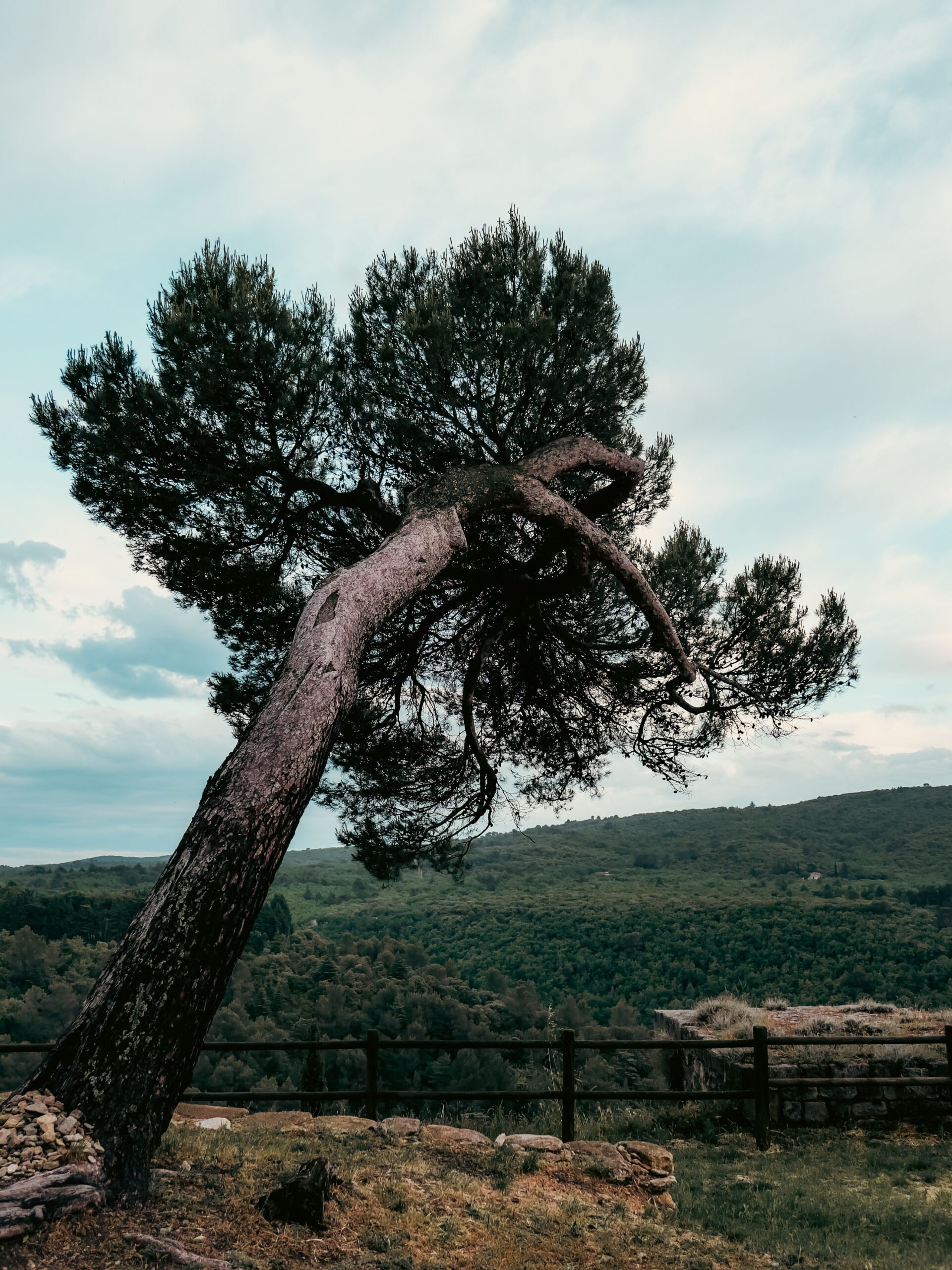
A tree that has leaned slightly for years is different from one that suddenly changes position during high winds.
Fresh leaning may indicate that roots have shifted or broken beneath the soil.
Look from a safe location for raised ground, new cracks in the soil, exposed roots, or a root plate that appears to be lifting.
Do not walk around the trunk to examine the roots closely. If the tree could reach the house, garage, or driveway, keep those areas clear and call for an assessment.
We consider the direction of the lean, the remaining root support, the condition of the trunk, and what lies within the tree’s possible fall area.
3. The trunk or a major branch attachment has split
Large vertical cracks and splitting between major stems can indicate that the tree’s supporting structure has been compromised.
A crack near an existing cavity or decayed section deserves particular attention.
The tree may still have green leaves and look healthy from a distance, but foliage does not tell us whether the main stem can safely support the crown.
When we examine a damaged tree, we consider the crack location, the amount of supporting wood, and how the remaining branches are loaded.
If the defect threatens an occupied area, this may require emergency removal or another immediate risk-reduction measure.
4. Large broken branches are hanging overhead
After a windstorm, a broken limb may remain caught in another branch rather than falling to the ground.
These suspended branches are sometimes called hangers.
They can move without warning, especially when the supporting branch bends or another gust changes the load.
A hanger above a front entrance, sidewalk, driveway, or outdoor seating area deserves prompt attention.
Do not stand underneath it to judge its size. Avoid using a ladder, rope, pole saw, or vehicle to pull it down.
We evaluate the attachment and the support points before deciding how the damaged material can be removed.
5. A fallen tree blocks necessary access
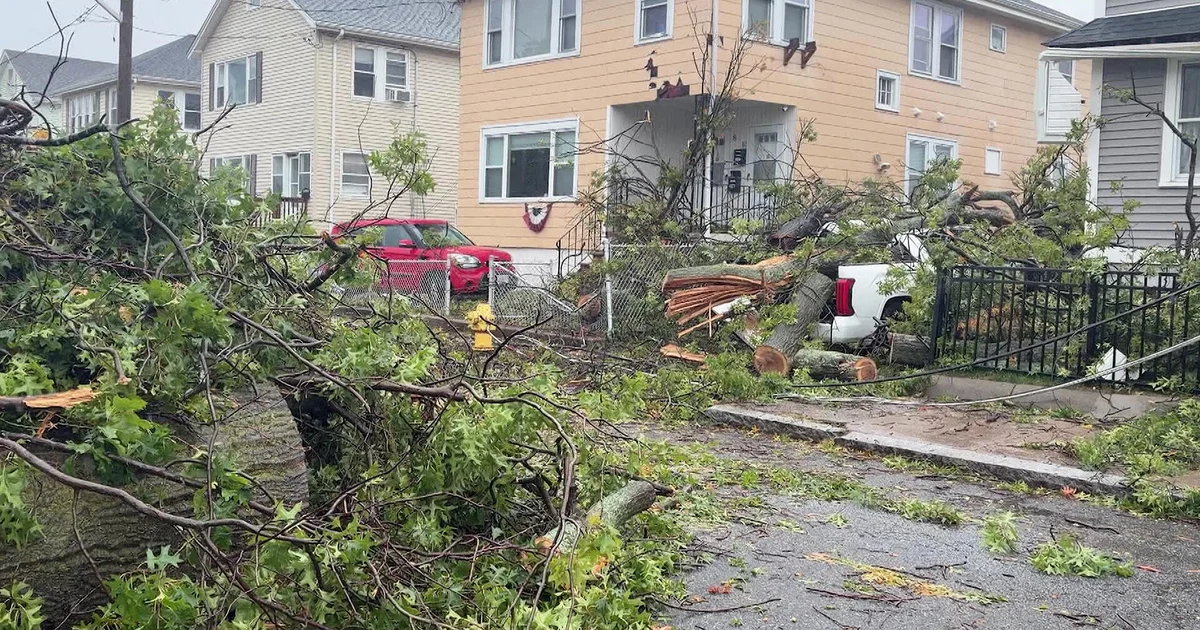
A tree across a private road or the only driveway to a property can create an urgent situation, particularly if it prevents emergency vehicles from reaching the building or blocks the occupants’ ability to leave.
Location changes the priority.
A trunk lying across an unused trail may be suitable for scheduled cleanup. A trunk that blocks the only safe entrance to a home may need an earlier response.
We also need to consider the condition of the fallen tree.
A trunk resting on another tree, a retaining wall, or a sloped surface may contain stored mechanical forces. Cutting it without understanding those forces can cause sudden movement.
If a tree blocks a public road, notify the appropriate local authority or emergency dispatch rather than attempting to clear the street yourself.
What if a Tree Is Touching Power Lines?
A tree in contact with an electrical line creates an electrical emergency.
Stay away from the wire, tree, branches, surrounding ground, and anything they are touching. Do not try to move the tree or determine whether the wire is live.
National Grid advises keeping at least 30 feet away from fallen electrical wires. Greater separation may be needed depending on the situation.
Do not approach to measure that distance. Keep people and pets well outside the affected area.
Even when the neighborhood has lost power, an electrical line may remain energized or become energized again.
Call 911 if a line is down or there is an immediate electrical hazard, and report the situation to the utility serving the property.
In Massachusetts, National Grid’s outage and downed-line number is 1-800-465-1212. Eversource also serves parts of Massachusetts, and homeowners should use the contact information for their actual provider.
The Massachusetts Emergency Management Agency’s power outage guidance explains why downed utility wires should always be treated as live.
Can a tree service remove branches from an energized line?
Ordinary tree removal should not proceed while an unresolved electrical hazard affects the work.
Utility personnel or appropriately qualified line-clearance crews must address the electrical conditions.
At East Coast Tree Service, we distinguish the utility’s responsibilities from the tree removal and storm cleanup work we provide.
Once the electrical hazard has been resolved and the site is suitable for the proposed tree work, we can assess the remaining damage.
Our guide to Eversource tree trimming versus private tree services in Massachusetts explains how utility-related clearance work differs from ordinary care and removal on private property.
What Usually Does Not Count as a Tree Emergency?
Not every dead branch, leaning tree, or storm-related change requires an emergency crew.
The decision depends on the condition of the tree and what could be affected if something fails.
A standing dead tree away from occupied areas
A dead tree may need removal, but it is not automatically a same-day emergency.
For example, a standing dead tree in an isolated part of a property may allow time for a scheduled assessment and removal.
A similar tree leaning toward a house is a different concern.
Dead trees can become harder to dismantle as structural deterioration progresses, so scheduled removal should not mean indefinite postponement.
Our tree removal service in North Reading and surrounding towns addresses dead, declining, and structurally compromised trees that need professional removal.
Small twigs and minor canopy damage
Broken twigs scattered across the lawn or a small amount of leaf damage generally do not call for emergency removal.
Minor damage can still be worth checking, particularly if it reveals a larger problem in the crown.
A broken limb that remains hanging overhead requires more attention than a similar branch already lying on an open lawn.
We recommend considering where the damaged wood is located and whether additional material could fall into an occupied area.
An established lean without new movement
Some trees grow at an angle because of their natural growth pattern or past conditions.
An old, stable lean is not proof that a tree is about to fall.
New soil movement, an expanding crack, root deterioration, or a sudden change in the angle can alter that assessment.
Previous photographs may help establish whether the tree’s position has changed.
Routine pruning and planned landscape work
Branches that need clearance from a roof, ordinary deadwood pruning, and removal for a future landscaping project can usually be evaluated and scheduled as regular tree work.
We recommend planning these jobs rather than requesting emergency pricing when there is no active threat.
Our tree trimming services address pruning needs that can be managed through a scheduled visit.
How Can You Tell Whether to Call 911 or a Tree Service?
Some situations require public emergency services before a tree contractor can begin work.
| Situation | First Action |
|---|---|
| Downed power line or tree touching electrical wires | Stay clear. Call 911 and the electric utility. |
| Someone injured, trapped, or in immediate danger | Call 911. |
| Tree blocking a public roadway | Notify local emergency dispatch or the responsible public authority. |
| Tree resting on a house with no apparent electrical hazard | Keep people away from affected areas and contact emergency tree service. Call 911 if there is an immediate threat to occupants. |
| Recently split or leaning tree threatening a building | Keep the potential fall area clear and request urgent professional assessment. |
| Minor branches on an open lawn | Arrange routine cleanup if needed. |
When in doubt about an immediate threat to people, emergency dispatch is the appropriate first contact.
Tree contractors are responsible for evaluating and performing tree work within their qualifications and the conditions of the site. We do not replace fire, police, medical, or utility emergency responders.
What Should You Do While Waiting for Emergency Tree Service?
Keep people out of the area where a tree or branch could move or fall.
Do not attempt to stabilize the tree by tying it to a vehicle, building, fence, or another tree.
If branches are pressing against a roof, avoid the affected rooms and do not climb onto the roof to investigate.
When an electrical hazard is present, stay away and follow the instructions of emergency responders and the utility.
From an already safe location, you may be able to note the tree’s position, the affected structures, and whether access to the property is blocked.
Those details help us understand the initial situation when you call.
Should you take pictures before the tree is removed?
Photographs may help with insurance documentation, but they should only be taken from a safe location.
Do not move debris, enter a damaged building, or stand beneath a hanging limb to get a clearer image.
If the situation is unsafe to photograph, leave it for the professionals responding to the incident.
For additional information, our guide to homeowners insurance and tree removal in Massachusetts explains the circumstances that may affect coverage.
What Happens During an Emergency Tree Removal Assessment?
The first objective is to understand the active danger.
We consider whether the tree is resting on a structure, still attached to its roots, supported by another tree, or suspended above an occupied area.
A partially uprooted tree may still be held by roots and soil. A large branch resting on a garage may contain tension that changes when other branches are cut.
Those details affect the removal plan.
We also evaluate site access and nearby obstacles. A truck or lifting equipment may not be able to reach every part of the property.
Where appropriate for the job, the company advertises crane-assisted tree removal and other professional removal methods.
The method should be selected after the tree and site have been evaluated, rather than assuming every emergency requires the same equipment.
Does Emergency Tree Service Mean the Entire Property Will Be Cleaned Up?
Not necessarily.
Emergency work may focus first on removing the part of the tree creating the immediate threat or restoring access to a building.
After that, the property may still need log hauling, additional branch removal, or stump work.
Some jobs can be completed during one visit. Others may involve separate stages, depending on the conditions, access, and authorized scope.
Our storm damage tree cleanup service covers fallen trees, broken limbs, and storm debris in North Reading, Tewksbury, Billerica, and surrounding towns.
Before authorizing emergency work, ask whether the estimate includes immediate hazard removal, full debris cleanup, hauling, and stump work, or whether some of those services will be addressed separately.
How Much Does Emergency Tree Service Cost in Massachusetts?
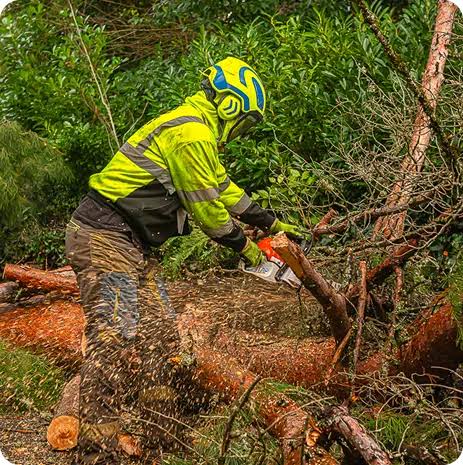
Emergency tree removal is priced differently from many scheduled jobs because of the urgency, equipment requirements, and work involved.
At East Coast Tree Service, our published emergency service terms specify an eight-hour minimum and triple-time billing for jobs classified as emergencies.
Those terms apply to emergency work performed during normal business hours as well as after hours, weekends, and holidays. The published policy covers labor, equipment, and other work-related charges.
The policy does not establish one fixed total price for every emergency. The actual cost depends on the work and the equipment and personnel required.
We recommend discussing the emergency classification, estimated charges, and authorized scope before work begins whenever circumstances allow.
If the tree is dead or declining but presents no immediate hazard, a scheduled estimate may be more appropriate.
Can a homeowner choose scheduled removal instead?
Sometimes.
If a tree can reasonably remain in place without exposing people, structures, or access routes to an immediate danger, scheduled removal may be an option.
That decision should account for the condition of the tree and its surroundings.
Do not assume a visibly split or newly uprooted tree is safe to leave overnight simply because an emergency job costs more.
We can discuss what has happened and determine whether the situation calls for emergency attention or a regular assessment.
Will Homeowners Insurance Cover Emergency Tree Removal?
Coverage depends on the policy and the circumstances of the loss.
A tree that falls onto a covered home or garage may involve different coverage than a tree that falls harmlessly in the yard.
Some policies cover limited tree removal costs when a fallen tree blocks access or damages covered property. Deductibles, exclusions, and payment limits may apply.
Emergency billing does not automatically mean an insurer will reimburse the full amount.
We recommend notifying the insurance company, keeping records of the damage when safely possible, and requesting a clear description of the work performed.
Our website describes providing invoices, photographs, and other documentation associated with storm cleanup. The insurer decides whether the work qualifies for payment under the policy.
How Quickly Can Emergency Tree Removal Begin?
East Coast Tree Service advertises emergency service availability 24 hours a day, seven days a week.
That means homeowners can contact us outside normal business hours about urgent tree hazards. It does not establish a guaranteed arrival time for every property.
During severe weather, road conditions, active electrical hazards, access restrictions, and the number of affected properties can influence when work can proceed.
Some sites also require the utility or emergency authorities to address a hazard before a tree crew can begin.
When you call, provide the location, what has happened, and whether people, structures, or access are currently affected.
We can discuss the situation and the appropriate next step based on the information available.
Emergency Tree Service in Lowell, Methuen, and the Merrimack Valley
East Coast Tree Service is a family-owned and operated company serving residential and commercial properties throughout eastern Massachusetts.
We provide tree removal, trimming, stump grinding, storm cleanup, and 24/7 emergency tree services.
Our service area includes Merrimack Valley communities such as Lowell, Methuen, Lawrence, Dracut, Chelmsford, Andover, and North Andover, as well as Reading, Tewksbury, and Billerica.
Property owners can learn more about our tree services in Lowell, MA and tree services in Methuen, MA.
In each location, the urgency depends on the condition of the tree and the exposure of nearby people and property.
Call East Coast Tree Service About an Urgent Tree Hazard
If a tree has fallen onto a building, shifted suddenly after a storm, or left a large branch hanging over an occupied area, keep people away and contact us to discuss the situation.
If electrical wires are involved or someone is in immediate danger, call 911 and notify the electric utility first.
For emergency tree service in Massachusetts, call East Coast Tree Service at (781) 518-8014.
Tell us your town, what part of the tree is damaged, where it is resting, and whether the driveway or another access route is blocked. We’ll discuss the appropriate next step and explain the applicable emergency service terms before work is authorized whenever circumstances allow.