

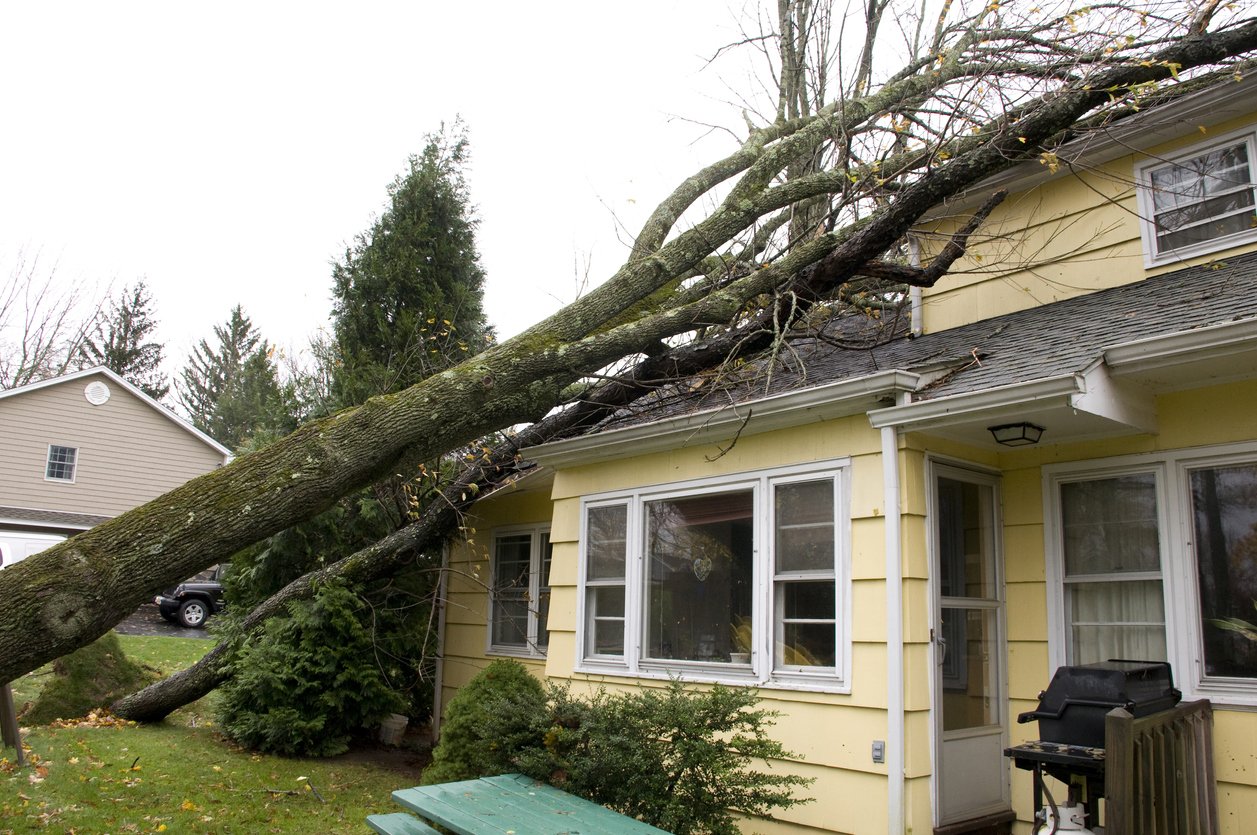
If a tree fell on your house in Massachusetts, get everyone away from the part of the building that was hit, stay clear of any wires, and call 911 if someone is injured or there is an immediate electrical, fire, gas, or structural danger. Do not climb onto the roof and do not start cutting the tree yourself.
Once the immediate hazard has been controlled, contact your homeowners insurance company and an emergency tree service. Take photos or video from a safe location if you can do so without approaching the tree.
The sequence matters because a tree resting on a building may still be carrying a great deal of stored weight and tension. What looks settled from the driveway can move when a limb breaks, the roof gives way, or someone makes the first cut.
1. Get People and Pets Away From the Impact Area
Start with the people in the house, not the tree.
If the tree has come through the roof or is resting heavily against the structure, keep everyone out of the rooms below and around the impact. A damaged ceiling, roof framing, wall, chimney, or attached porch may not show the full extent of the problem from inside.
If you can leave the house without moving underneath the damaged area, do so.
Call 911 when there is an injury, fire, smell of gas, downed electrical equipment, someone trapped inside, or another immediate threat.
Do not walk into an attic to see where the tree landed. Do not step onto a sagging ceiling. A better photograph is not worth standing underneath damaged framing.
2. Assume Any Downed Power Line Is Live
A fallen tree and a damaged power line can turn the entire scene into an electrical hazard.
The line does not need to spark.
A branch touching a conductor can become energized. Wet wood can conduct electricity, and current from damaged equipment can also travel through the surrounding ground.
If the tree has contacted a utility line, stay back and keep other people away. Call 911 or the electric utility and wait until the electrical hazard has been addressed before approaching the tree.
Do not grab a branch to pull it away from a wire. Do not move a fence, vehicle, or other object that is tangled with the tree and line.
East Coast Tree Service gives the same warning on its tree service page for Chelmsford, MA: when a tree or branch is touching a power line, stay away and contact the utility rather than trying to move it.
Electrical clearance comes before tree removal.
3. Do Not Start Cutting the Tree Yourself
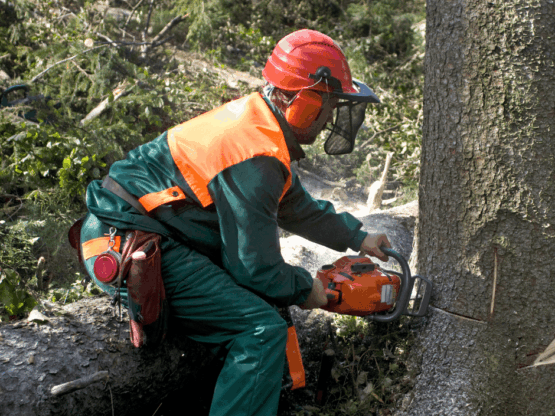
A fallen tree is often harder to read than a standing one.
The trunk may be resting on the roof while the root plate still pulls in the opposite direction. A branch bent underneath the trunk can behave like a spring. Another limb may be hanging above the area where you would need to stand with the saw.
Cutting one piece changes how the remaining weight is supported.
That can cause the trunk to roll, a branch to release, or a section of the tree to settle farther into the building.
A chainsaw also does not solve the problem of where the weight will go after the cut.
Emergency crews use rigging, bucket trucks, cranes, or combinations of equipment when the tree’s position requires controlled removal. East Coast Tree Service’s 24/7 emergency tree service specifically includes trees that have fallen onto roofs, garages, sheds, vehicles, and other structures.
Leave the tree in place until someone who can evaluate the loading has determined how it should be removed.
4. Document the Damage From a Safe Location
Once everyone is out of danger, photographs can help document what existed before cleanup began.
You do not need roof-level close-ups.
Start with wide photos showing the tree, the building, and where the trunk or branches landed. From safe ground, document visible damage to the roof, siding, gutters, windows, vehicles, decks, fences, and other property.
If you can see the base of the tree safely, photograph that too. A lifted root plate or broken trunk can help document how the failure occurred.
Keep weather alerts, contractor invoices, emergency-service records, and correspondence related to the loss.
If the tree came from a neighboring property and there was prior communication about its condition, keep those records as well.
Documentation should preserve the scene without delaying work needed to address an active hazard.
5. Contact Your Homeowners Insurance Company Promptly
Massachusetts homeowners policies differ, so the insurer should be involved early.
Tell the carrier that a tree has struck the house, describe any immediate structural or weather exposure, and ask what documentation it wants before emergency removal begins.
Do not assume you must wait for an adjuster while the tree remains in a dangerous position. Ask the insurer what it wants you to do when work is needed to prevent additional damage or make the site safe.
Most standard homeowners policies in Massachusetts cover damage to the home caused by falling trees or other falling objects when the event is a covered loss. The details still depend on the policy, deductible, cause of loss, coverage limits, and the type of property damaged.
Tree debris removal can have separate conditions and limits.
A tree that falls harmlessly into an open yard may be treated differently by insurance than a tree that goes through the roof.
Save the tree-service invoice and any photographs supplied after the emergency work. East Coast Tree Service states that its emergency service can provide detailed invoices and photos to support an insurance claim.
6. Do Not Climb Onto the Roof to Put Up a Tarp
Homeowners are often told to take reasonable steps to prevent more damage after a loss.
That does not mean you should climb onto a roof that has just been struck by a tree.
The tree may still be loading the rafters. Roof decking can be cracked or displaced. Water can make the surface slippery, and branches may hide damaged sections.
If the tree is still on the building, let the tree crew determine how the weight can be removed first.
After the structure has been made accessible, a roofer, restoration contractor, or other appropriate professional can determine what temporary weather protection is needed.
The goal is to keep rain out without putting someone on a surface whose remaining strength has not been established.
7. Emergency Removal Is Different From Cutting Up a Tree in the Yard
A tree lying flat in an open lawn gives a crew room to approach the trunk and process the wood.
A tree lying across a house may offer almost none.
The crew has to determine which portions are carrying weight, whether the tree can shift, where workers can stand, and whether sections can be lowered without transferring more load into the building.
Nearby trees may be involved too. Broken limbs can hang in neighboring crowns, and another tree can be damaged by the same storm even though it remained standing.
East Coast Tree Service says its emergency process starts with a hazard assessment and securing the work zone. The crew then uses controlled rigging, bucket trucks, or crane support according to the condition and location of the tree.
For larger or awkwardly positioned trees, crane-assisted tree work can allow sections to be supported before they are separated from the remaining tree.
The equipment choice depends on the actual site rather than on the fact that the tree touched the house.
8. Why a Crane May Be Used for a Tree on a House
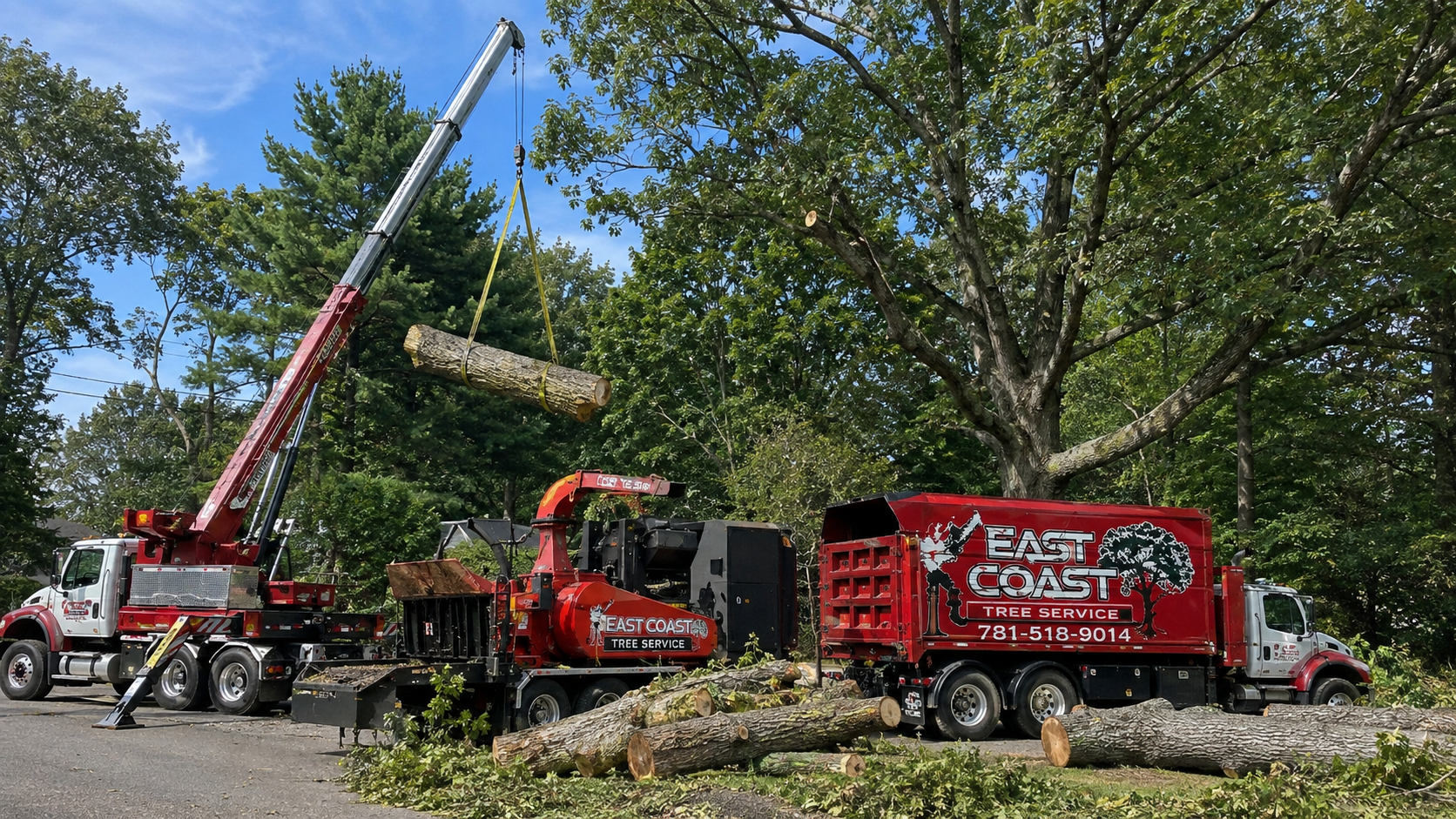
When a large section is resting on a roof, letting that piece drop farther is usually not an acceptable removal method.
A crane can sometimes support the weight before a cut is completed, allowing a section to be lifted away from the structure instead of lowered through the same damaged area.
That can be useful where the tree is large, the yard is tight, or there is little usable space beneath the tree.
Crane access still has to work.
The crew needs a setup location, sufficient reach, stable ground, and a lift path that accounts for the building, utilities, other trees, and surrounding property.
A smaller tree may be handled with conventional rigging. Another job may need a bucket truck. A complex tree may require several methods during the same removal.
The point is controlled movement, not using the biggest piece of equipment available.
9. What if the Tree Came From Your Neighbor’s Yard?
The property line does not automatically decide who pays.
Massachusetts insurance guidance says that when a neighbor’s tree damages your property, your own homeowners policy generally handles your covered loss first.
If the loss resulted from the neighbor’s negligence, your insurance company may then try to recover its payment and your deductible from the neighbor or the neighbor’s insurer.
A healthy tree that fails unexpectedly during severe weather is different from a tree that had a known dangerous condition that was ignored.
Whether someone was legally negligent depends on facts such as what was wrong with the tree, whether the owner knew or reasonably should have known about the condition, what notice existed, and the circumstances of the failure.
That is a legal and insurance question, not something the tree crew decides at the curb.
If the tree originated on another property, document the scene and let your insurer know where it came from. If liability becomes disputed, your insurer or an attorney can address that question separately from the emergency removal.
10. What if Your Tree Fell on the Neighbor’s House?
The same principle works in the other direction.
The fact that the trunk originated on your lot does not automatically establish that you were negligent.
Your neighbor may report the property damage to their own insurer. If there is evidence that you knew of a dangerous condition and failed to address it, the insurers may examine liability differently.
If you previously had the tree evaluated, received written recommendations, exchanged messages with the neighbor, or completed maintenance on it, keep those records.
Do not make liability agreements at the scene while the tree is still sitting on the building.
Get people safe, deal with utilities, report the loss, and let the documentation establish what happened.
11. What Should Happen Before the Tree Crew Arrives?
You do not need to inspect the tree closely.
When you call, give the dispatcher the information you can see from a safe place:
- the property address;
- whether anyone is injured or trapped;
- whether the tree is on the house, garage, vehicle, or another structure;
- whether wires are involved;
- whether the driveway is open;
- where the tree appears to have failed;
- and whether there is room for trucks or equipment to approach the property.
Photos taken safely from the yard or street can also help the company understand the general situation.
Do not enter the impact zone to collect better measurements.
The crew will assess access and tree position on site.
12. A Tree in the Yard May Not Require the Same Emergency Response
Not every storm-damaged tree needs immediate removal.
A tree lying completely in an open section of the yard, away from people, buildings, roads, vehicles, and utilities, may be able to wait for a normal appointment.
A tree resting on the house belongs in a different category.
So does a trunk that is still shifting, a broken leader hanging over the driveway, a damaged tree blocking the only exit, or a tree tangled with utility lines.
The priority comes from what can be harmed if the tree moves again.
East Coast’s current tree removal service distinguishes routine removal from storm situations involving buildings, access, and other targets. Its storm damage cleanup service covers damaged trees and debris after severe weather.
13. Check the Other Trees After the Immediate Emergency
The tree on the roof gets everyone’s attention, but the same weather may have damaged more than one tree.
After the emergency area has been made safe, look at nearby trees from the ground.
A formerly upright tree that developed a new lean deserves attention. Fresh soil lifting around the roots can indicate movement. Large cracked limbs, split stems, hanging branches, and newly broken tops also warrant a closer look.
This does not mean every neighboring tree needs to be removed.
The point is to find damage while the storm event is still fresh instead of discovering the second problem when another branch comes down days later.
Homeowners in the Andover area can review East Coast’s tree service in Andover, MA, while the company also provides tree service in Chelmsford, MA and throughout its eastern Massachusetts service area.
What to Do if a Tree Falls on Your House in Massachusetts
The first calls after a tree hits a house depend on what is happening at the scene.
If someone is injured, a gas line may be damaged, fire is involved, or wires are down, contact emergency services and the appropriate utility first.
Once those hazards are under control, notify your insurer and contact an emergency tree company. Keep people away from the tree, take documentation only from a safe area, and leave the cutting and roof access to crews equipped for the conditions.
East Coast Tree Service provides 24/7 emergency tree removal for fallen and storm-damaged trees across Reading, Tewksbury, Billerica, Andover, Chelmsford, and surrounding communities in eastern Massachusetts. Its emergency work includes trees on houses and other structures, controlled rigging, crane support where the site calls for it, debris removal, and documentation that can support an insurance claim.
If a fallen tree is currently on your house or creating another active tree hazard, East Coast Tree Service can be reached at (781) 518-8014.