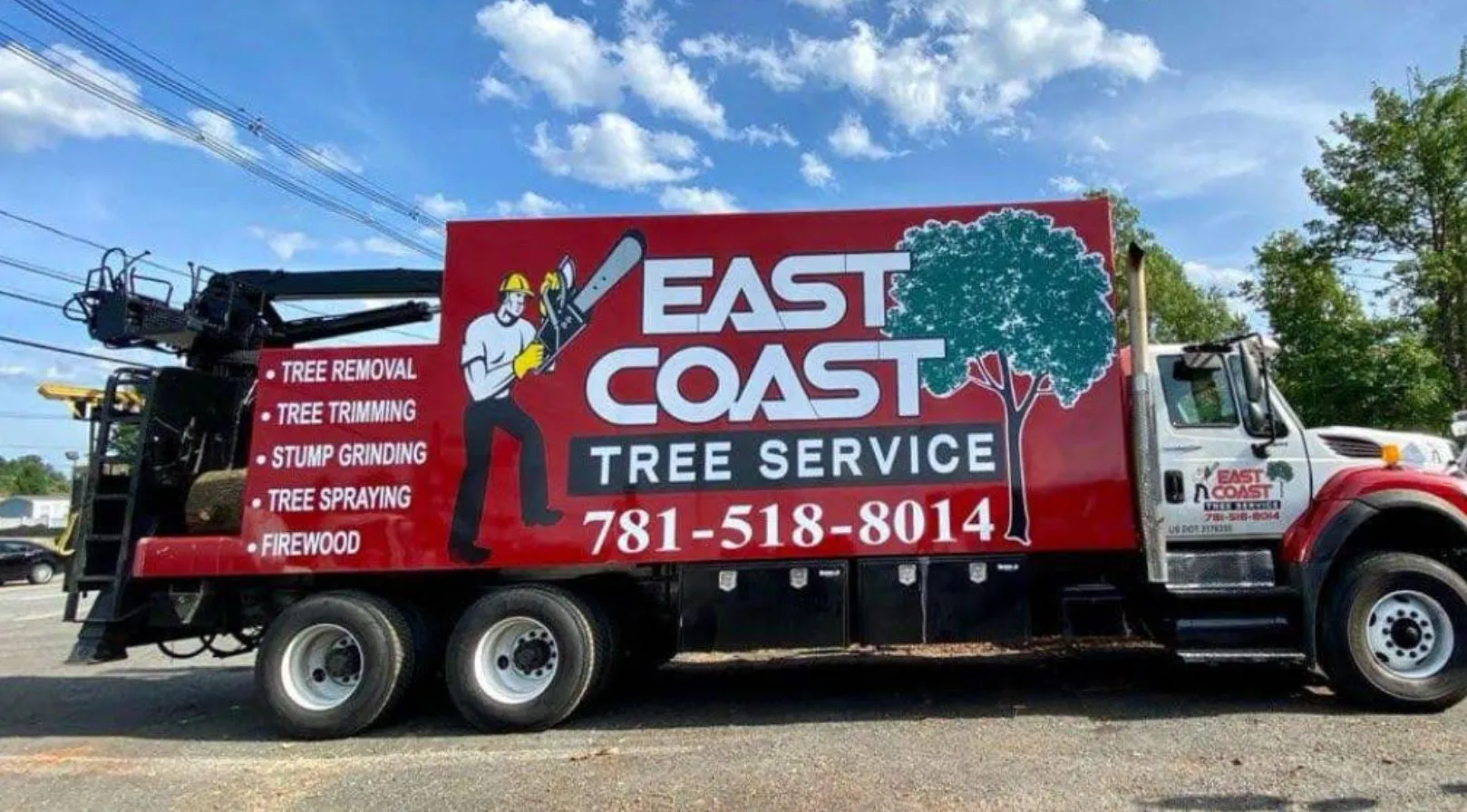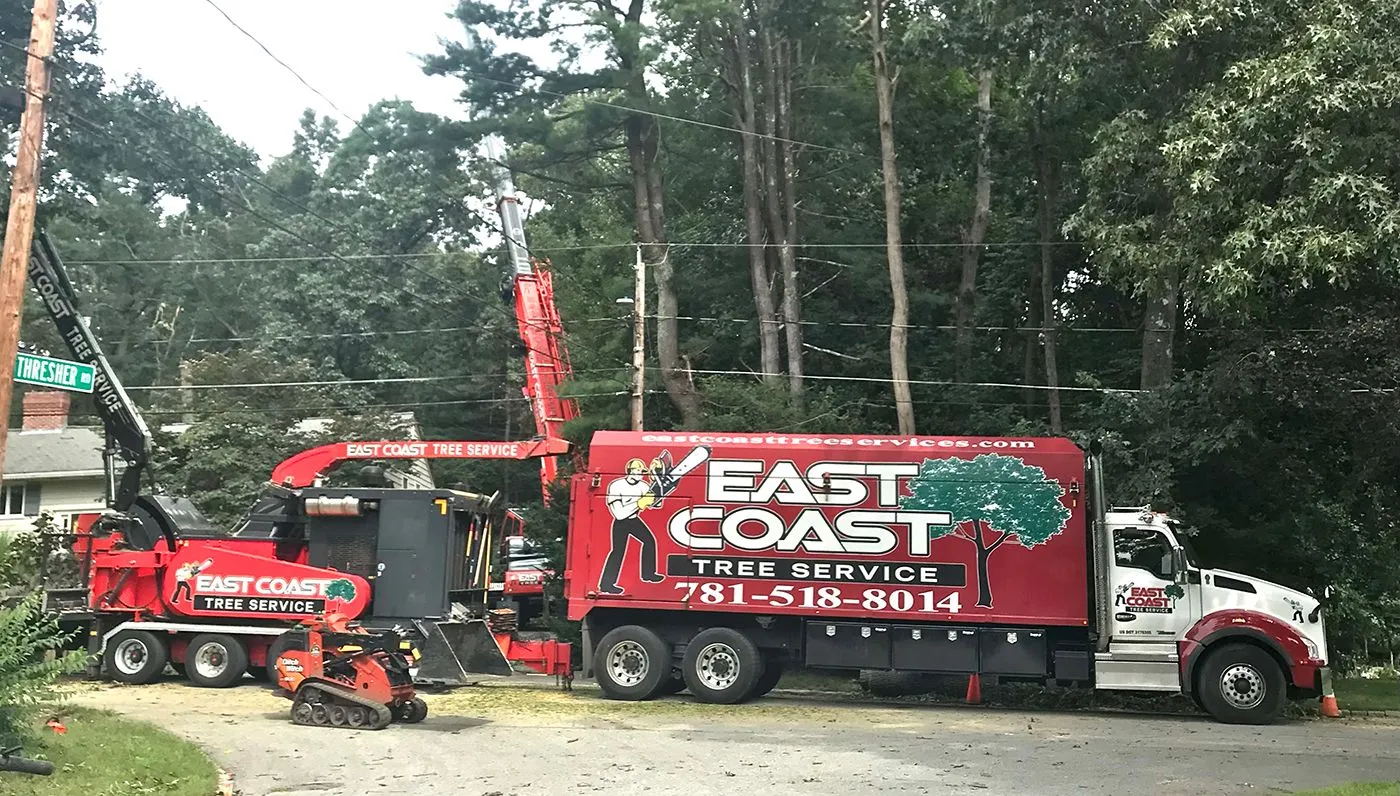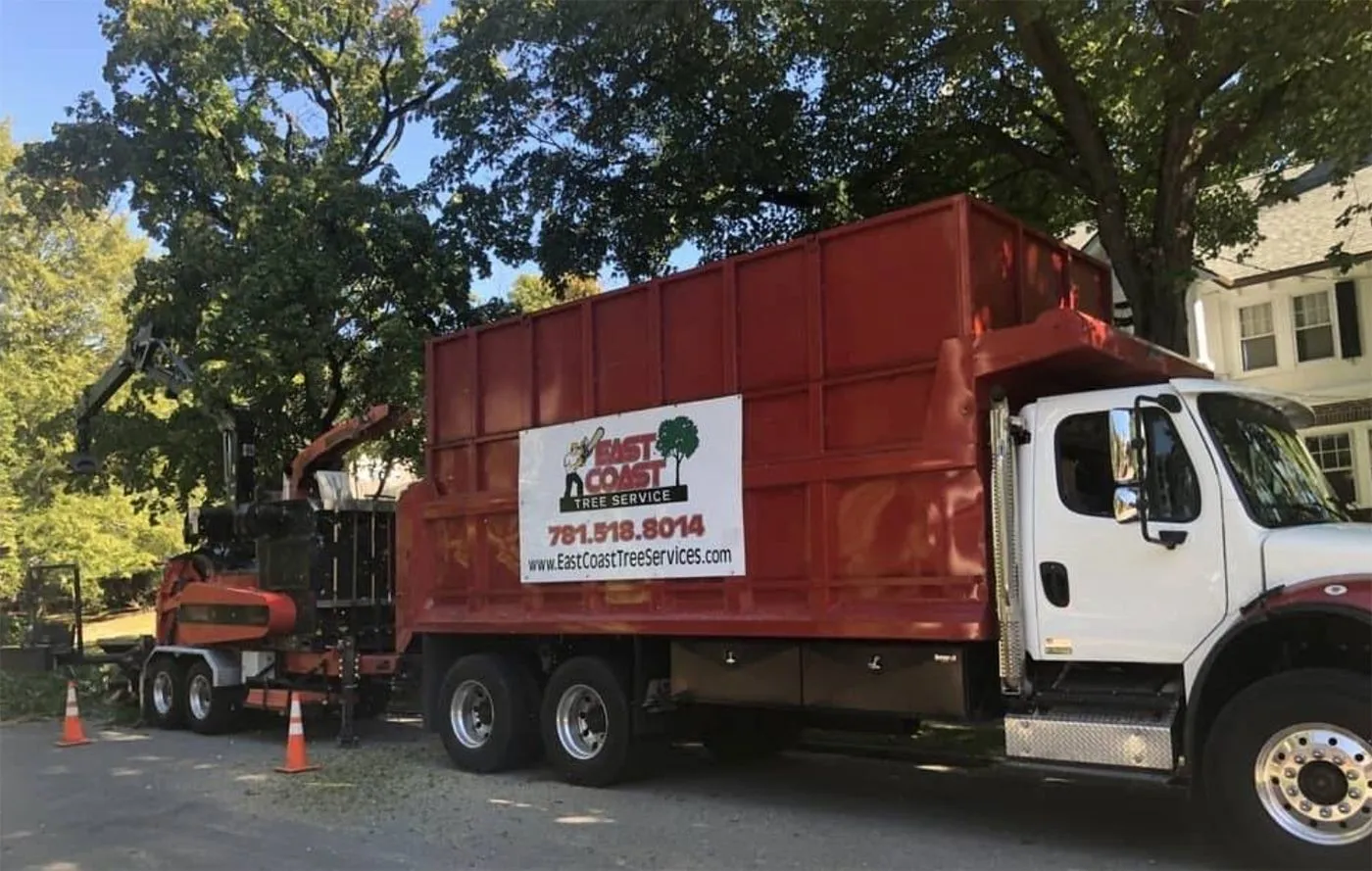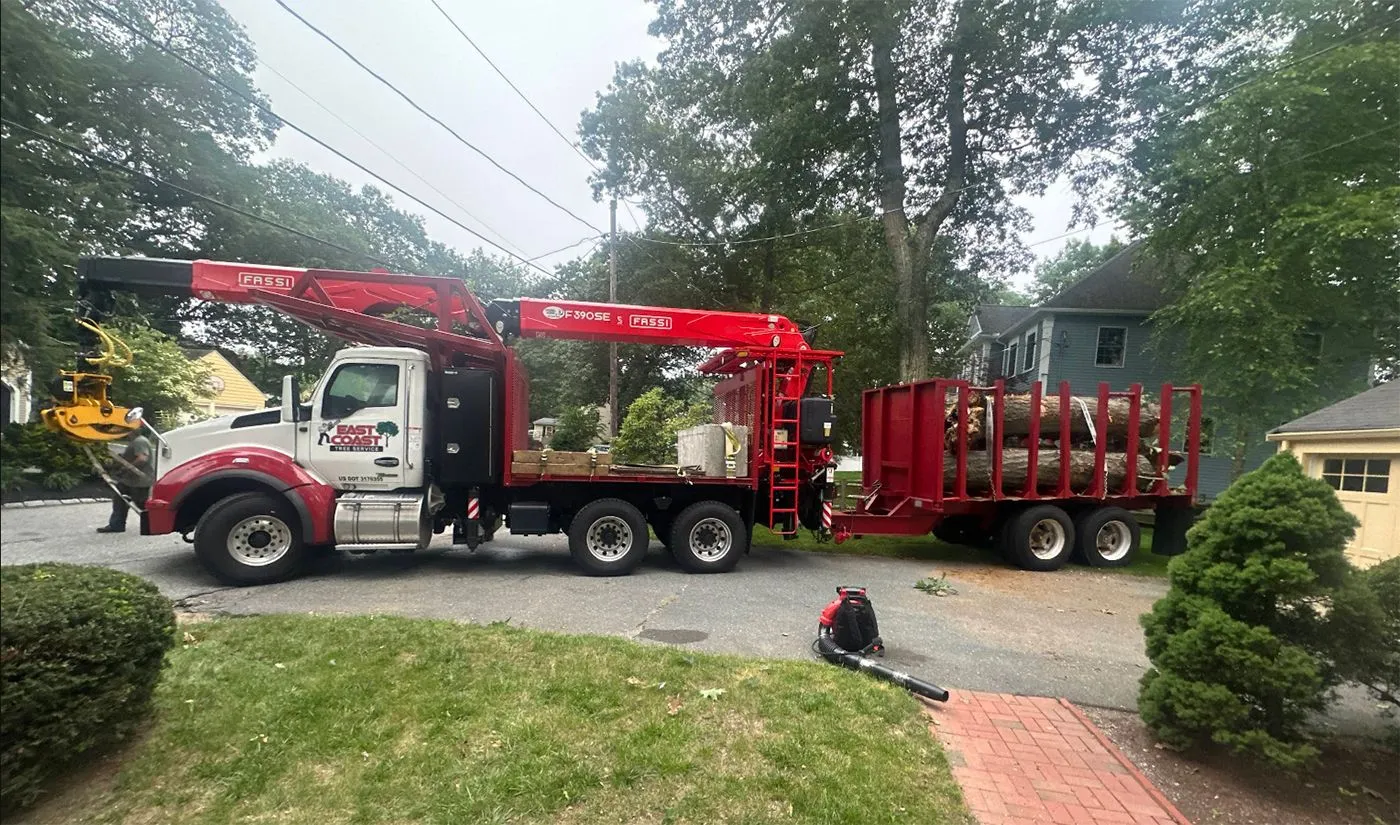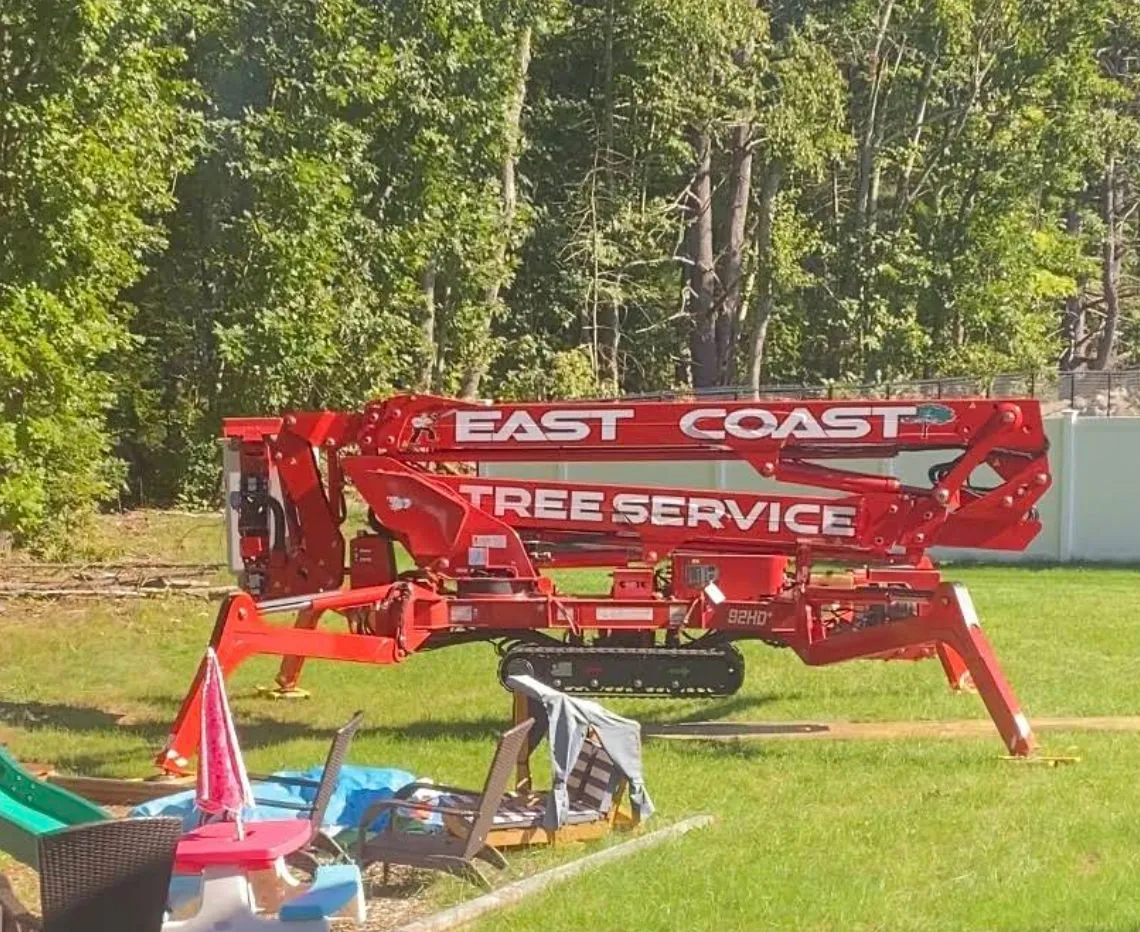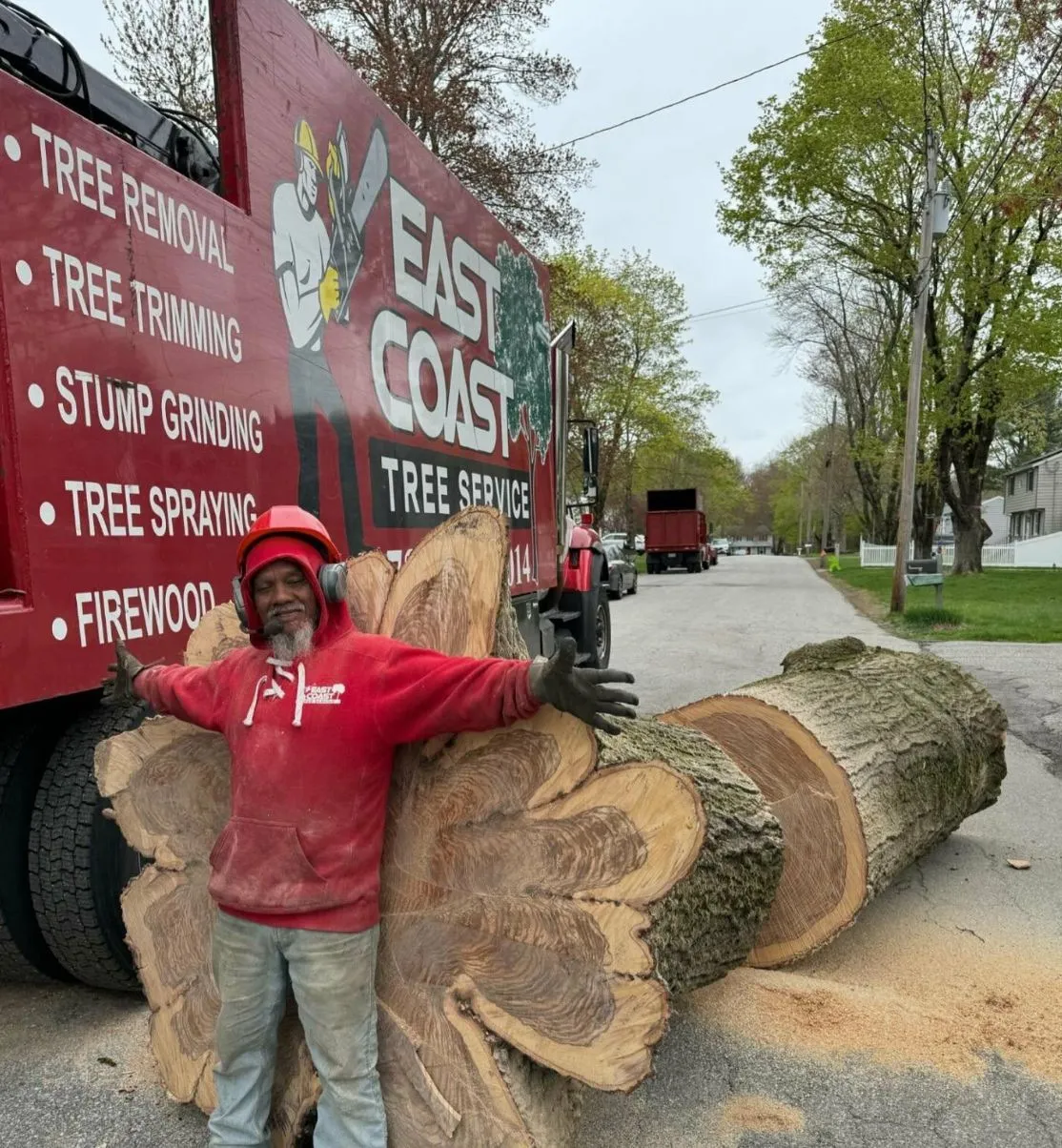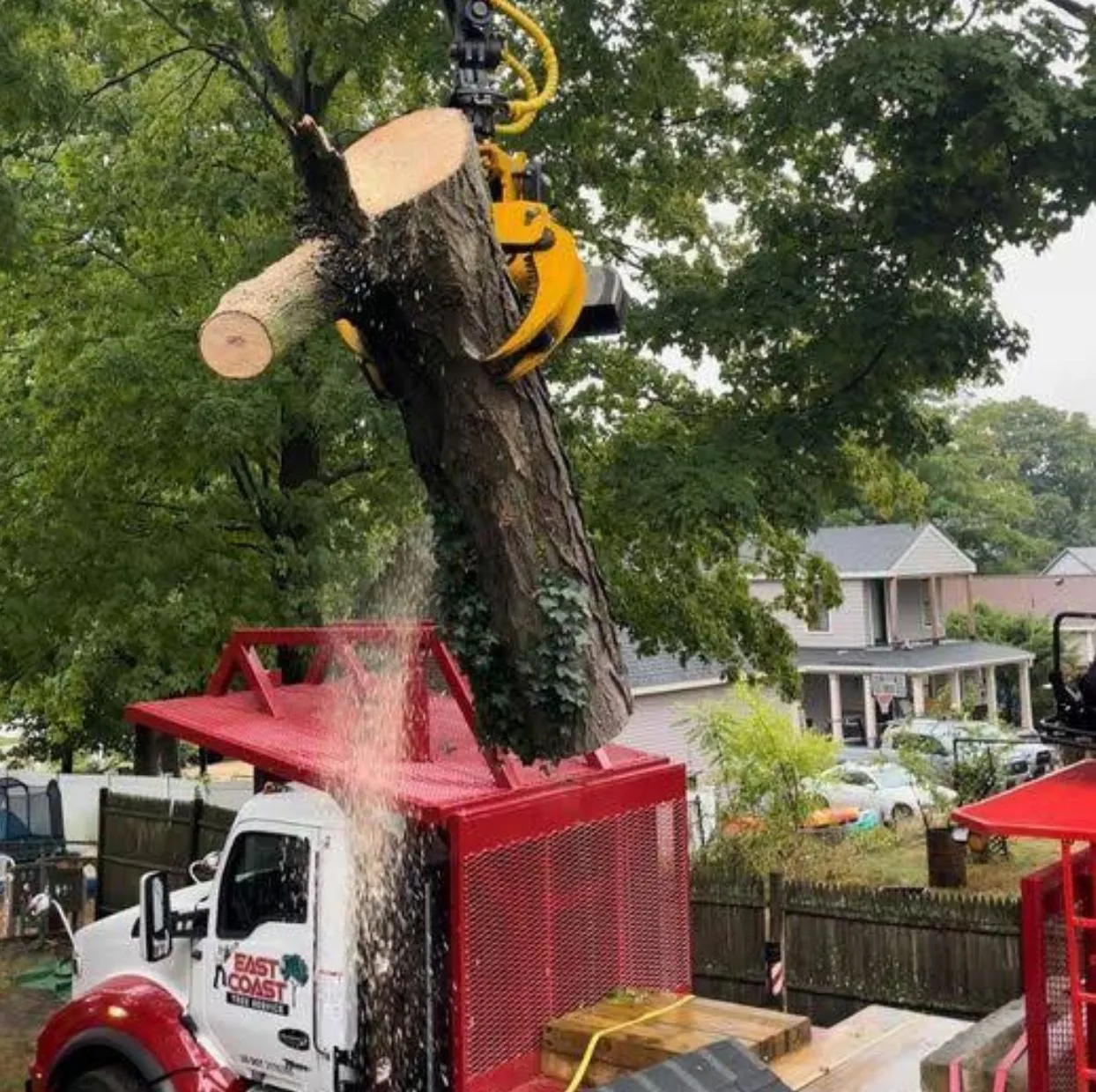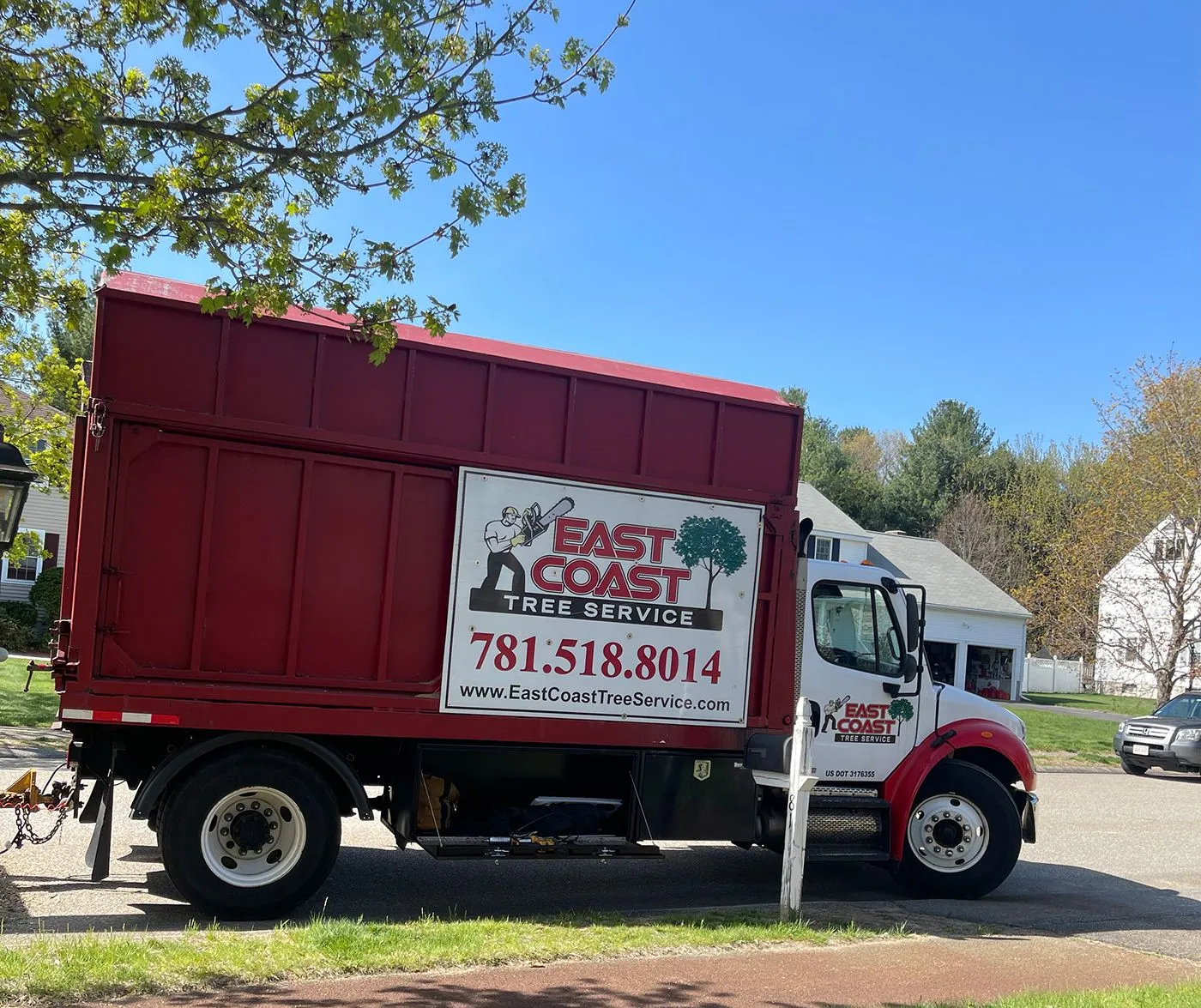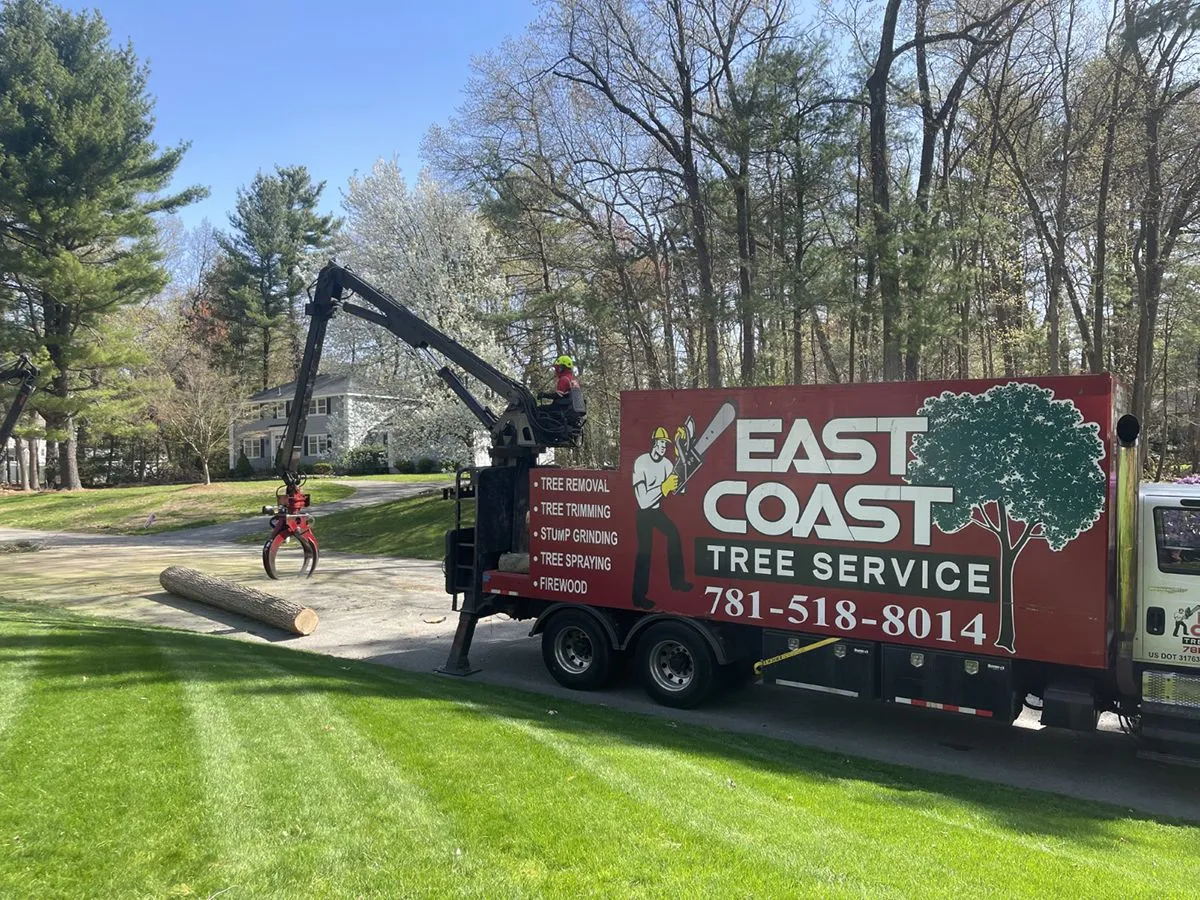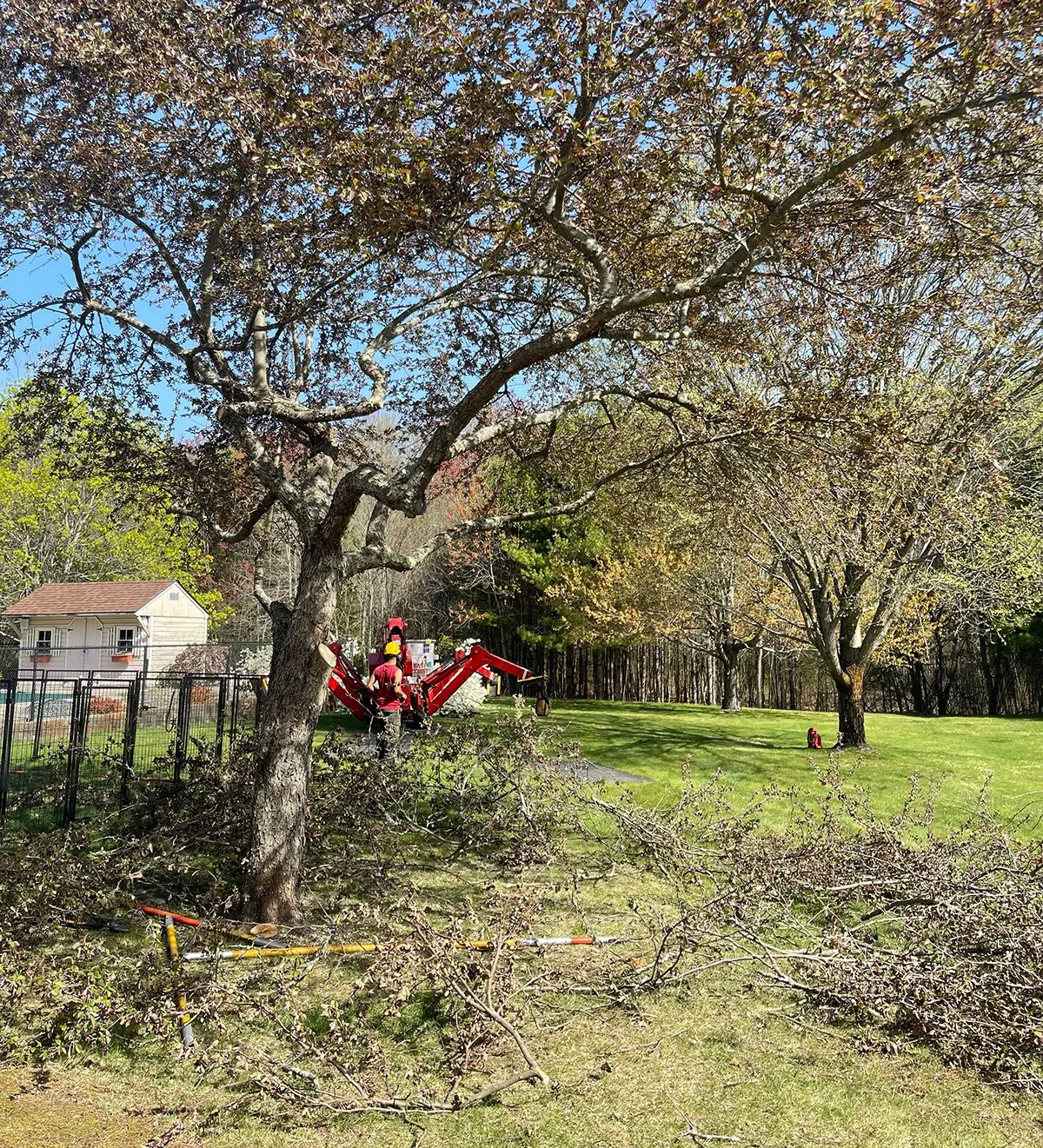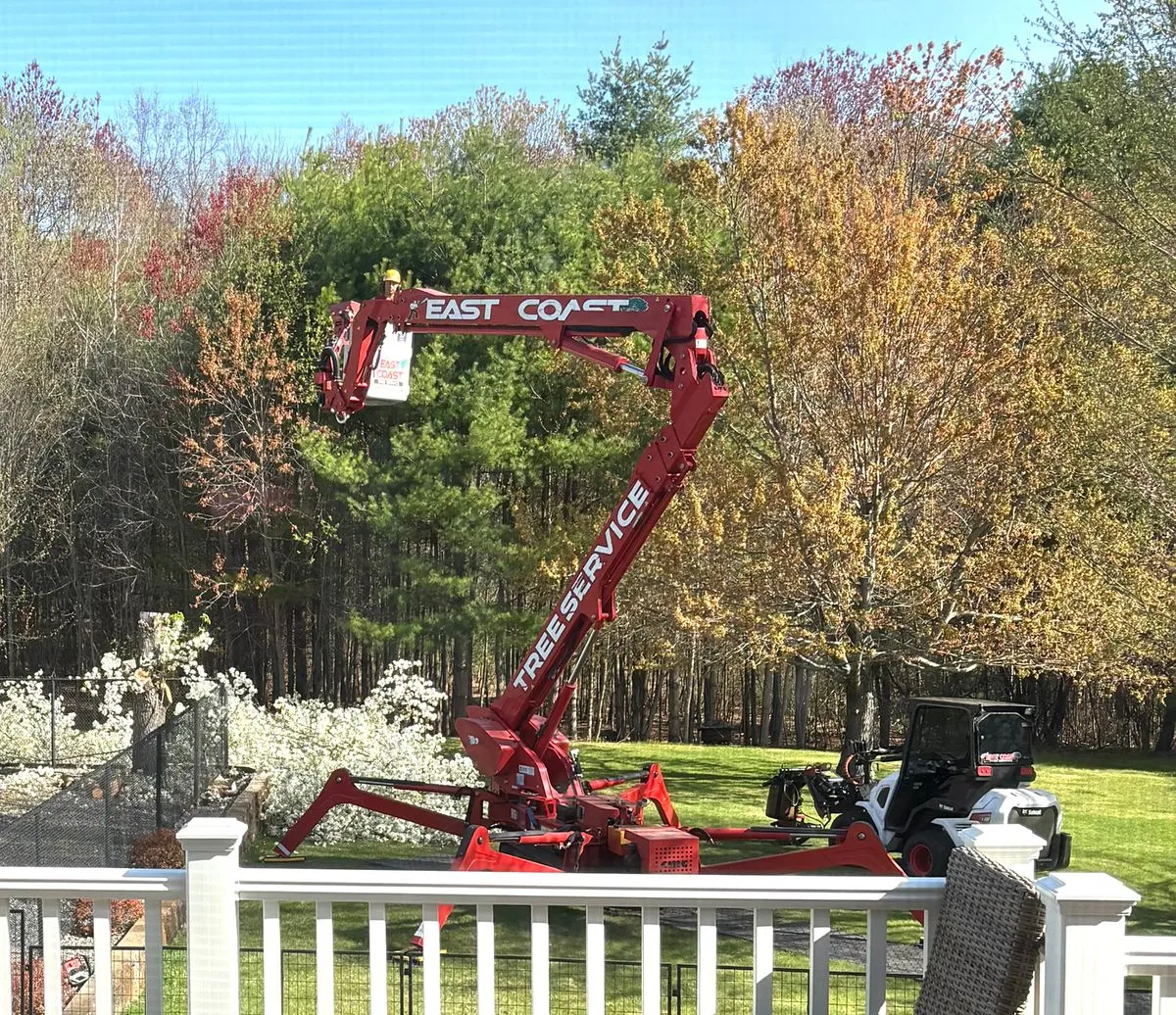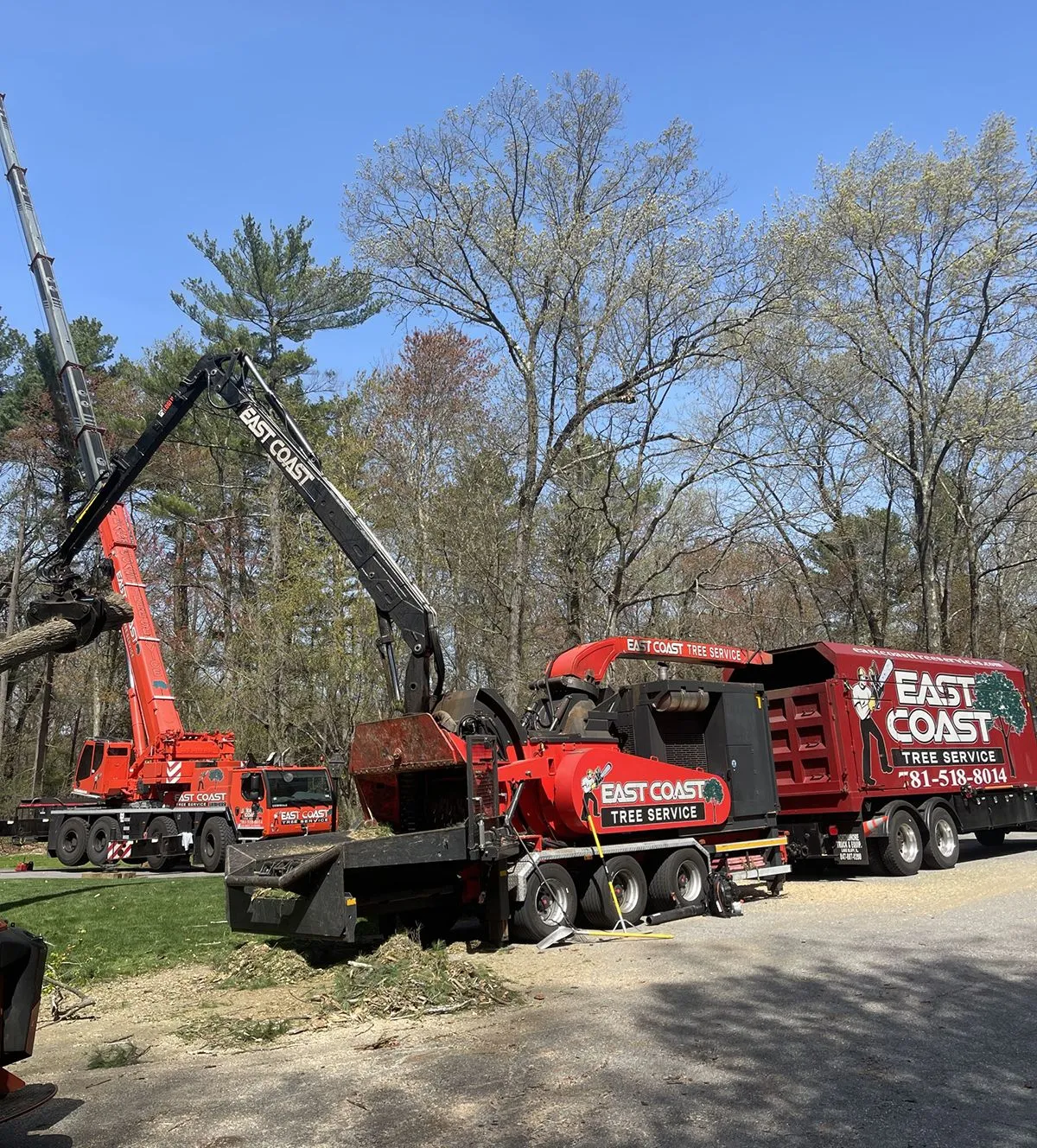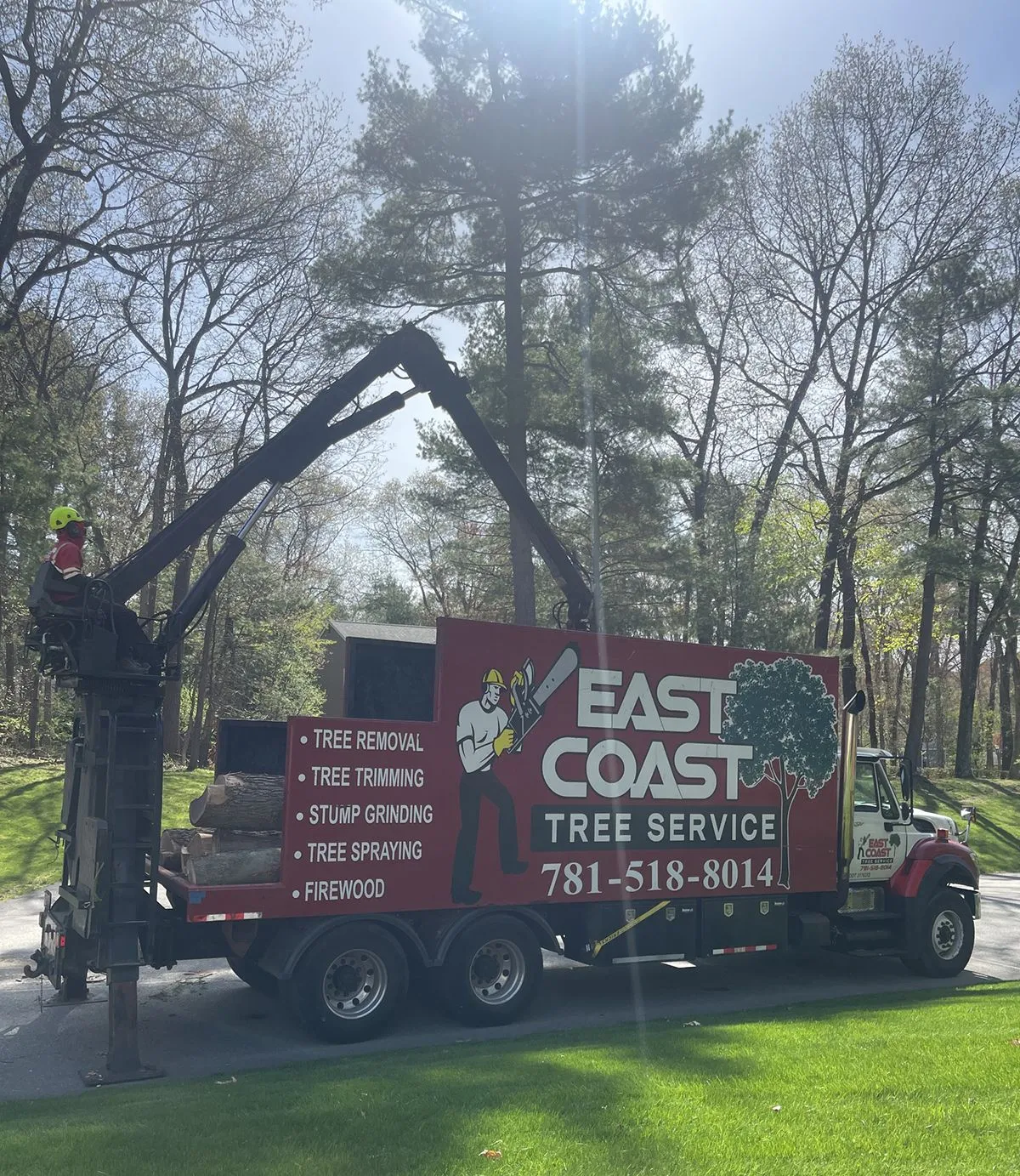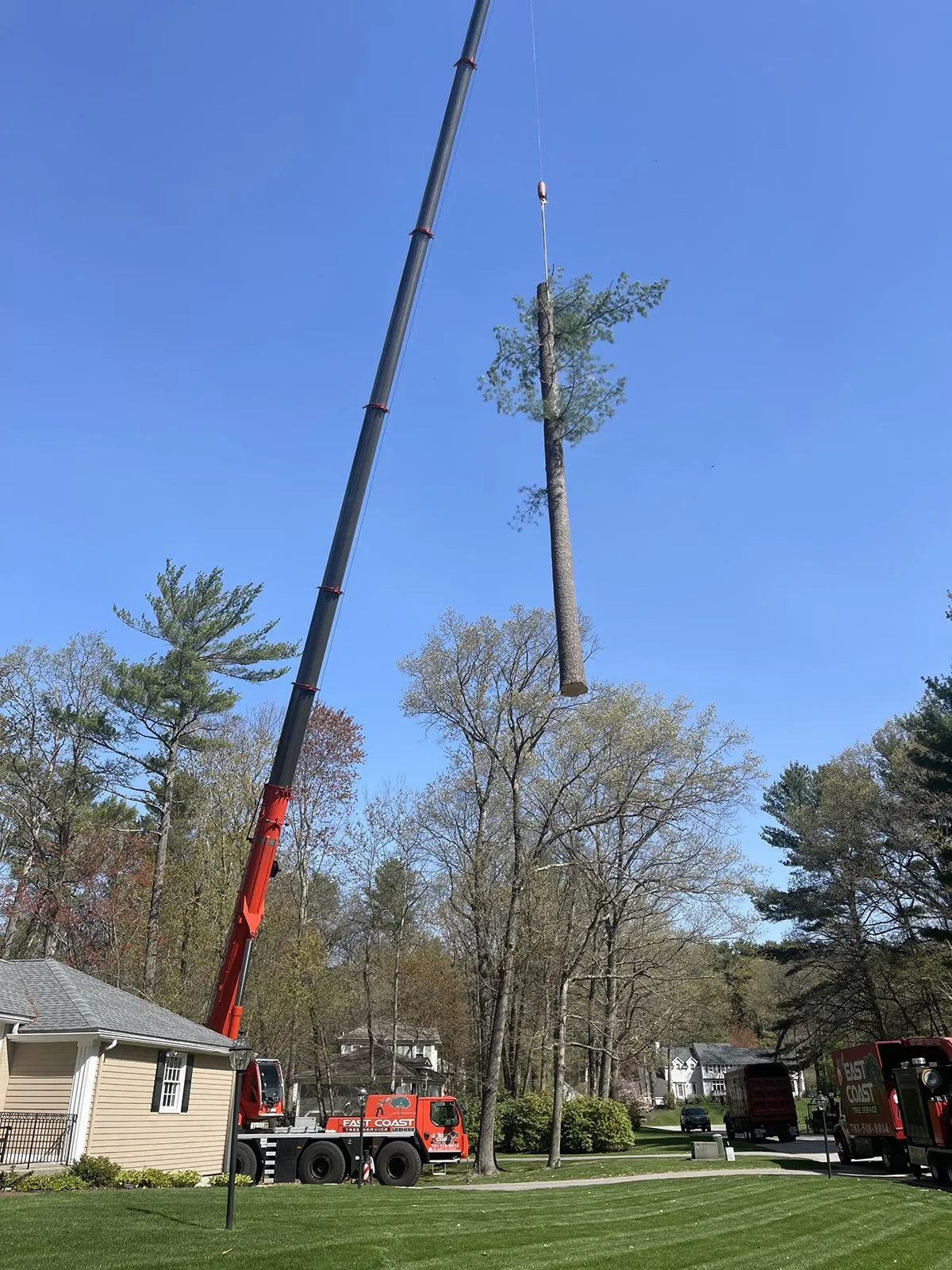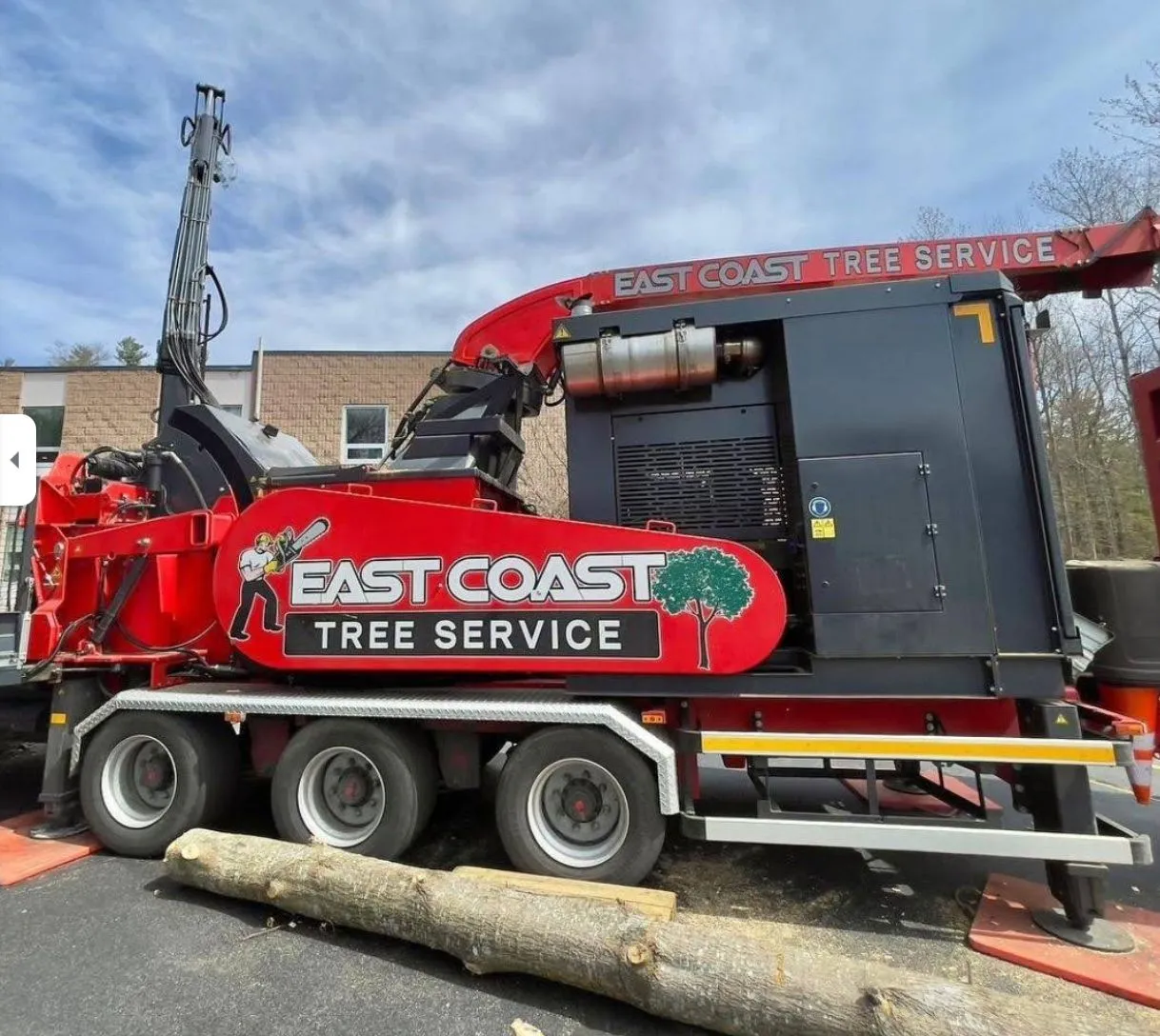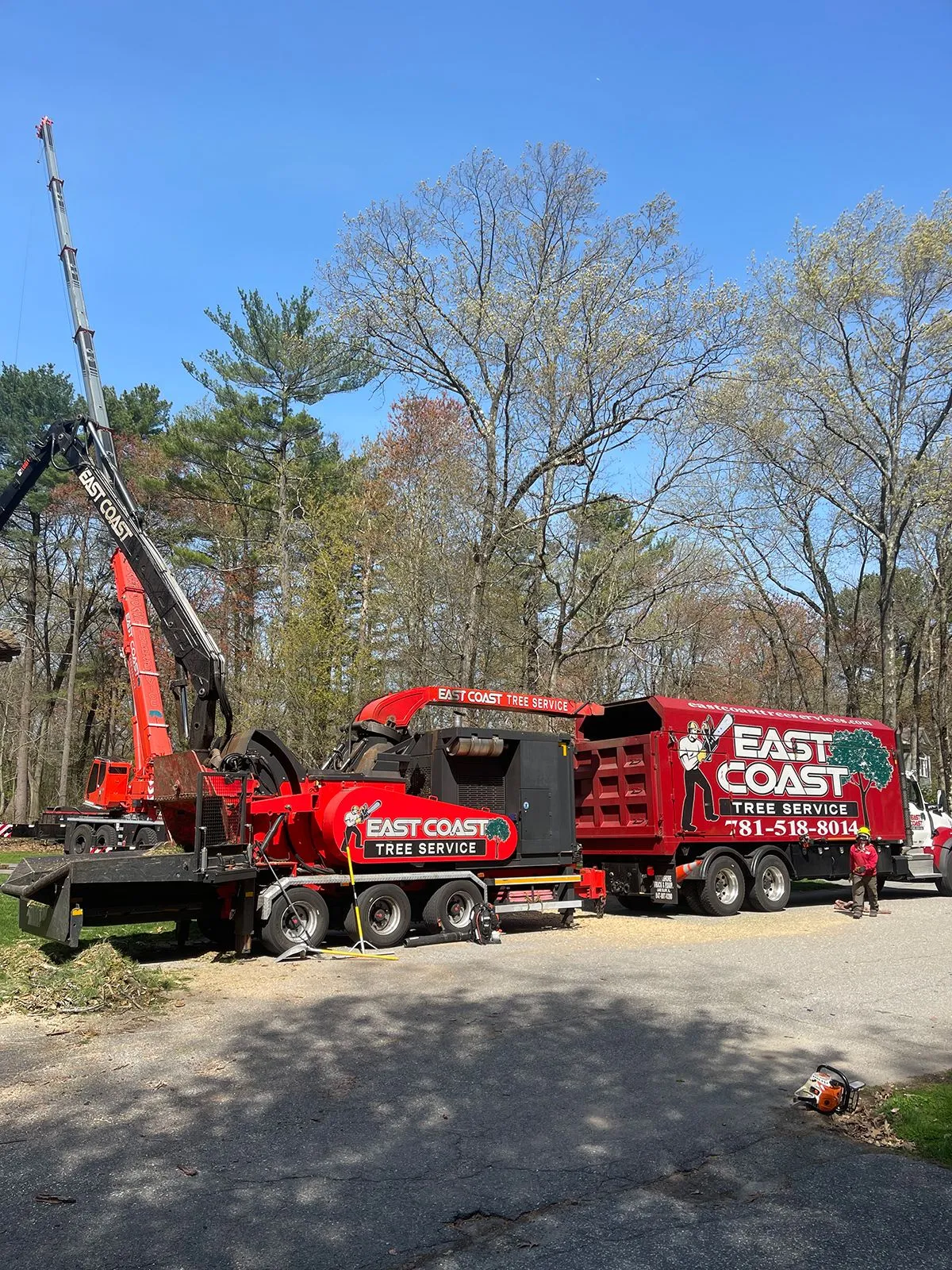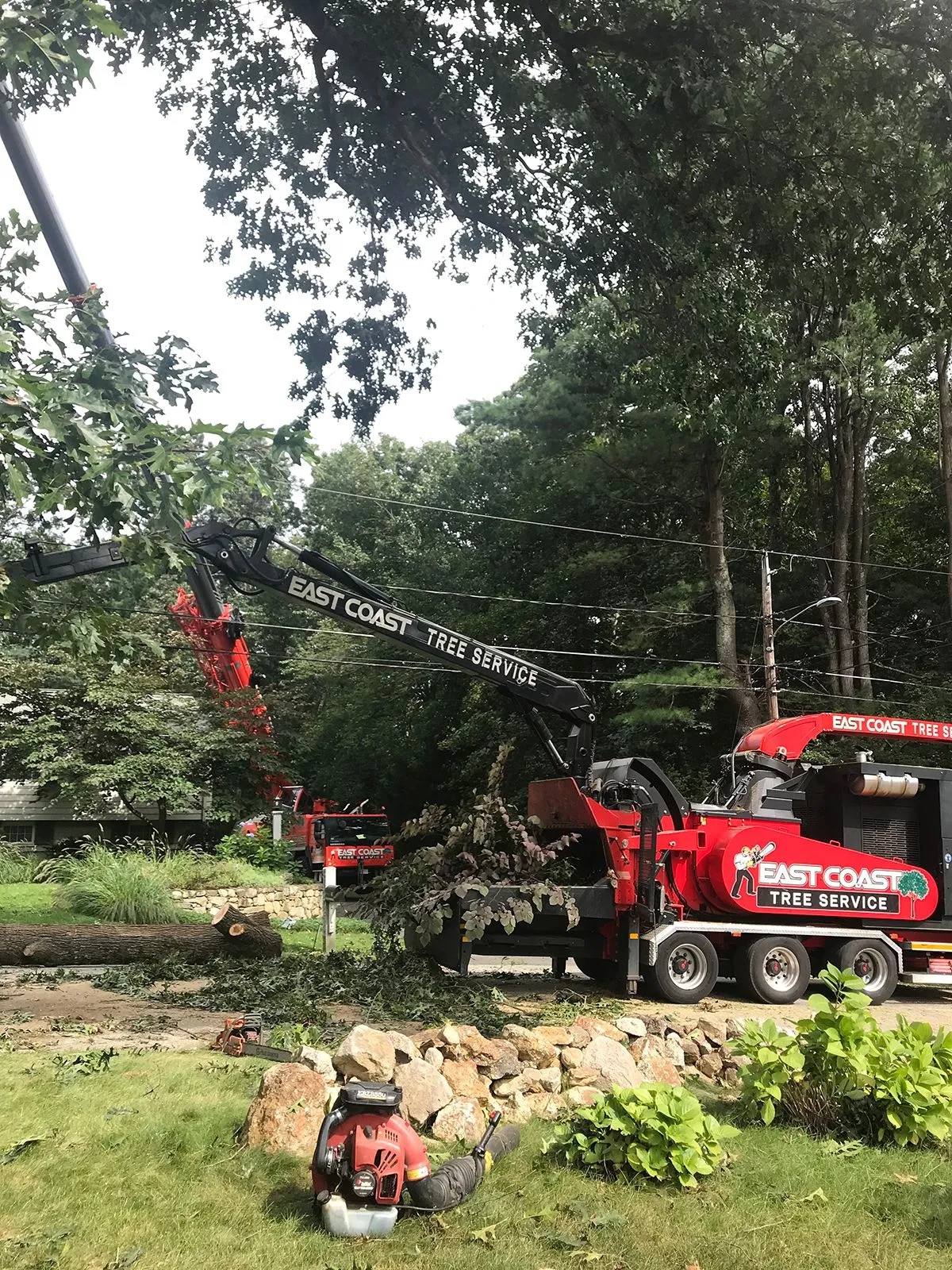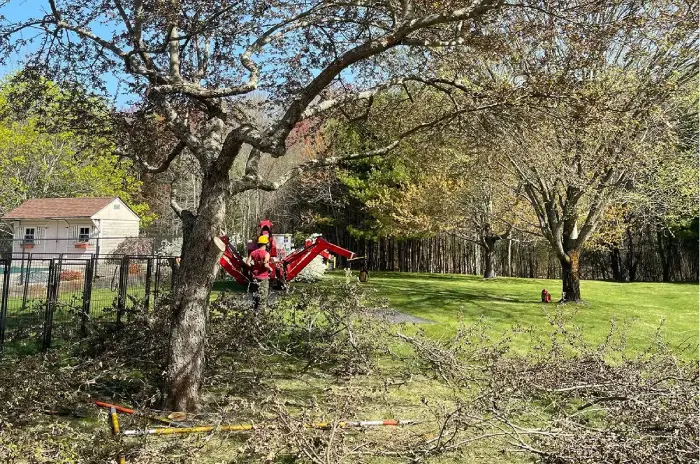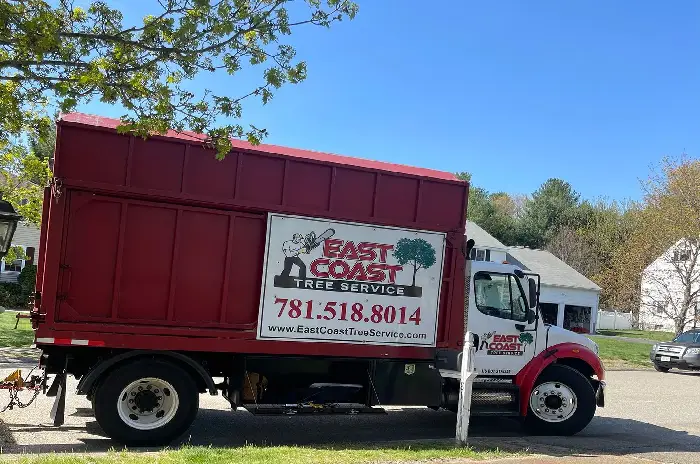
Our team includes multiple ISA Certified Arborists. East Coast Tree Service is a TCIA member and is fully licensed and insured for the work we perform, with general liability coverage and workers’ compensation insurance. Full cleanup is included, financing is available for qualifying projects, and emergency calls receive a response within up to 1 hour.
Call (781) 518-8014 for a free on-site tree service estimate in Wilmington.
Tree Removal, Trimming, Stump Grinding, and Storm Cleanup in Wilmington
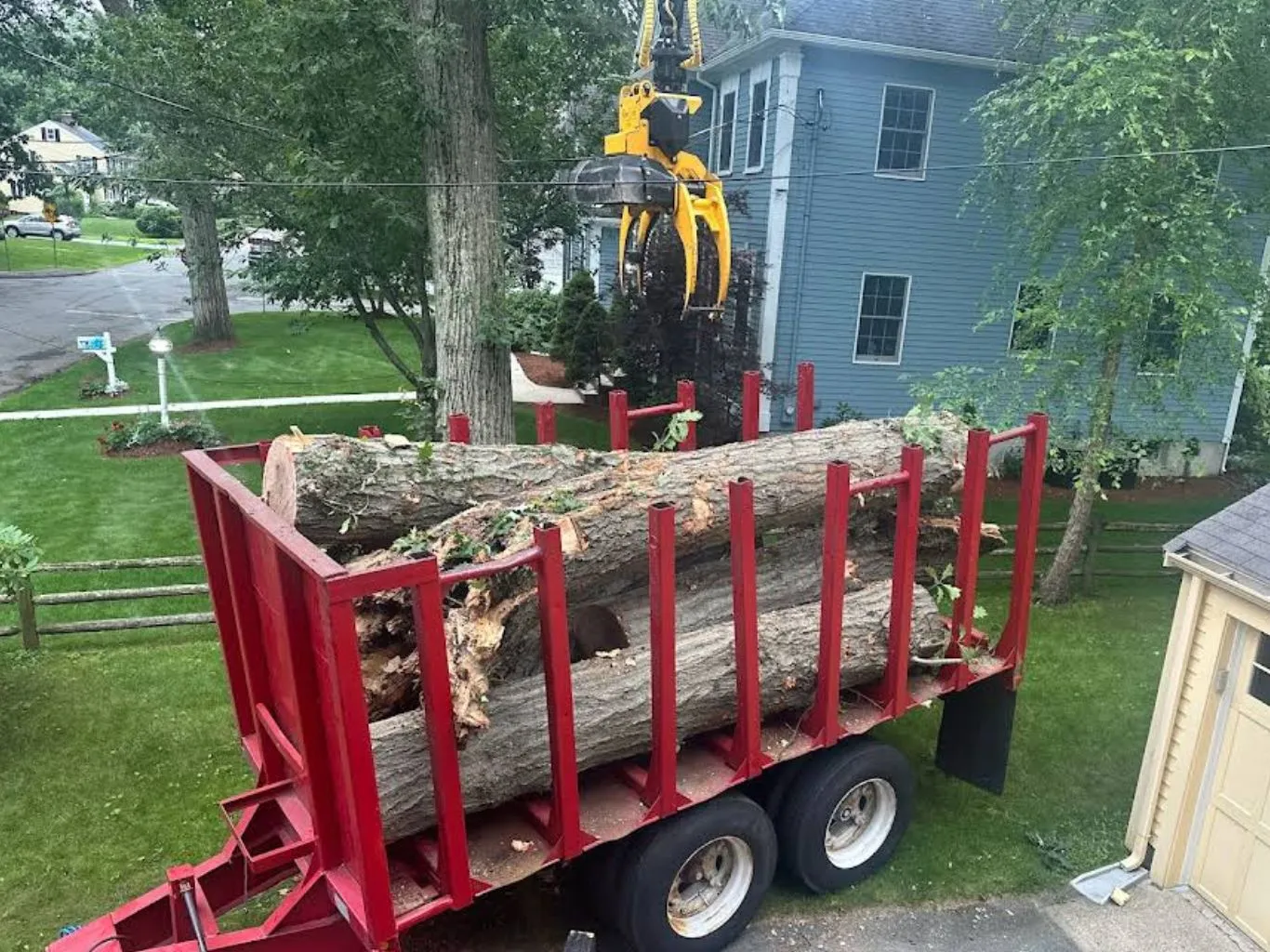
Tree removal is one of East Coast’s main areas of work. A dead tree is an obvious candidate, but removal decisions also come up when a tree develops major decay, root movement, a widening split, repeated storm damage, or a lean that is changing toward a house, driveway, garage, pool, utility line, or neighboring property.
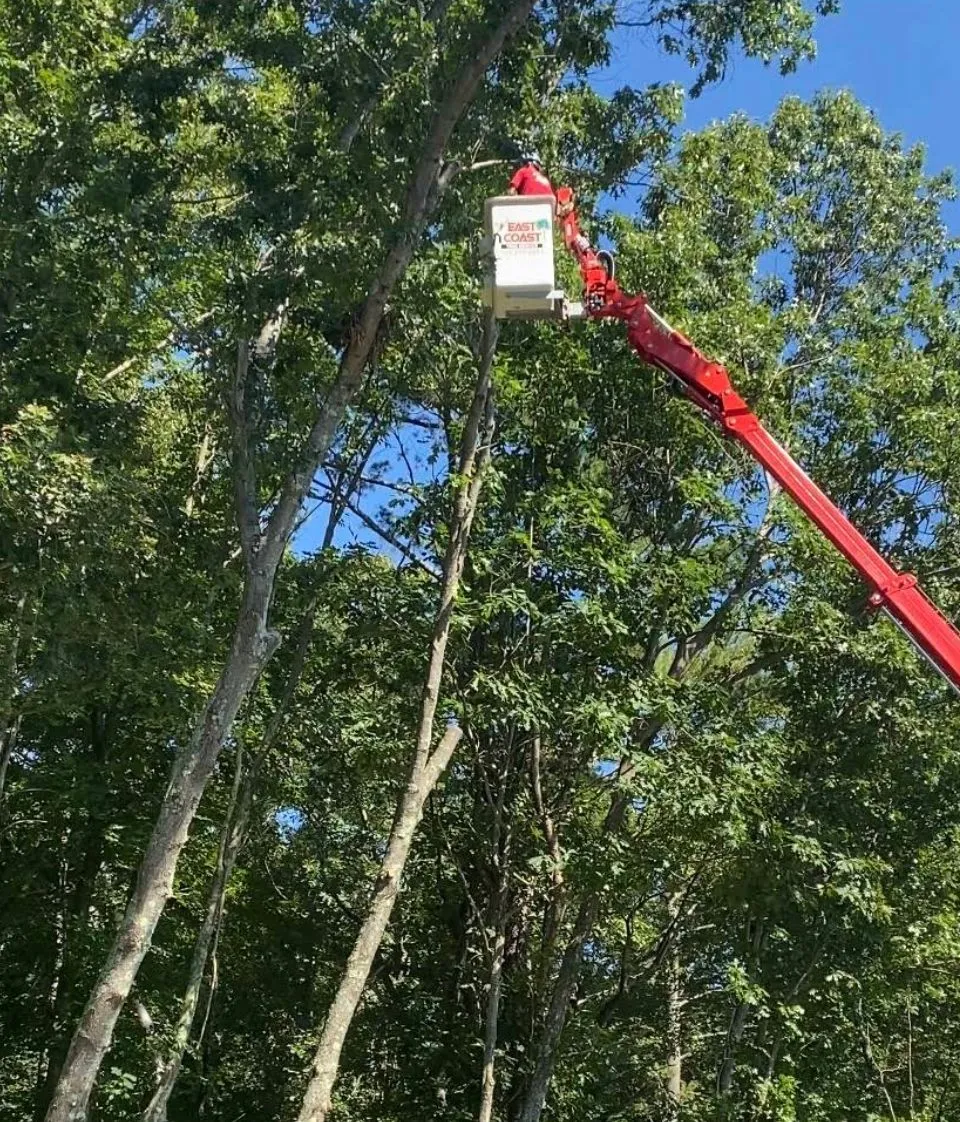
Tree trimming is the better fit when the whole tree can remain but dead, damaged, overextended, or poorly positioned limbs need attention. After a removal, stump grinding can address the remaining stump when it interferes with mowing, landscaping, access, or future use of the yard.
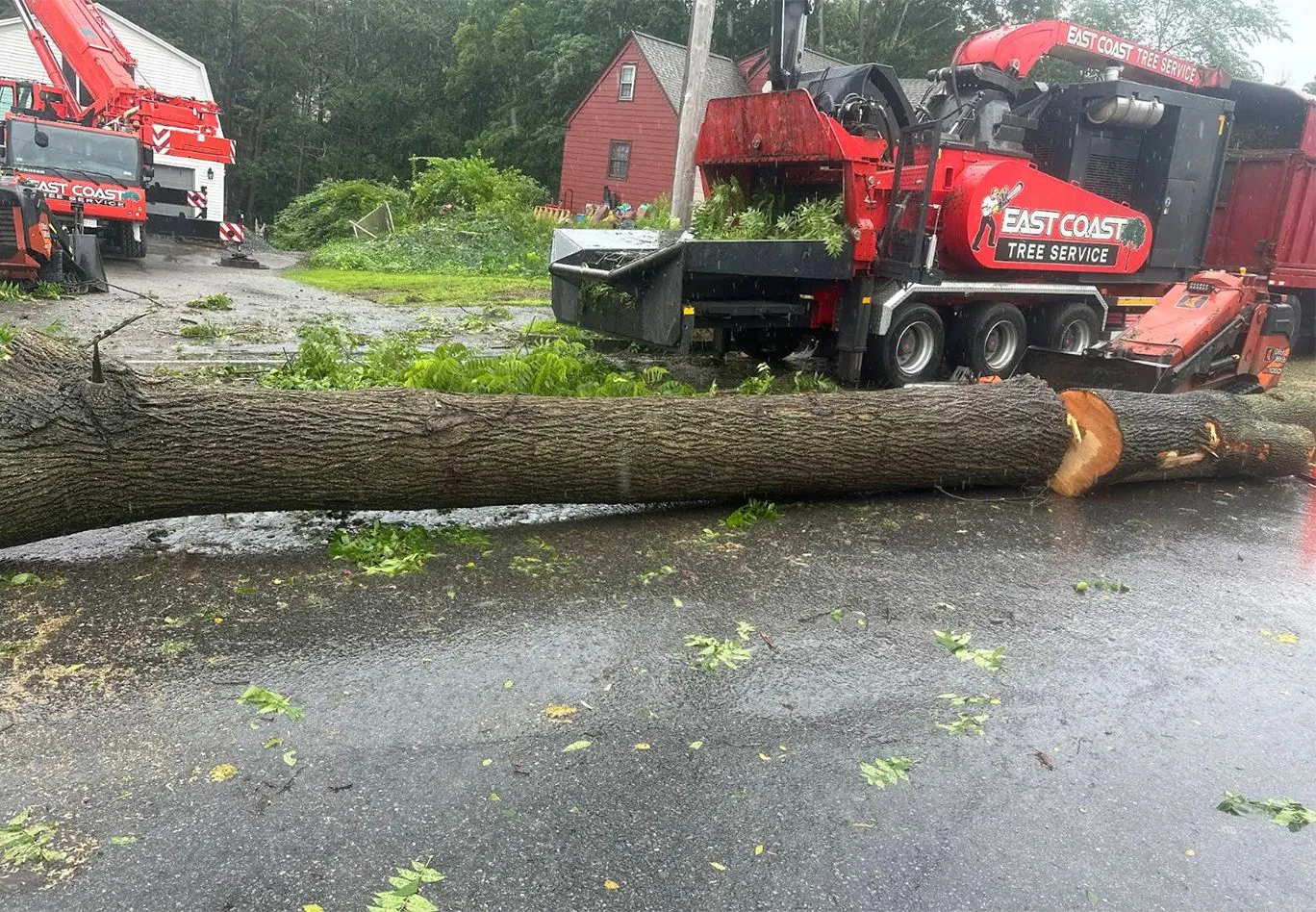
Storm cleanup covers broken limbs, fallen sections, damaged trees, and debris left by wind, snow, ice, or thunderstorms. When the condition is unsafe to leave in place, East Coast’s 24/7 emergency tree service is available at any hour.
Meet Tom FitzPatrick: 25+ Years in Tree Care
Tom FitzPatrick founded East Coast Tree Service in 2016 after already spending many years in the tree-care industry. He now has more than 25 years of industry experience and holds an Associate of Science in Arboriculture and Community Forest Management from the Stockbridge School of Agriculture at UMass Amherst.
Tom is not being presented here as an ISA Certified Arborist because an individual ISA credential for him has not been confirmed. The company fact we can verify is that East Coast’s team includes multiple ISA Certified Arborists. ISA is the International Society of Arboriculture, whose Certified Arborist credential covers professional knowledge across arboriculture.
That distinction matters. A company owner can bring decades of field and formal arboriculture experience while credentialed arborists elsewhere on the team provide another layer of tree-care knowledge. You can read more about Tom and the company on the East Coast Tree Service About page.
Wilmington’s Tree Canopy: Oaks, Maples, White Pine, Ash, and Wetland Trees
Wilmington’s own open-space planning documents describe a much broader tree community than a generic suburban planting list. The town lies in the northern hardwood region with strong oak-hickory and northern pine-oak influences.
Documented hardwoods include northern red oak, white oak, scarlet oak, sugar maple, Norway maple, red maple, American beech, ash, shagbark hickory, sycamore, birches, and other species. Wilmington also documents substantial white pine, red cedar, Norway spruce, and eastern hemlock.
The wetter parts of town look different. Red maple is especially common around marsh edges and brooks. Wilmington Town Forest also contains red maple swamp communities where red maple can dominate the canopy alongside swamp white oak, ash, white pine, tupelo, birch, sassafras, and elm.
Species changes the work. A broad mature red oak can carry heavy lateral limbs. A tall white pine may put much of its operating difficulty high above a roof or neighboring lot. A mature sugar maple can have a wide crown with substantial branch weight. Ash deserves another kind of attention because Emerald Ash Borer is now well established across Massachusetts and can leave declining ash increasingly brittle.
A species name still does not decide whether a tree should stay or come down. Condition, trunk diameter, roots, lean, crown structure, nearby targets, access, and storm history are more useful when deciding what work is appropriate.
Tree Service Around Silver Lake, Wilmington Town Forest, and the Town Common
Wilmington covers about 17 square miles in northeastern Middlesex County. I-93 is the major north-south highway through town, while Route 38/Main Street, Route 62, Route 125, and Route 129/Lowell Street connect residential, commercial, and wooded parts of Wilmington.
Those routes help explain the town geographically. Route 38/Main Street runs through the developed center of Wilmington. Route 62 follows Middlesex Avenue and Salem Street through parts of town; the Wilmington Town Museum at the Col. Joshua Harnden Tavern is at 430 Salem Street on Route 62. Route 129 follows Lowell Street and crosses I-93. North Wilmington extends beyond the commuter rail line toward Andover and the New Hampshire-facing side of the region.
Silver Lake is one of Wilmington’s best-known natural features and includes the Town Beach recreation area. The municipal open-space plan also identifies the Town Forest high point scenic overlook, the Harnden Tavern Museum, the Sawmill Brook gorge, and the Middlesex Canal route among Wilmington’s distinctive landscape and historic features.
These places are relevant to tree service for a practical reason. A wooded property near Town Forest or one of Wilmington’s brooks may involve different soils, groundwater, access, and wetland constraints from a compact lot near Main Street. A property near Silver Lake may need Conservation review if tree work will disturb a protected resource area or buffer zone.
Protecting Wilmington’s Historic Oaks and Other Shade Trees at Town Common
Wilmington’s planning documents describe the Town Common, Church Street, and Middlesex Avenue area as a civic center characterized by tall shade trees, mature vegetation, historic residential structures, and a landscaped Common. The area includes or sits near the library, schools, churches, cemetery, and other civic uses.
It would be inaccurate to call every mature tree there an historic oak. The Town’s own records document a mix of public plantings. One specific example is a Princeton elm planted on the Town Common in 2021 in memory of former Tree Division Foreman Robert Allen.
The larger point is tree preservation around established civic and residential properties. Mature shade trees near older structures should be evaluated before removal simply because a branch is large or the tree is close to a building. Deadwood, structural defects, root problems, clearance, and actual targets matter more than age alone.
When pruning can address the condition without compromising the remaining tree, removal may not be necessary. When the root system, trunk, or major structure has deteriorated beyond a reasonable retention option, the removal plan then has to account for the same historic buildings, landscaping, sidewalks, traffic, and neighboring properties that make those trees so noticeable in the first place.
Crane-Assisted Tree Removal Near Silver Lake and Shawsheen Avenue
This is not a claimed East Coast case study. We do not have a verified company project showing a specific crane removal over a pool on Silver Lake or Shawsheen Avenue, so we will not invent one.
The conditions described by the comparison brief are still realistic for Wilmington. A large tree can have a house, pool, fence, septic or utility area, established landscaping, or neighboring property underneath the canopy. On that type of site, there may be too little usable drop zone to lower or fell large pieces conventionally.
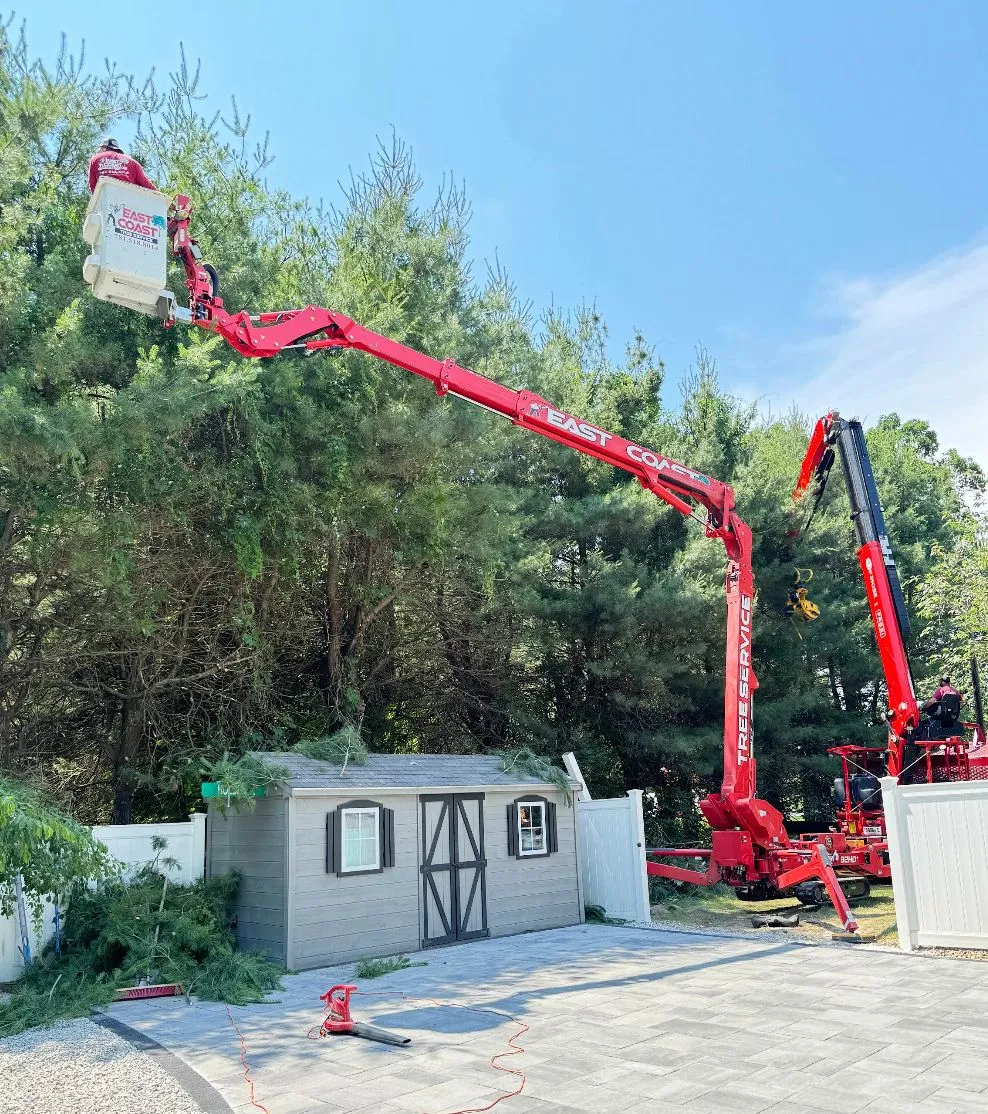
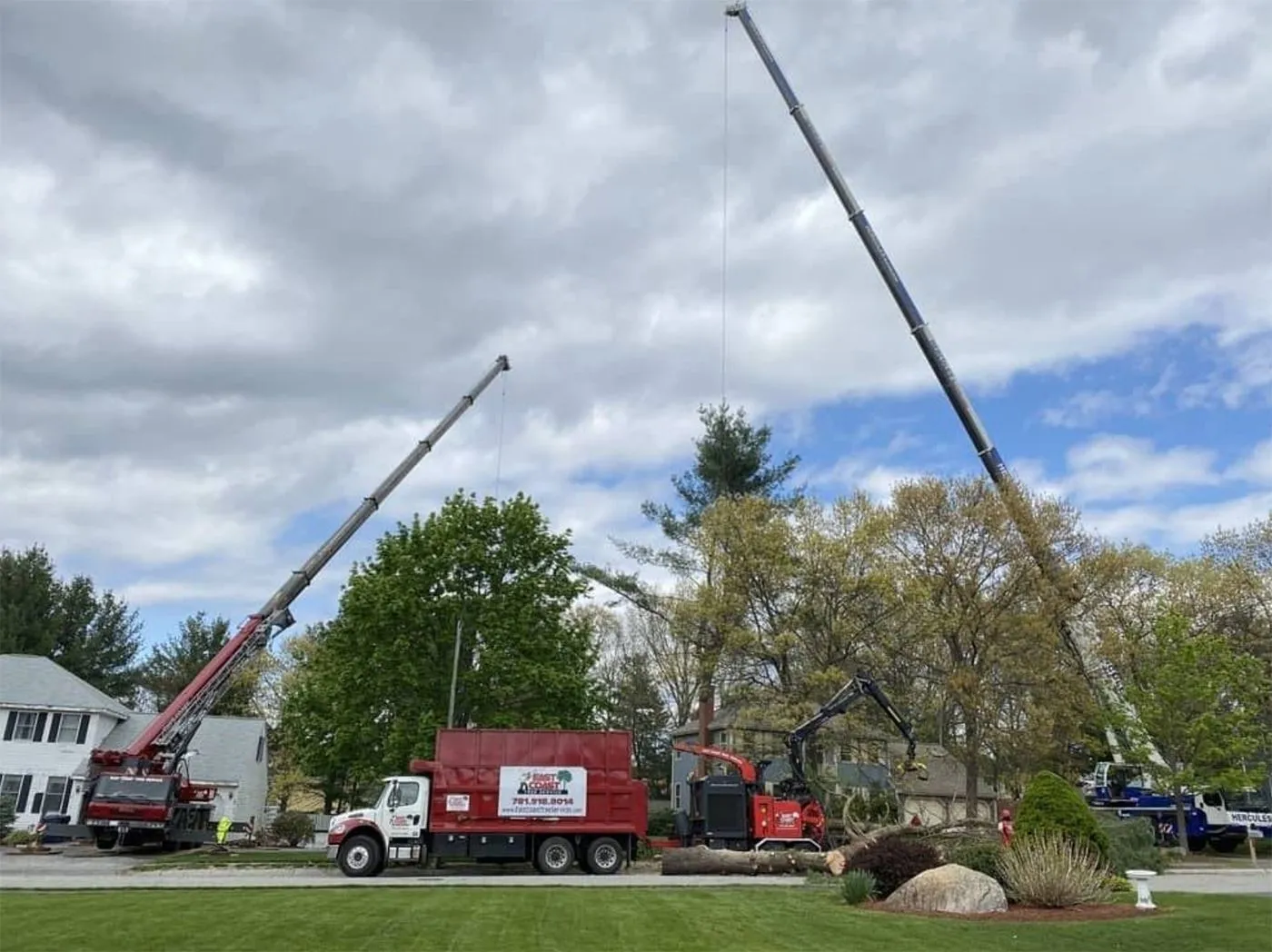
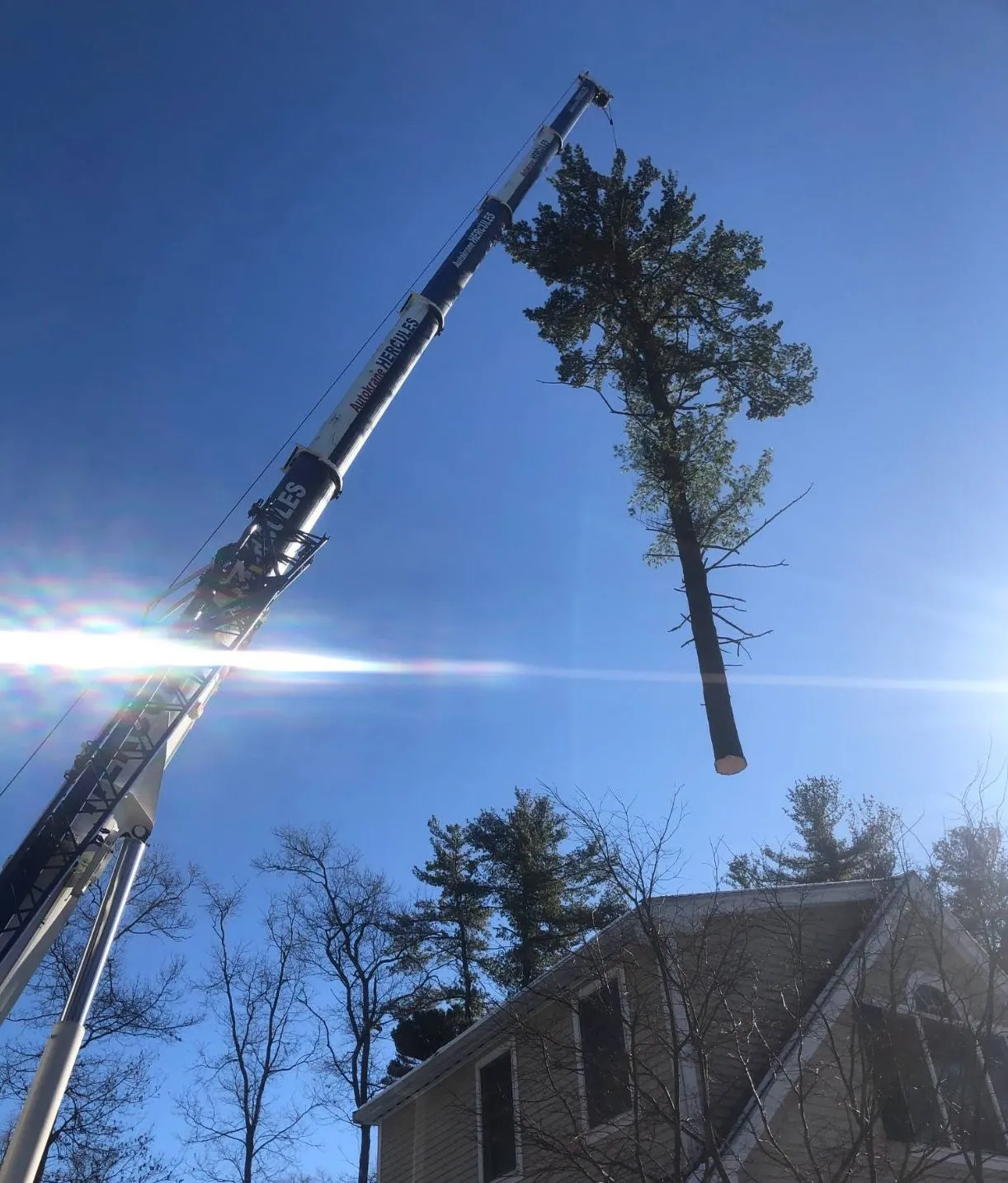
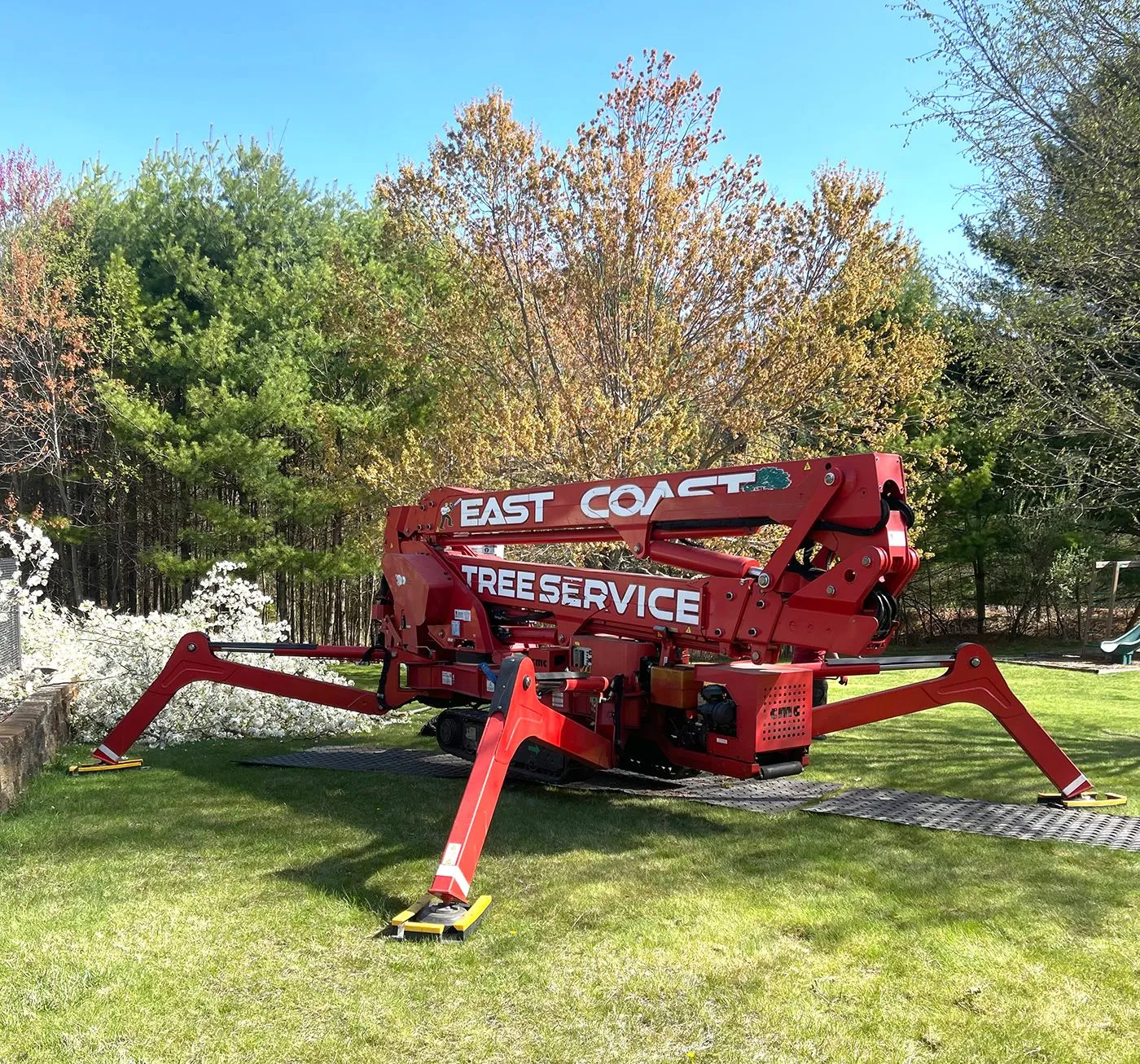
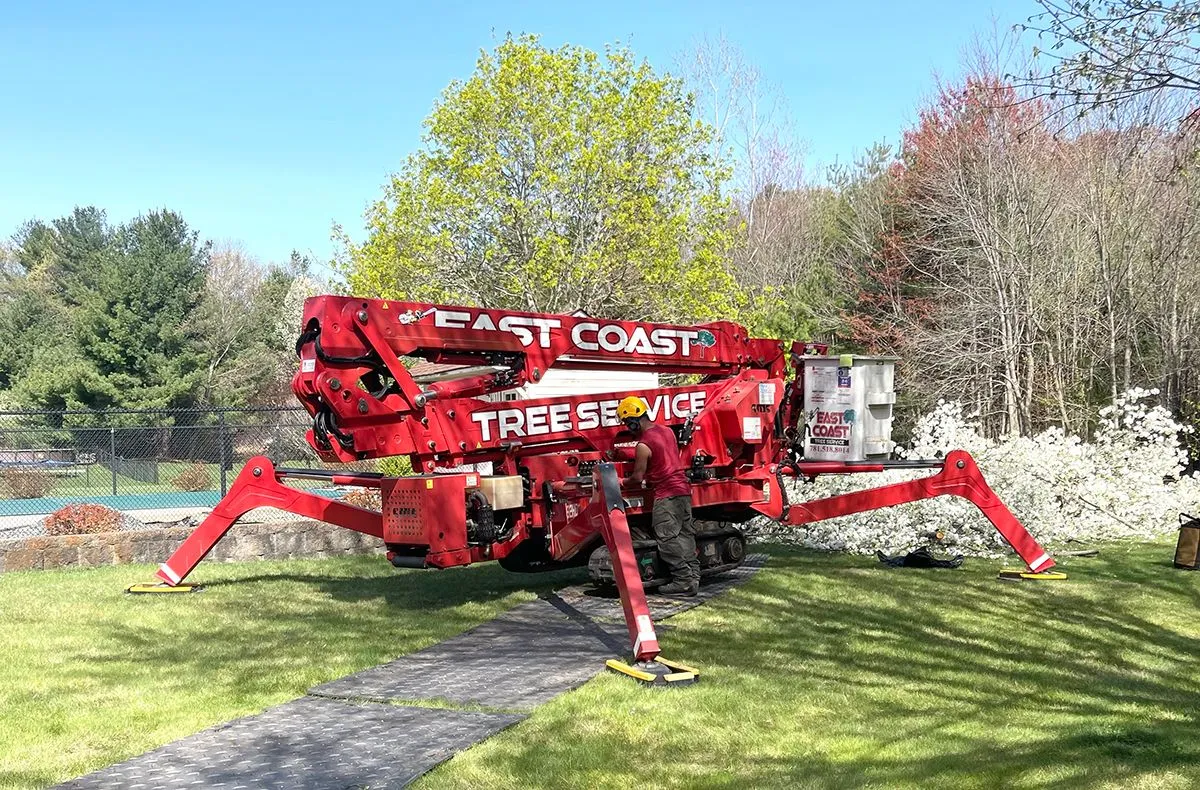
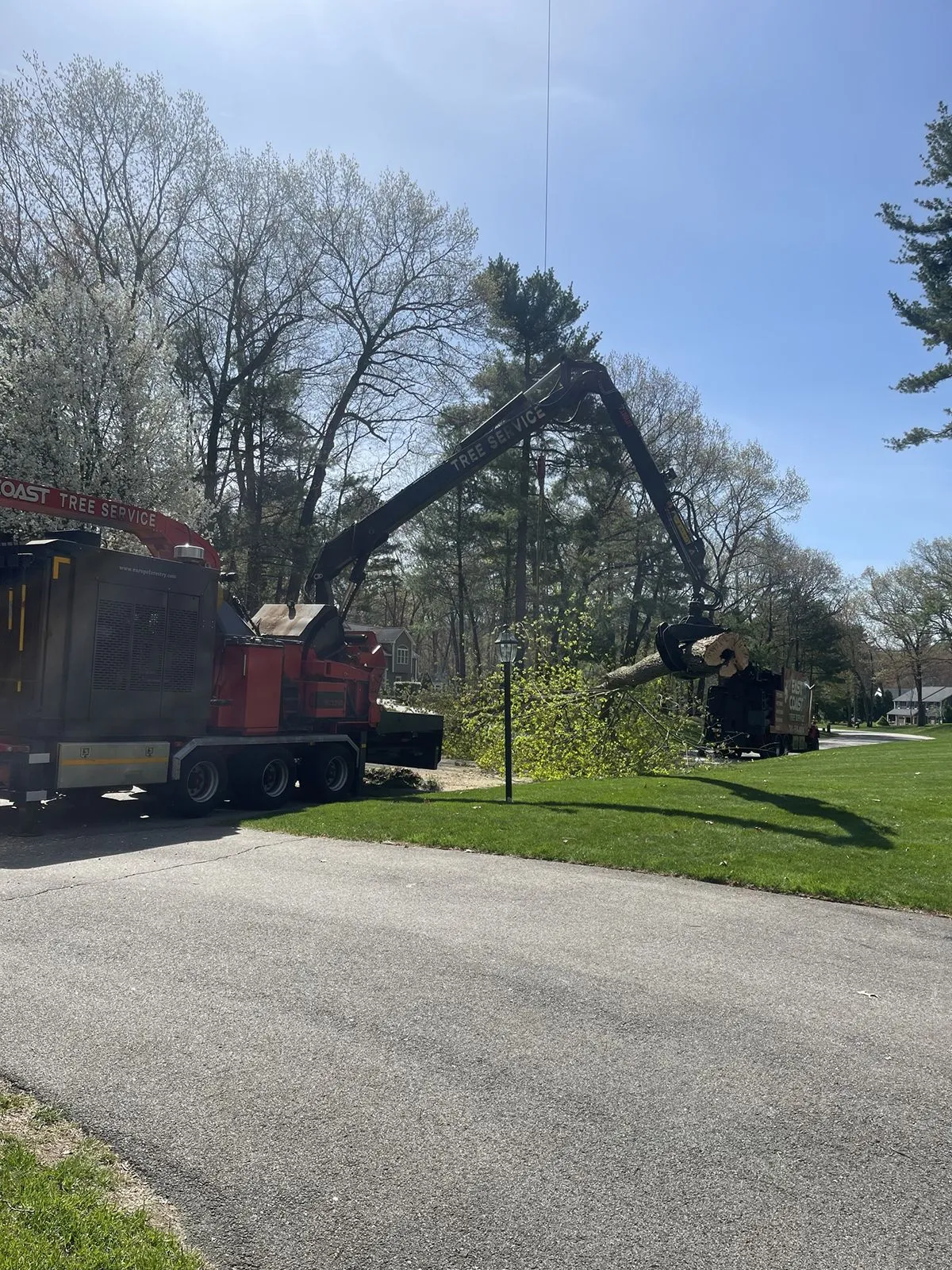
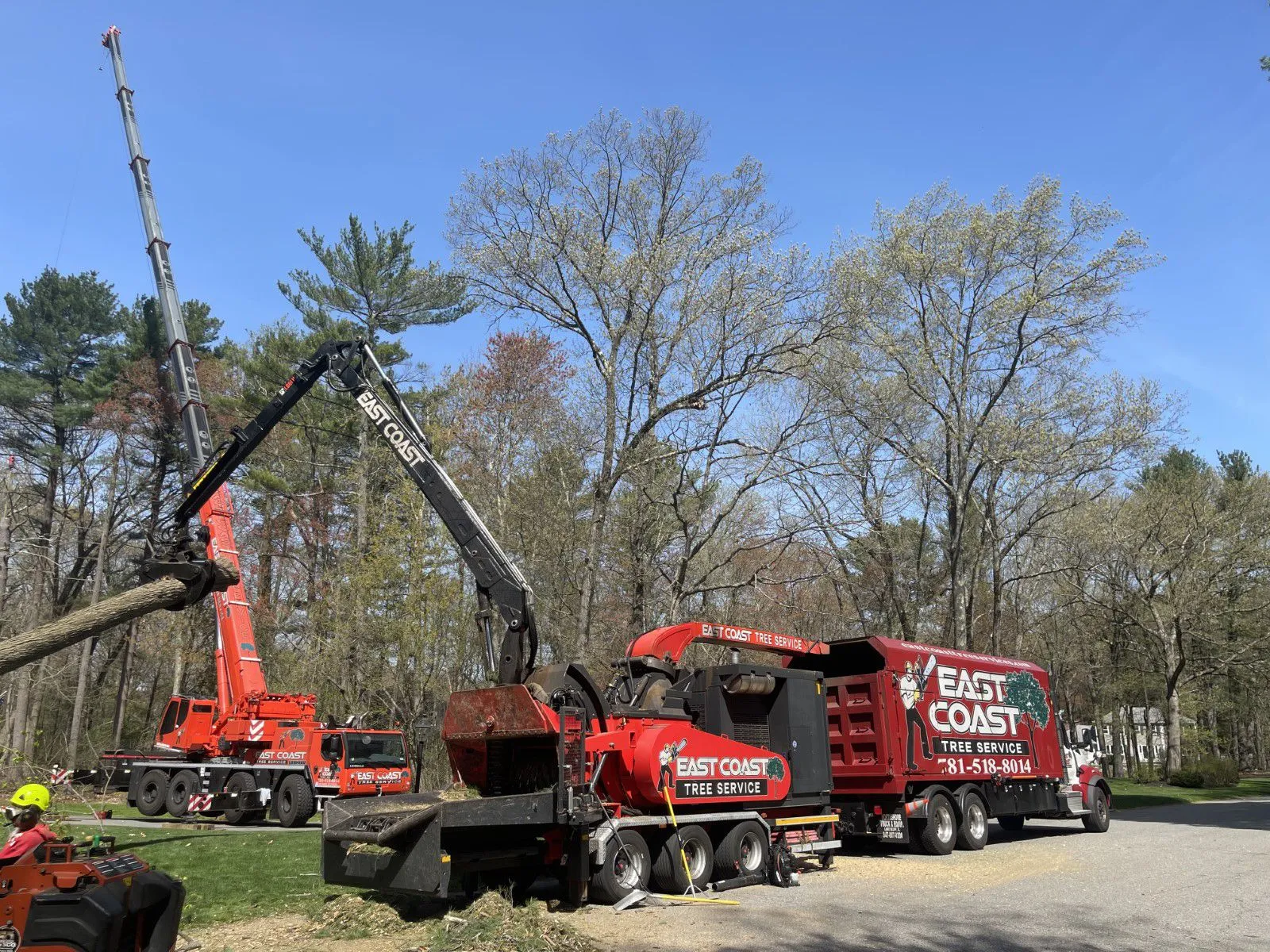
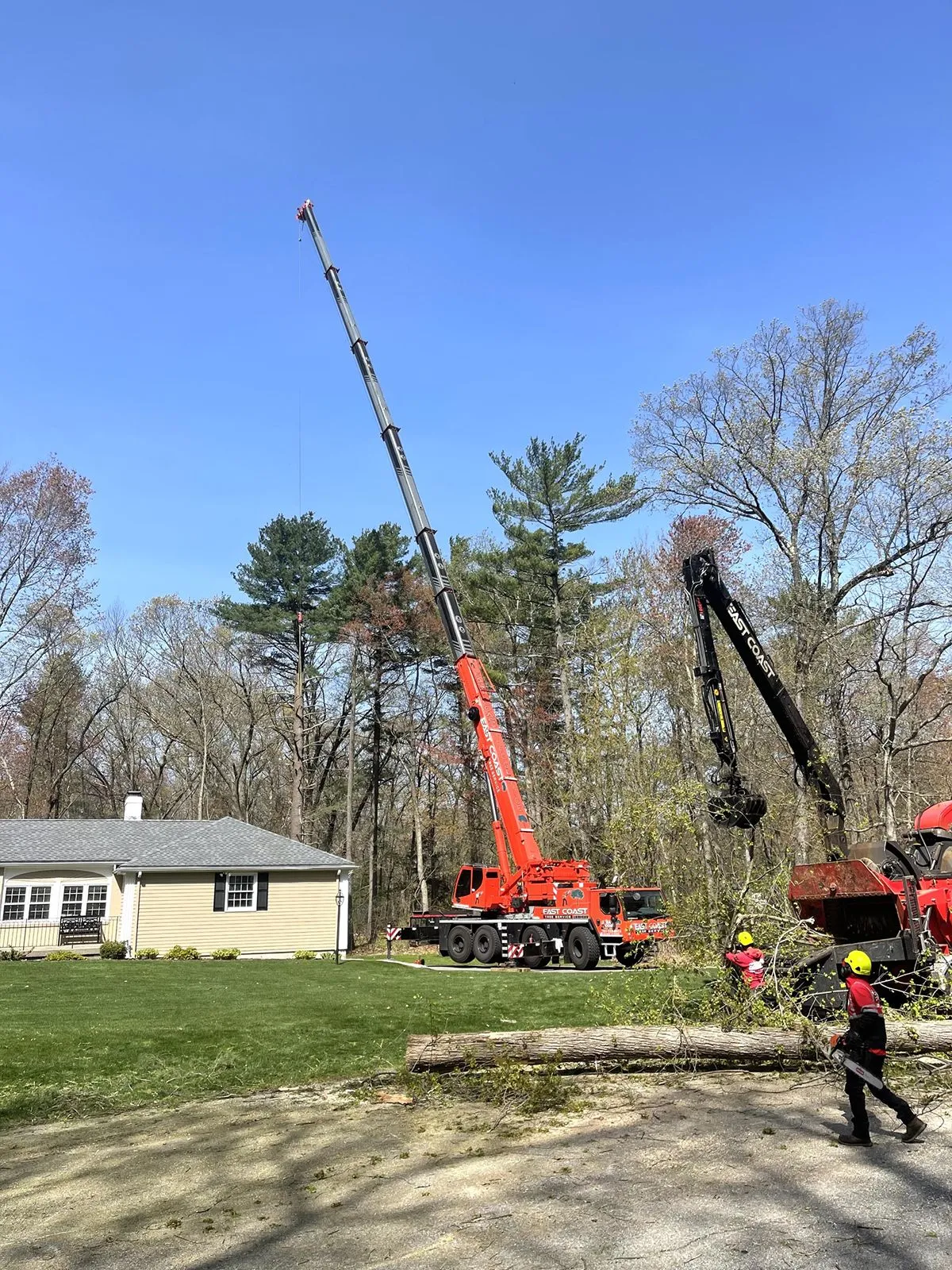
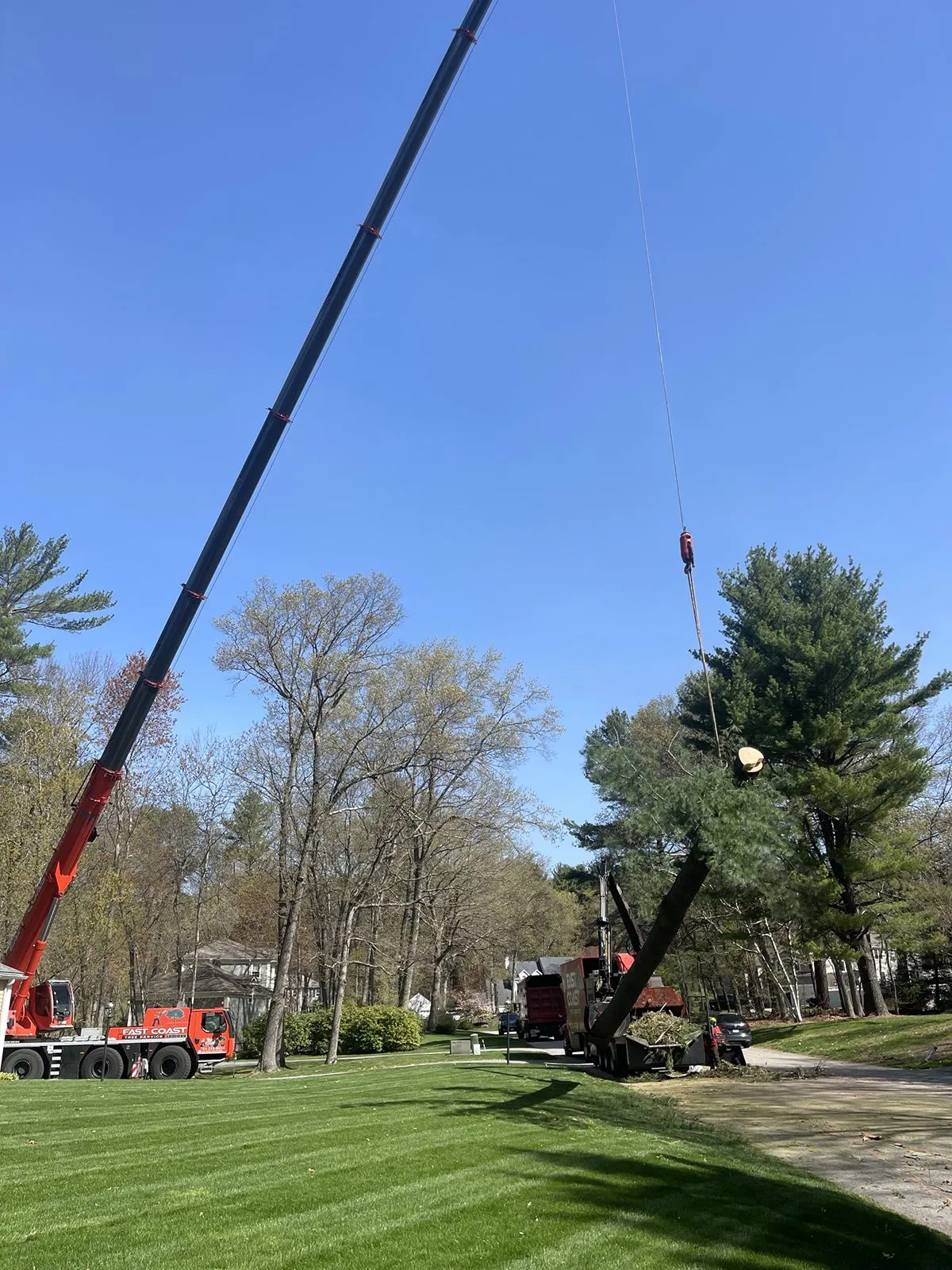
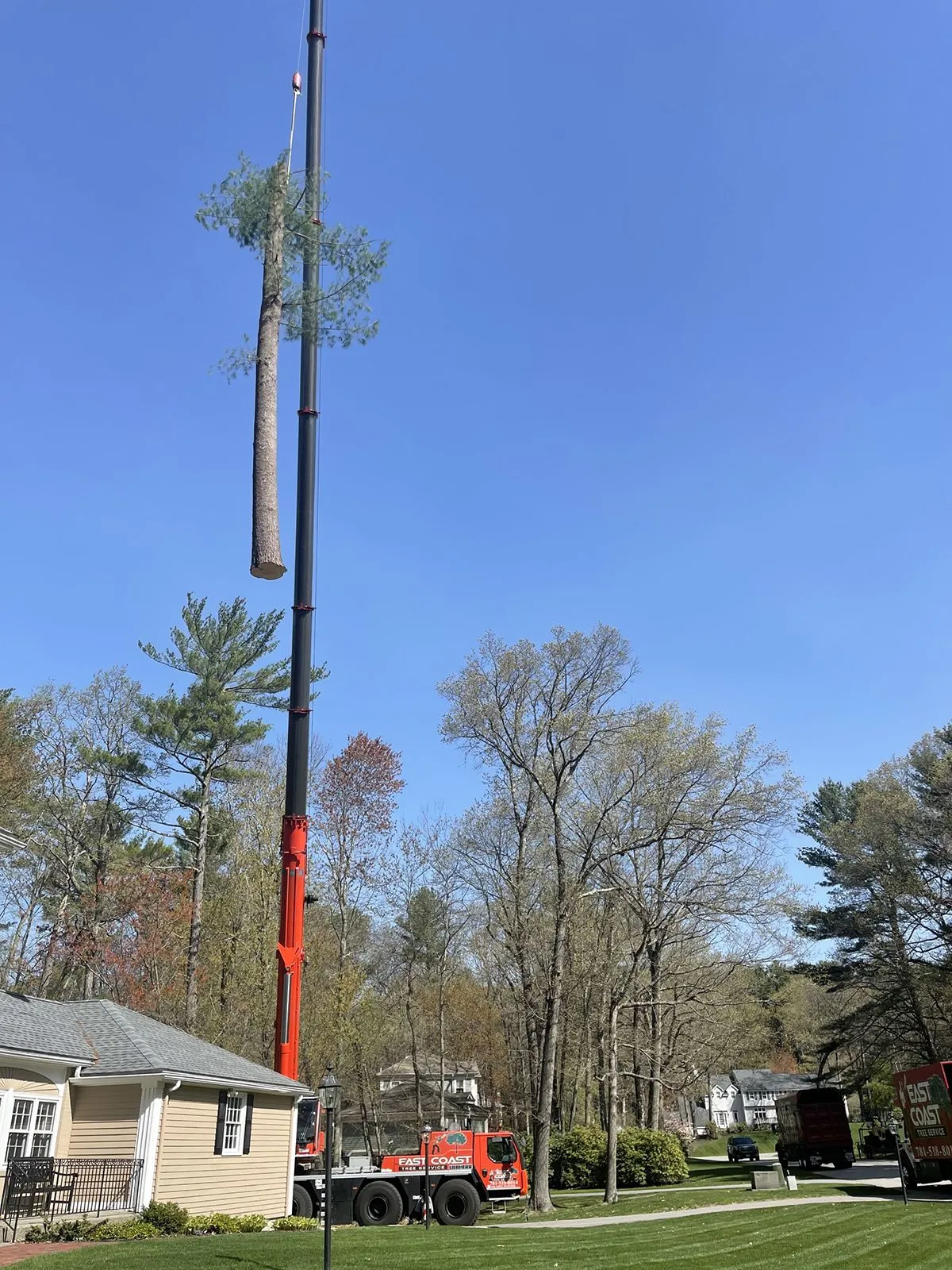
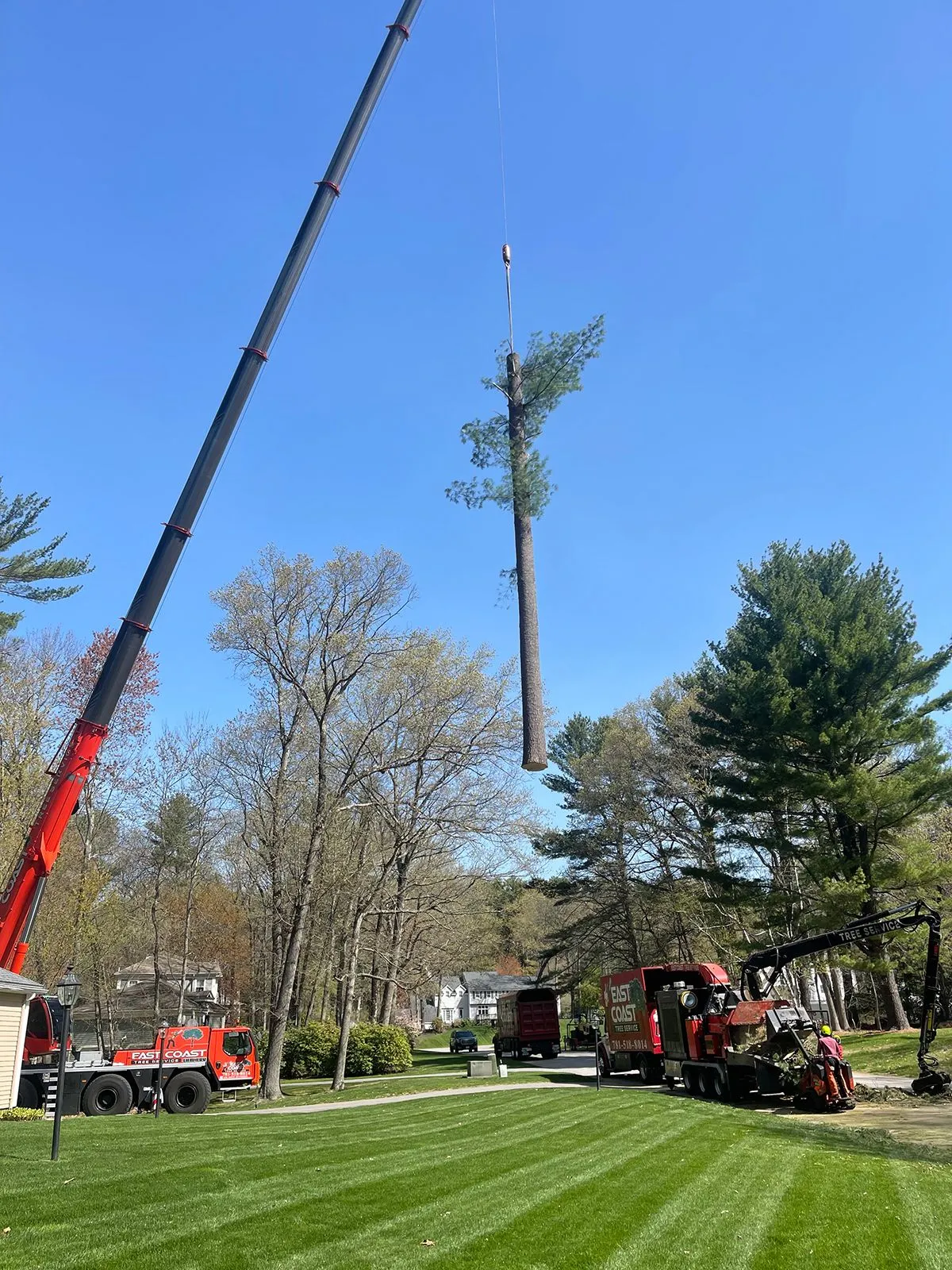
Crane-assisted removal can allow sections to be secured, cut, lifted, and transferred to a controlled processing area instead of dropping heavy wood through the property. The crane is chosen because the site supports that approach, not simply because the tree is tall.
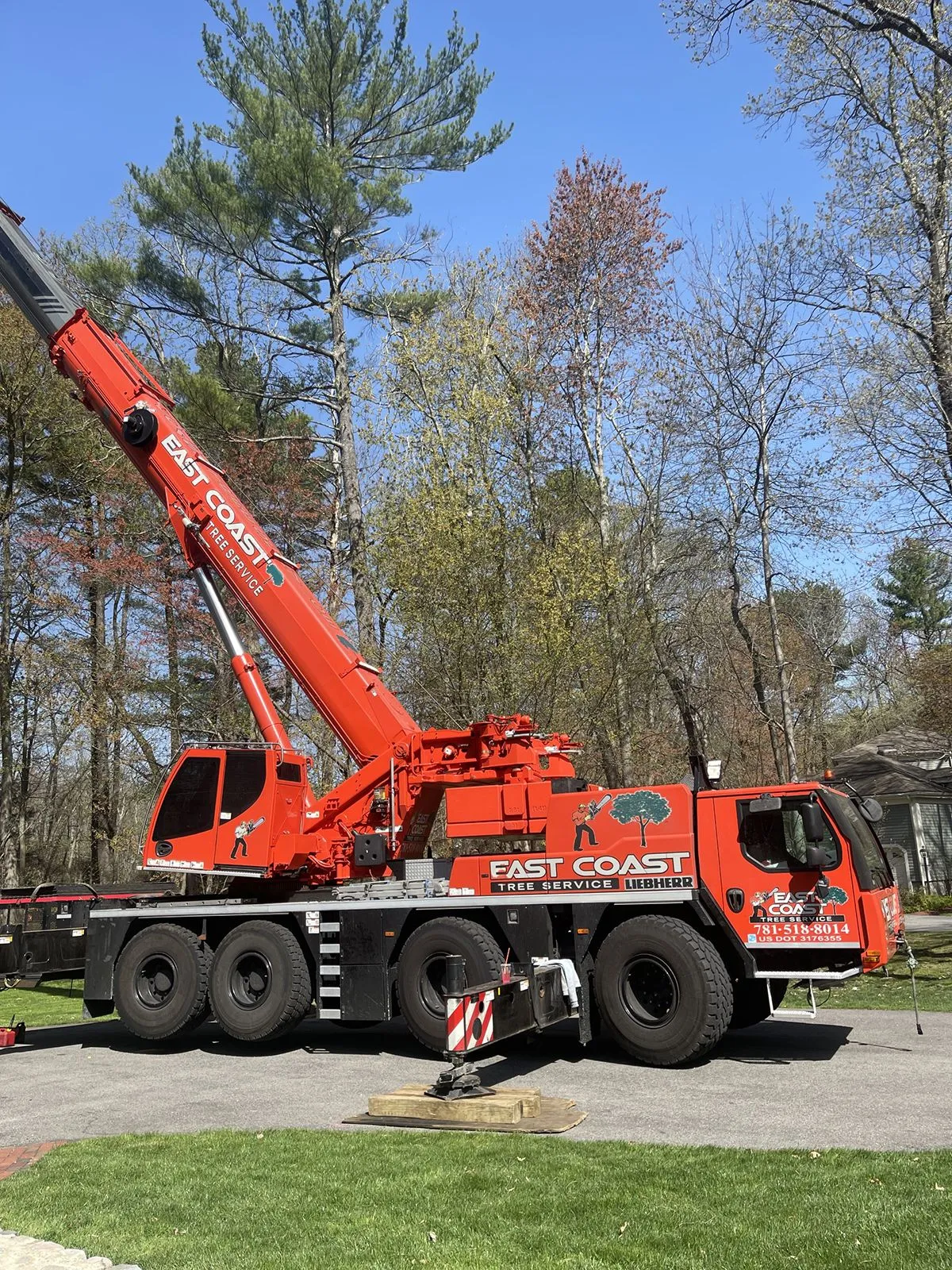
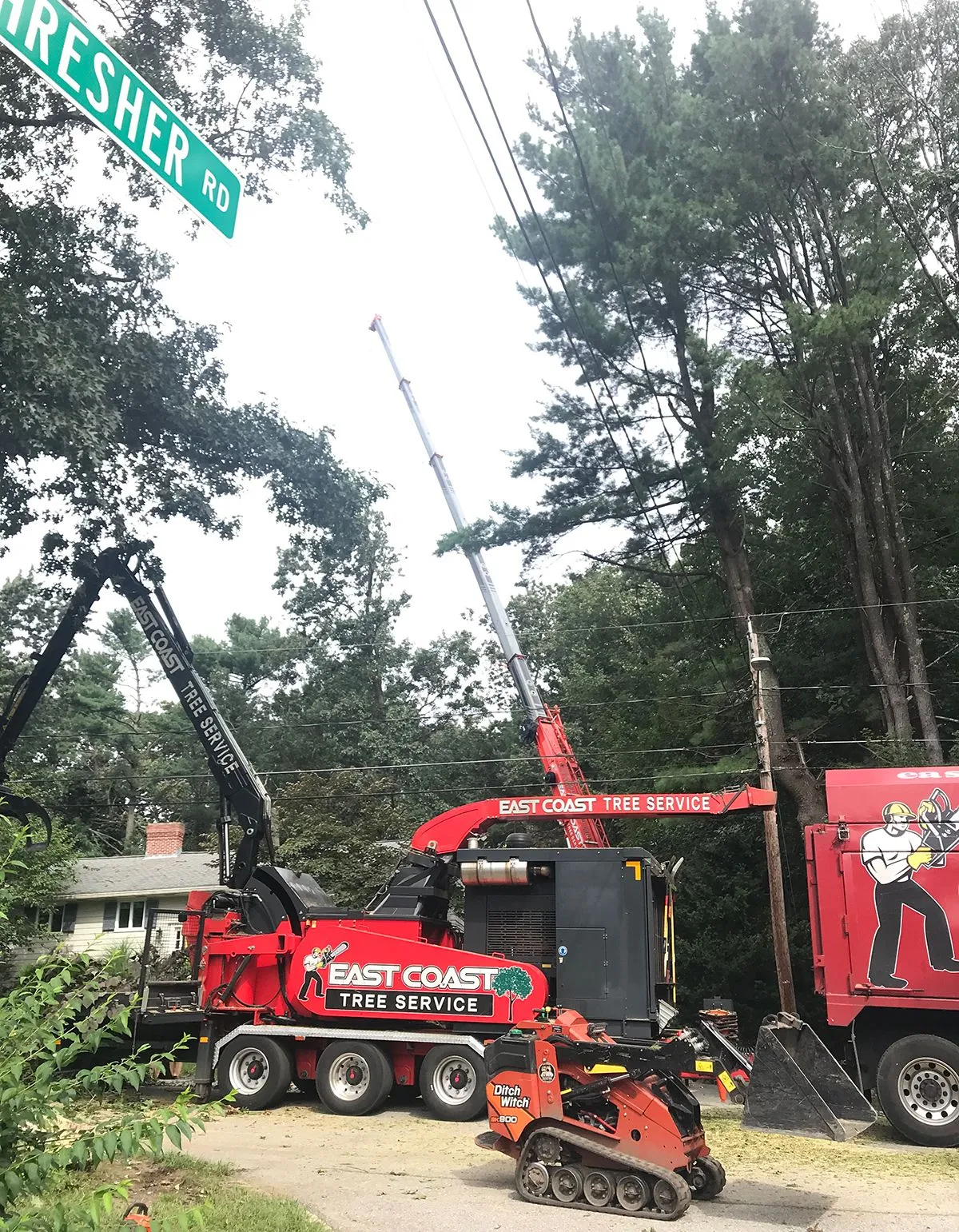
Before crane work, the estimator needs to consider access, reach, ground conditions, nearby structures, overhead wires, piece weight, setup space, and outrigger position. Crane outriggers require appropriate support and load distribution for the surface involved. The exact method can vary by property.
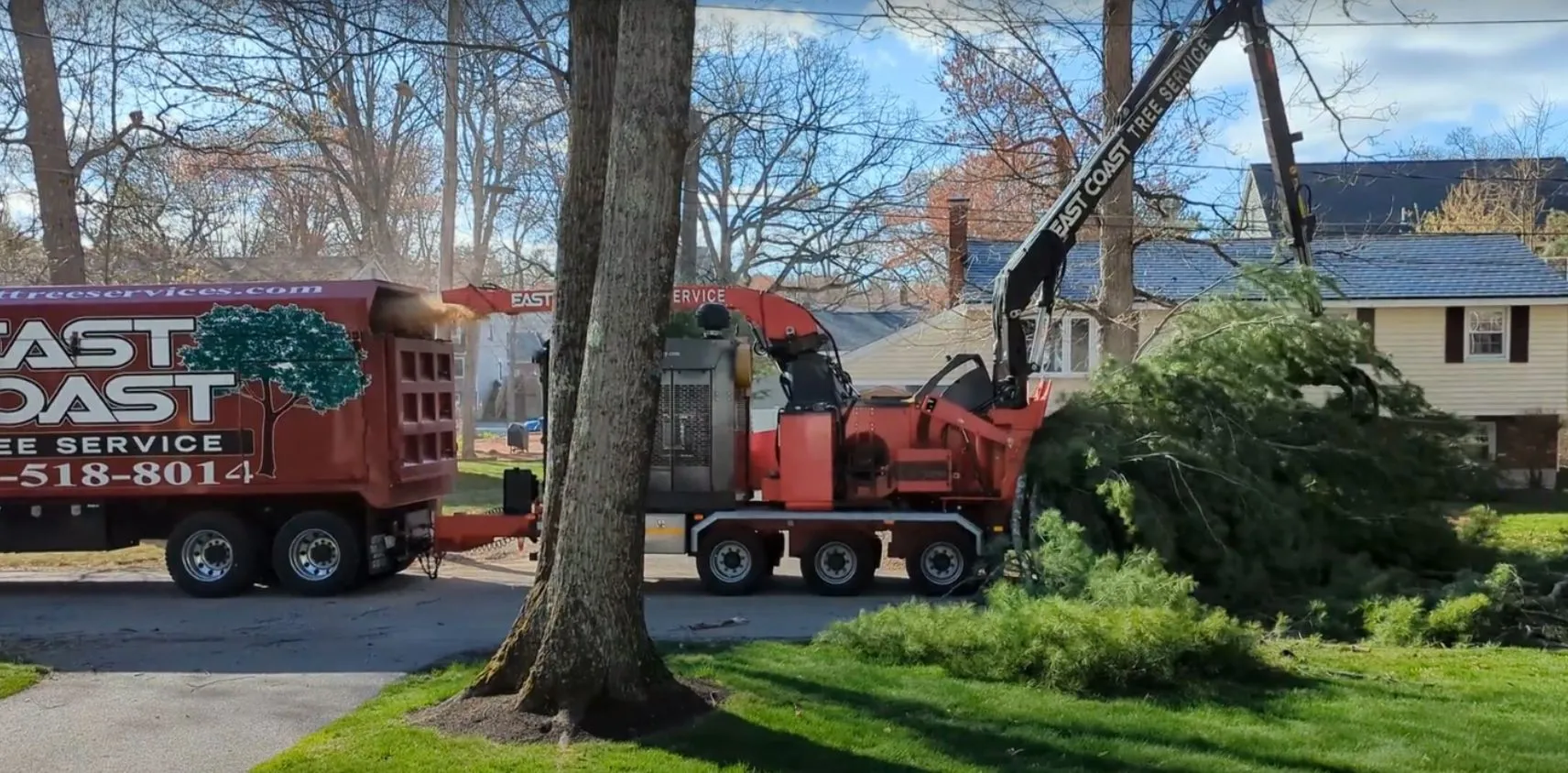
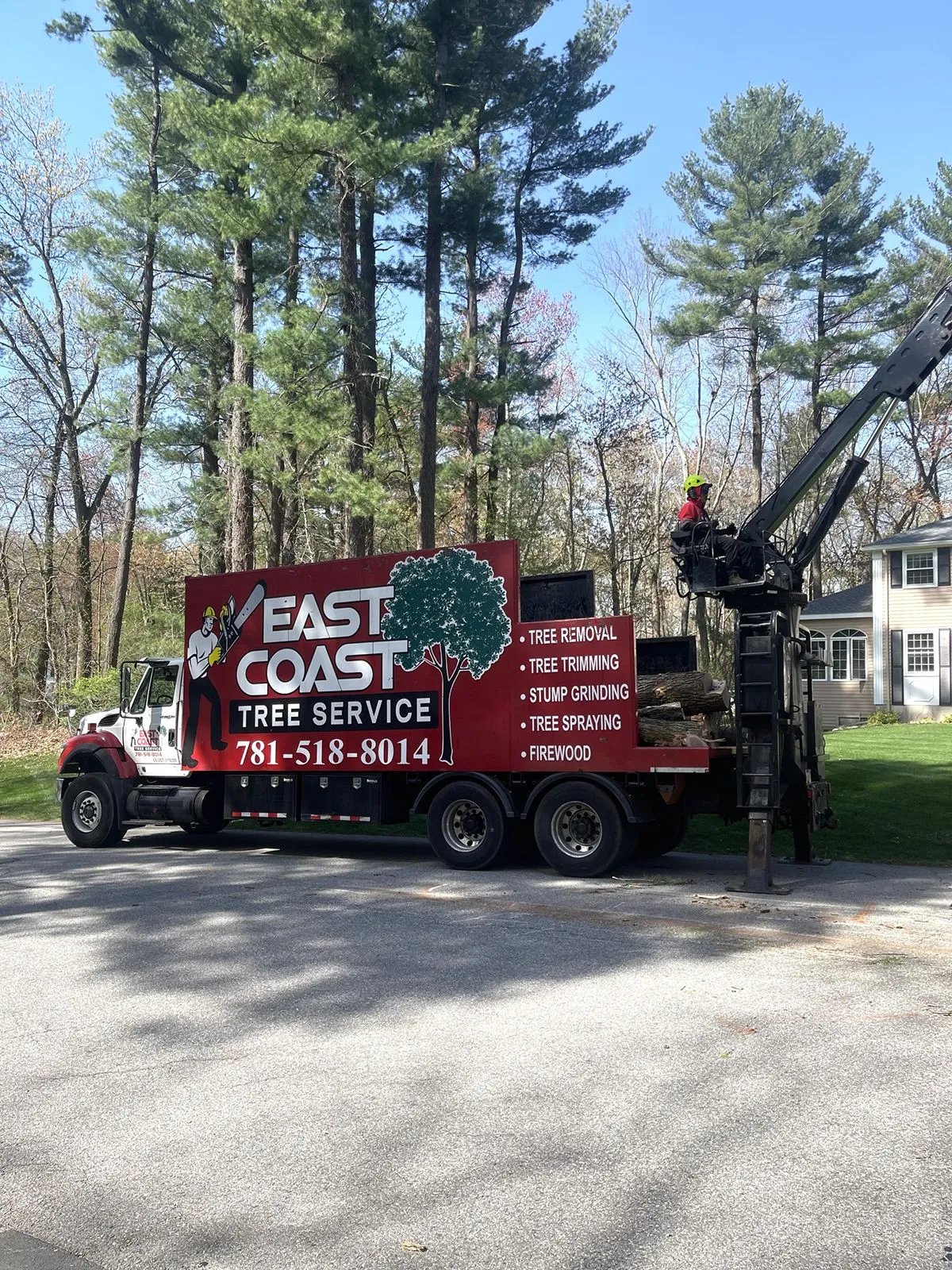
East Coast includes full cleanup after the job. The sales team also reviews lawns, driveways, hardscape, pools, fences, and other property features when planning access and setup.
Trees Along Shawsheen Avenue, Lowell Street, and Public Ways
Wilmington’s Tree Division gives us unusually specific evidence of the species growing along local streets. A 2020 public shade tree hearing at 530 Shawsheen Avenue involved a 26-inch white oak. A separate hearing for the Woburn Street and Lowell Street intersection documented red maples, sugar maple, ash, black oak, elm, and other maples.
Those hearings also show why a roadside tree can be different from a backyard tree. Massachusetts General Laws Chapter 87 protects public shade trees. Wilmington requires a written request to the Tree Warden before a healthy public shade tree can be cut, trimmed, or removed. The Tree Warden inspects the tree and, when required, schedules a public hearing.
Wilmington’s current Public Works staff lists Jamie Magaldi, PE, MCA, as Public Works Director and Tree Warden. MCA means Massachusetts Certified Arborist, a different credential from ISA Certified Arborist. East Coast is not claiming MCA status or membership in the Massachusetts Arborists Association.
If the tree sits near the street and ownership or right-of-way status is unclear, check with the Wilmington Tree Division before authorizing removal.
Tree Work Near Silver Lake, Brooks, Wetlands, and Riverfront Areas
Wilmington contains extensive wetlands, streams, ponds, floodplain, and groundwater-dependent areas. The town specifically documents Sawmill Brook, Lubbers Brook, Martins Brook, Silver Lake, wetland swamps, bogs, and other water resources.
The Wilmington Conservation Commission administers the Massachusetts Wetlands Protection Act locally. The Town’s wetlands guide states that wetlands have a 100-foot buffer area and perennial rivers or streams can have a 200-foot Riverfront Area. Removing vegetation, including trees, is one of the activities that can require review or a permit when it occurs in a regulated area.
This means a tree can be privately owned and still sit in a location where tree work needs Conservation Commission review. The safest sequence is to check jurisdiction before cutting rather than discovering a resource-area issue after vegetation has been removed.
East Coast does not make a blanket claim that it files or obtains Wilmington Conservation permits for every customer. Potential wetland or public-way concerns can be identified during the estimate so the applicable Town requirements can be checked before work begins.
Storm Damage Response: What to Do Before We Arrive
Wilmington’s hazard planning documents high exposure to winter storms and nor’easters. A March 2018 nor’easter brought down trees, blocked local roads, caused outages, and gave the Town a recent local example of what heavy wind and saturated ground can do together.
After a storm, stay away from a tree that has shifted at the roots, split through a main union, hung a large limb overhead, or fallen into an area people need to cross. If a tree is resting on a house or blocking a driveway, keep people away from the failure zone until it can be evaluated.
Power-line situations need a different first call. Wilmington’s electric service is provided by Reading Municipal Light Department, or RMLD, not Eversource. The Town instructs residents to report downed electrical lines immediately to 911 and power outages to RMLD. RMLD also tells customers to stay well away from downed lines and electrical equipment.
Once the electrical hazard is controlled, tree work can be planned around the remaining damage. East Coast provides 24/7 emergency service, and emergency calls receive a response within up to 1 hour. When you call, explain whether a tree has fallen on a structure, whether access is blocked, and whether any utility lines are involved.
Hazard Tree Assessment: When a Mature Oak or Maple Needs Attention
A mature oak or maple does not need removal because it is large. More useful warning signs include recent root-plate movement, soil cracking near the base, a new or increasing lean, large dead sections, substantial cavities, major split unions, fungal decay indicators, storm-created cracks, or repeated limb failures.
A long-standing lean can be stable. A lean that appeared after high wind, saturated soil, or root disturbance is a different situation. The change matters as much as the angle.
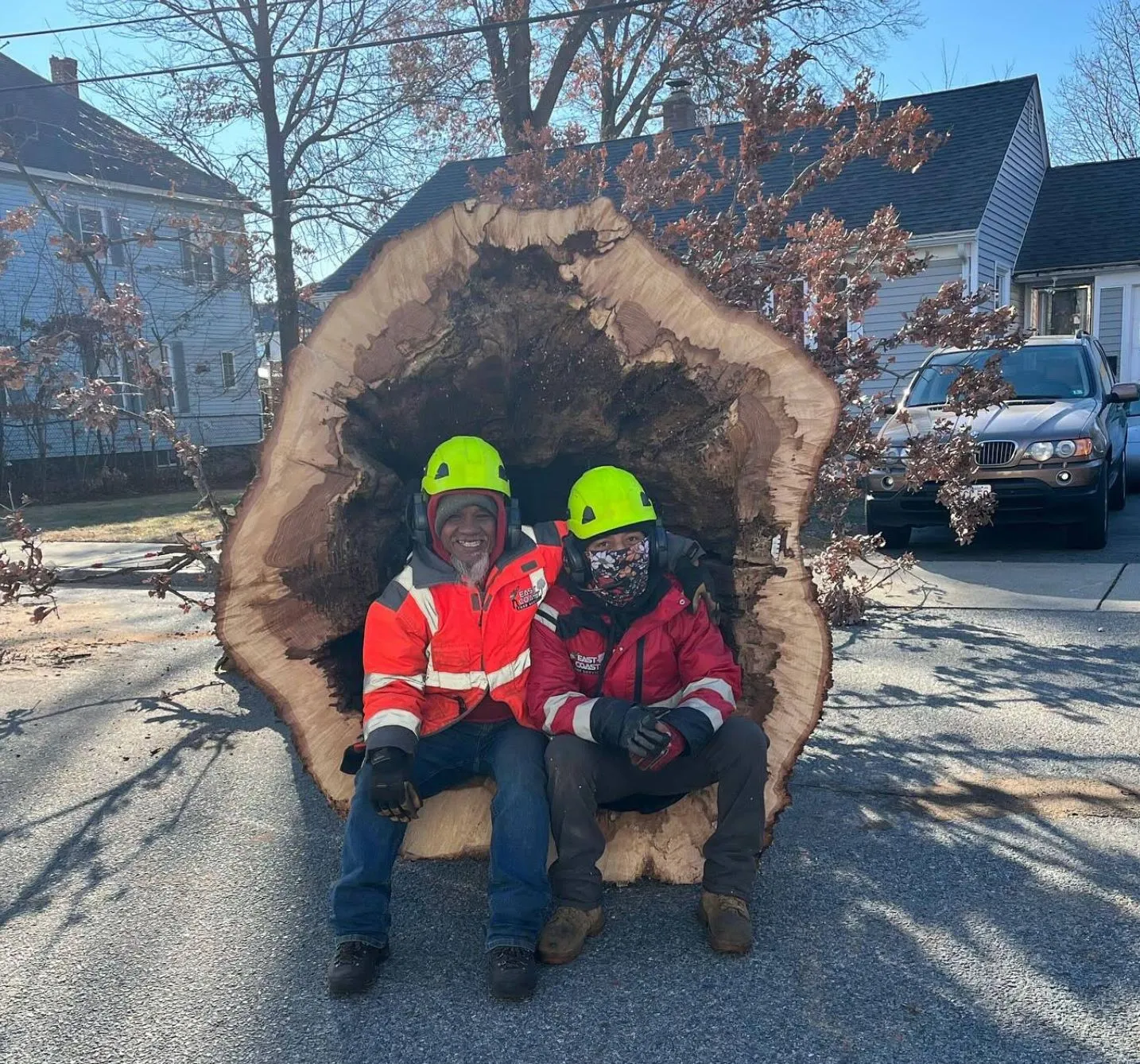
Hidden decay can complicate removal because wood that looked strong from the outside may not support the same loads once cutting begins. If compromised wood is uncovered, the removal method may need to change: smaller sections, different rigging points, reduced loading, or crane assistance may become the safer approach.
The free on-site estimate looks at the visible condition of the tree together with access, structures, targets, and equipment requirements. It is not advertised as a formal ISA Tree Risk Assessment Qualification report unless that specific service and credential are separately confirmed.
Tree Preservation Services: Cabling and Bracing
Cabling and bracing systems are recognized tools in arboriculture for selected trees with structural weaknesses. In the right situation, supplemental support may be considered when a tree can reasonably remain rather than being removed outright.
East Coast does not currently advertise tree cabling or bracing as a company service. We include the subject because homeowners comparing removal with preservation should know the option exists.
If a tree appears suitable for retention but the recommended solution involves cabling or bracing, the homeowner can consult a qualified provider that offers that service. East Coast can still address services it does provide, such as tree trimming, tree removal, stump grinding, or storm cleanup, when those are the appropriate part of the job.
Plant Health Care Programs for Wilmington Trees
Plant Health Care, commonly shortened to PHC, is the broader arboricultural approach of monitoring and managing tree health through diagnosis, pest and disease management, soil or root-zone care, and other treatments intended to retain trees where possible.
East Coast does not advertise a Plant Health Care program as a company service. The term appears here because PHC can be an alternative path when a tree’s problem is biological rather than structural.
Emerald Ash Borer is a good example of why the distinction matters. Massachusetts reports EAB as well established statewide. An ash showing crown decline may need a closer evaluation of infestation and structural condition. Some tree-health problems can be managed by specialists; a severely compromised ash may reach a point where removal becomes the practical option.
The goal is to avoid presenting every tree problem as a removal problem. If preservation requires a service East Coast does not provide, the homeowner should use an appropriately qualified provider for that treatment.
How We Protect Underground Utilities During Tree and Stump Work
Tree removal itself does not always disturb the soil deeply, but stump grinding, excavation, access work, and other ground disturbance can put underground services into the planning process.
Massachusetts requires Dig Safe notification before excavation. The work area is premarked, Dig Safe is contacted at 811, and participating utilities are notified to identify the underground facilities they own. In Massachusetts, the required waiting period is at least 72 business hours before excavation can begin.
That system does not locate every private line. Irrigation, private electric feeds to garages or landscape lighting, pool equipment lines, and other privately owned facilities may require separate locating. Municipal water or sewer infrastructure can also require separate checking because not every municipal utility participates in the Dig Safe system.
For a Wilmington tree-service job, this matters most when the requested scope involves stump grinding or other work that moves soil in an area where buried utilities may be present.
What Streets and Areas of Wilmington Do We Serve?
East Coast serves tree-service customers throughout Wilmington rather than limiting service to one neighborhood. That includes properties around Wilmington Center and the Town Common, Silver Lake, North Wilmington, and developed corridors such as Shawsheen Avenue, Lowell Street/Route 129, Main Street/Route 38, Middlesex Avenue/Route 62, Salem Street, Woburn Street, and nearby residential streets.
Mentioning those roads does not mean East Coast is claiming a completed project on each one. They are documented Wilmington corridors that help homeowners understand the company’s town-wide coverage.
Wilmington also connects directly to other East Coast service areas. Nearby pages include tree service in Tewksbury, Billerica tree service, tree service in Burlington, Woburn tree service, and tree service in Andover.
Multi-Tree Jobs and Special Project Pricing
East Coast does not advertise a fixed multi-tree discount. Special pricing may be available when several trees need to be removed as part of the same project.
That can make sense because equipment mobilization, crane setup, crew time, debris handling, and site access may overlap across multiple removals. It does not mean every second or third tree receives an automatic percentage discount.
The sales team looks at the full scope during the free on-site estimate and prices the project based on the actual trees and property conditions.
Financing for Wilmington Tree Service Projects
Yes, financing is available for qualifying projects. Specific rates, payment terms, approval requirements, and program availability depend on the financing option in place at the time of application.
If financing would help with a larger removal or multi-tree project, mention it while scheduling the estimate. East Coast does not publish a universal APR or fixed payment term because those details depend on the current financing program and customer approval.
Why Wilmington Homeowners Choose East Coast Tree Service
There is a practical difference between choosing a company because it says it does tree work and choosing one based on verifiable capabilities.
- Our team includes multiple ISA Certified Arborists.
- East Coast Tree Service is a TCIA member.
- The company is fully licensed and insured for the work it performs.
- General liability coverage and workers’ compensation insurance are in place.
- Tree removal is one of the company’s strongest areas of work.
- Crane-assisted removal is available for appropriate sites.
- 24/7 emergency service is available, with emergency calls receiving a response within up to 1 hour.
- Full cleanup is included.
- Free on-site estimates are available.
- Financing is available for qualifying projects.
East Coast does not claim that an ISA Certified Arborist is present on every job or that every estimate is completed by one. Estimates are handled by the company’s sales team and are based on seeing the actual tree, property, access, and requested scope.
Schedule a Free On-Site Tree Service Estimate in Wilmington
The estimate is where a broad request like “I have three trees I am worried about” becomes a usable scope of work. The salesperson can review tree condition, size, access, houses and garages, pools, fences, driveways, lawns, utility concerns, possible crane setup, rigging, debris, full cleanup, stump grinding, and any obvious public-tree or wetland issue that should be checked.
If removal uncovers unexpected internal decay, the crew may need to change how the tree is supported, rigged, or cut rather than continuing with a plan based on stronger wood. If a leaning tree appears retainable, removal is not automatically the answer; pruning or a preservation evaluation may be appropriate depending on the cause of the lean and the condition of the root system.
Call (781) 518-8014 for a free on-site tree service estimate in Wilmington, MA. For a fallen, split, uprooted, or immediately hazardous tree, East Coast is available 24/7.