

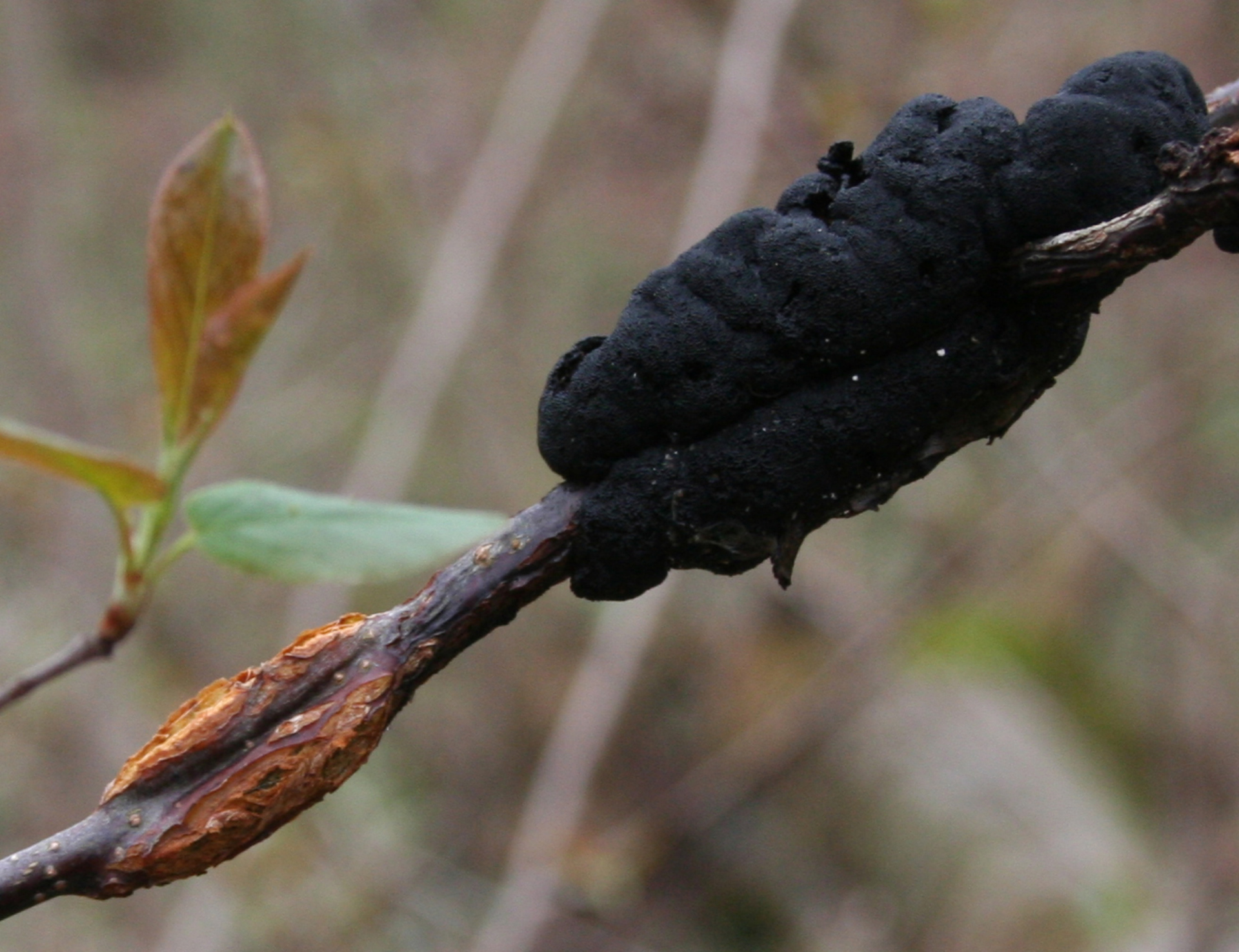
Black knot on cherry and plum trees can often be managed with pruning when the swollen, black growths are limited to smaller branches. If the disease affects the trunk, major scaffold limbs, or so much of the crown that removing infected wood would leave the tree badly damaged, removal may be the better option. At East Coast Tree Service, we look at where the knots are growing, how much healthy structure remains, and whether pruning can preserve the tree without creating new structural problems.
We provide tree trimming and removal throughout eastern Massachusetts, including Methuen, North Andover, Reading, Tewksbury, and Billerica. Black knot is especially worth checking on ornamental cherries, flowering plums, and other susceptible trees in the Prunus genus.
Finding a black swelling doesn’t automatically mean the tree is dying. What matters is how extensive the infection is, which branches are affected, and whether the remaining tree can continue growing with a suitable structure.
What Is Black Knot Disease?
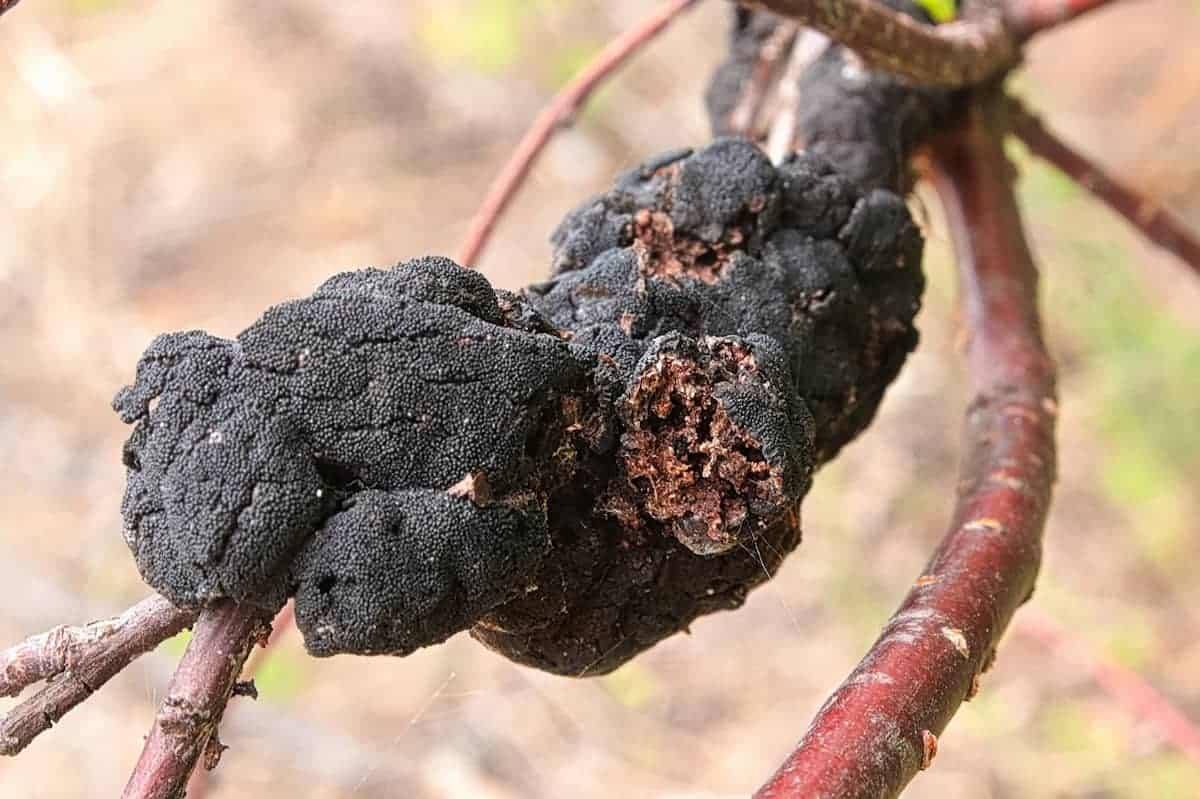
Black knot is a fungal disease caused by Apiosporina morbosa. It affects cherry, plum, chokecherry, and other trees and shrubs belonging to the Prunus genus.
The fungus grows within infected stems and branches. As the infection develops, the tree produces abnormal tissue that forms an elongated swelling called a gall, or knot.
Older knots become hard, rough, and black. Some extend several inches along a branch, while others grow much larger over several seasons.
The disease is common in the northeastern United States, including Massachusetts.
According to the UMass Amherst Extension guide to black knot, the fungus affects more than 25 species in the Prunus genus and can be particularly damaging to ornamental cherry, plum, and chokecherry trees in southern New England.
How Do You Recognize Black Knot on a Cherry or Plum Tree?
The most recognizable symptom is a dark, irregular swelling that grows around or along a twig, branch, or occasionally the trunk.
But the earliest symptoms don’t necessarily look black.
Young knots can be green or brown
During the first growing season after infection, a branch may develop a relatively small swelling.
The affected area can appear olive green or light brown. At this stage, homeowners may mistake it for an ordinary irregularity in the bark.
The fungus is already growing inside the branch even when the swelling is difficult to recognize.
Older knots become hard and black
As the infection matures, the swelling becomes darker, harder, and more irregular.
An established knot may extend lengthwise along a branch and eventually surround much of its circumference.
When the gall girdles a branch, it can interfere with the movement of water and nutrients to the growth beyond it.
Leaves beyond the affected area may wilt or die, although some trees continue producing normal-looking foliage around numerous knots.
Black growth on a trunk needs closer evaluation
A knot on a small twig is easier to manage than a large swelling involving the main trunk.
Trunk infections can develop cracks. Those openings may allow other wood-decay organisms to enter, creating a separate structural concern.
Not every dark growth on bark is black knot, however.
Other cankers, old wounds, and fungal growths can look similar. Before recommending major pruning or removal, we want to establish which tree is affected and what the growth represents.
Which Trees Can Get Black Knot?
Black knot primarily affects trees and shrubs in the Prunus genus.
Susceptible hosts include:
- Ornamental flowering cherry trees
- Fruit-bearing cherry trees
- European and American plums
- Ornamental purple-leaf plums
- Chokecherry and Canada red cherry
- Several wild cherry and wild plum species
Some other Prunus species can also be infected, but susceptibility differs by species and cultivar.
Black knot doesn’t spread to unrelated landscape trees such as oaks, maples, pines, or arborvitae.
That distinction matters when we’re discussing an infected plum growing among several other tree species.
The immediate disease concern is primarily for susceptible Prunus trees, although a severely damaged branch may still present an ordinary structural concern regardless of species.
Can a Cherry or Plum Tree With Black Knot Be Saved?
Yes. Many trees with black knot can be retained, particularly when the disease is identified early and infected branches can be removed without sacrificing most of the crown.
The number of visible knots matters, but their location matters more.
A few knots on outer twigs may be manageable through selective pruning. A large knot involving the main trunk presents a more complicated decision.
When pruning is usually the better choice
Pruning is worth considering when the infection is restricted to smaller branches and the tree retains a healthy trunk, sound major attachments, and enough living crown to continue growing.
We look at how each infected branch connects to the rest of the tree.
Removing a small branch near the outside of the canopy may have limited effect on the tree’s overall structure. Removing several major limbs from the same side can change its shape and load distribution substantially.
The purpose is to remove infected wood while preserving suitable branch structure.
Our professional tree trimming services cover selective pruning and removal of damaged branches when pruning is a reasonable approach.
When removal may make more sense
Removal becomes more likely when the disease is widespread through major branches or the trunk, the tree has extensive dieback, or adequate pruning would leave very little healthy crown.
We also consider the presence of cracks, decay, and other structural defects.
A heavily infected ornamental plum next to a driveway may present different concerns from a tolerant wild cherry in a wooded area.
Some Prunus trees can tolerate numerous galls for years without severe decline. Therefore, we don’t treat a particular knot count as an automatic reason for removal.
The decision depends on the tree’s actual health, structure, surroundings, and the amount of living wood that would need to be removed.
Black Knot: Prune or Remove?
This comparison shows how the location and severity of infection affect the likely recommendation.
| Tree Condition | What We Consider | Likely Approach |
|---|---|---|
| A few knots on small outer branches | Whether all affected wood can be removed with appropriate pruning cuts | Pruning and follow-up inspection |
| Multiple knots on secondary branches | How much living canopy must be removed and whether the main structure remains sound | Selective pruning if sufficient healthy crown remains |
| Knots near major branch attachments | Structural consequences of removing the affected limbs | Individual assessment; pruning may be limited |
| Large knots on the main trunk | Extent of infection, cracking, decay, and the remaining structural wood | Professional evaluation; removal may be appropriate |
| Widespread infection with major dieback | Remaining crown, trunk condition, landscape value, and proximity to occupied areas | Removal often deserves serious consideration |
A tree that is still producing green leaves is not necessarily free of structural defects. Likewise, visible black knot doesn’t mean the entire tree is beyond recovery.
How Far Below a Black Knot Should You Prune?
Pruning directly against the visible swelling can leave infected tissue inside the branch.
The fungus extends beyond the area that has developed an obvious gall.
For Massachusetts landscapes, UMass Amherst Extension recommends removing infected branches at least 6 to 12 inches away from the gall when possible.
Other university extensions publish somewhat different distances, including 4 to 8 inches. These recommendations share the same objective: cut sufficiently into apparently healthy wood to remove the infection.
We also need to consider where the branch joins the trunk or a larger limb.
A proper cut at a suitable branch attachment may be preferable to leaving a long stub simply to achieve a measured distance.
On a major branch, attempting to remove the required amount of wood can cause considerable structural loss. That’s one reason infected scaffold limbs need closer evaluation.
Should you cut the black swelling off the trunk?
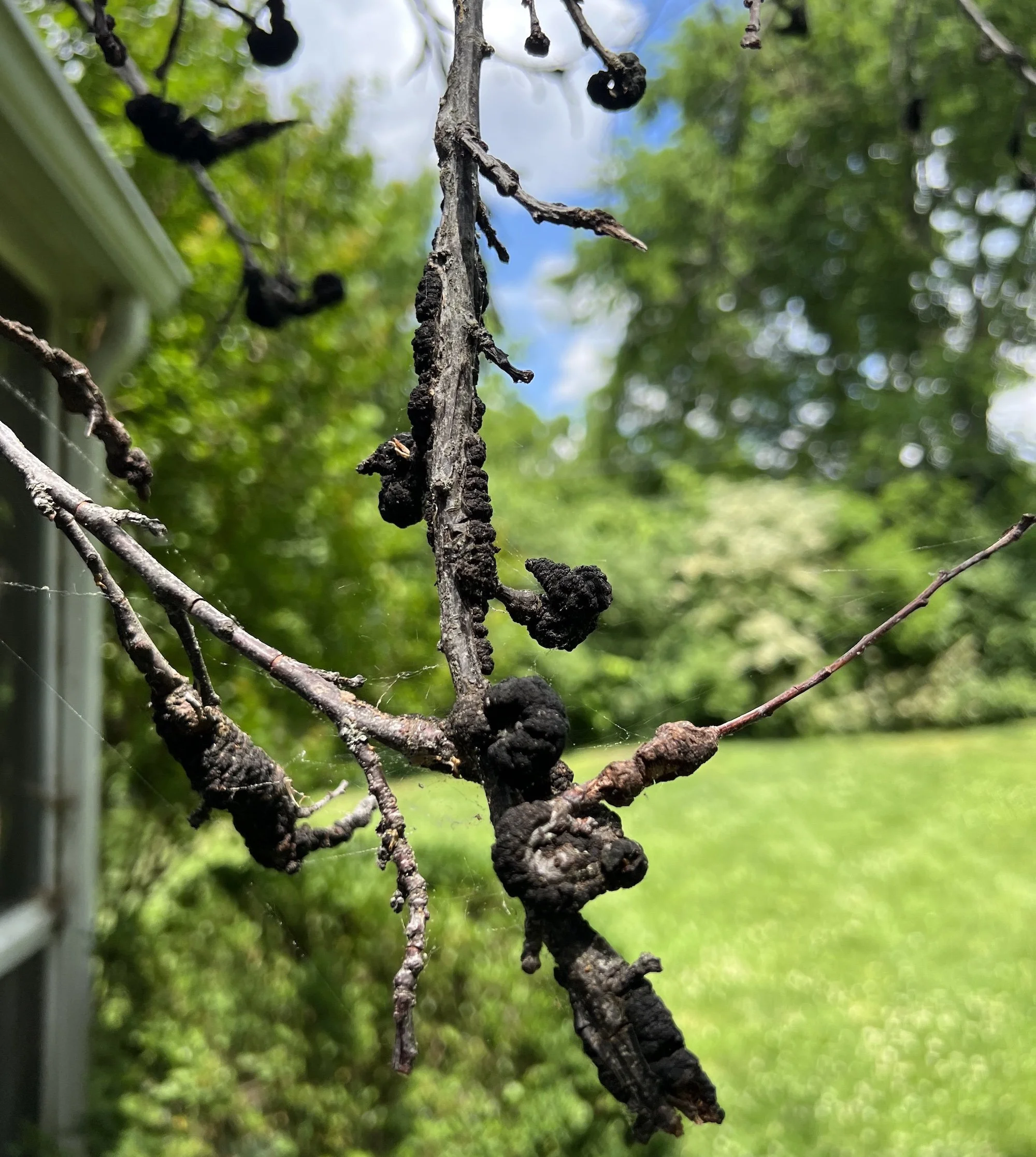
Cutting a large gall out of the trunk is not comparable to pruning a small branch.
Some extension publications discuss removing diseased tissue from trunk or major-limb infections under selected circumstances.
However, that work creates a wound in a structural part of the tree. It may not be appropriate when the knot is extensive, when decay is present, or when removing tissue would compromise the trunk.
We would want a proper assessment before attempting to carve out a large trunk infection.
Removing a visible swelling without understanding the underlying condition may leave the disease or create additional damage.
When Is the Best Time to Prune Black Knot in Massachusetts?
Late winter, while the tree is dormant and before spring bud break, is generally a good time to remove black knot infections.
Once the leaves have fallen, the knots become easier to see throughout the canopy.
Pruning during dormancy also allows infected material to be removed before the main spring period of spore release.
Dry weather is preferable when carrying out planned disease-management pruning.
For cherry and plum trees in eastern Massachusetts, the precise timing depends on weather conditions and the stage of bud development.
We wouldn’t recommend using one calendar date for every winter or every species.
Our article about seasonal tree work in New England explains how dormancy and property conditions influence the scheduling of planned work.
Should you wait until winter if a branch is already broken?
Not necessarily.
If a diseased branch has broken and is hanging above an occupied area, the structural concern may require attention sooner.
Disease-management timing should not be used as a reason to ignore a damaged limb that presents an immediate risk.
We would distinguish a planned pruning job from the removal of a hazardous branch.
How Does Black Knot Spread Between Trees?
The fungus survives inside infected knots through winter.
During wet periods in spring, mature knots release spores that can be carried by wind and rain to susceptible plant tissue.
Young shoots are particularly vulnerable during periods of active growth.
A newly infected branch may show few obvious symptoms during the first growing season. The more recognizable black swelling generally develops later.
That delay explains why finding and removing every visible knot in winter doesn’t guarantee that the tree will remain free of symptoms the following year.
Some infections may already be developing inside branches.
The University of Minnesota Extension’s black knot guide describes this infection cycle and why susceptible trees can develop new knots after earlier pruning.
Can Black Knot Spread From a Plum to a Maple or Oak?
No. Black knot is associated with susceptible Prunus hosts.
An infected plum does not transmit black knot to a neighboring sugar maple or red oak.
However, another cherry or plum nearby may be susceptible.
Wild cherries and plums growing at woodland edges can also carry the disease and provide a source of spores during spring.
We recommend looking at the surrounding susceptible trees when planning disease-management pruning.
What Should You Do With Infected Branches After Pruning?
Infected branches should be removed from the area rather than left beneath the tree.
Black knot can continue producing spores on infected material after it has been cut.
Leaving knot-covered branches in a brush pile near susceptible cherries and plums can undermine the benefits of pruning.
Disposal should follow local waste-handling rules and the arrangements made for the work.
We do not recommend assuming that open burning or burial is allowed at every Massachusetts property.
When scheduling pruning, ask how the infected material will be collected and removed.
Should pruning tools be disinfected?
Cleaning tools is a reasonable precaution during disease-management work, especially when moving between affected trees.
Some extension recommendations call for disinfecting tools between cuts or between trees using an appropriate disinfectant.
Tools should also be kept clean and maintained so that pruning cuts are made correctly.
Disinfecting equipment does not replace removing the infected branches or disposing of them properly.
Because black knot spreads primarily through spores, the condition of infected wood left in the landscape is a major part of management.
Should You Remove Wild Cherry and Plum Trees Nearby?
Nearby infected wild cherries and plums can contribute spores that reach ornamental or fruit-bearing trees.
That makes surrounding vegetation relevant to a long-term management plan.
Some agricultural extension recommendations discuss removing infected wild hosts within several hundred feet of susceptible orchards.
But a blanket instruction to remove every wild cherry or plum within 600 feet is not appropriate for every residential landscape.
Property boundaries, the condition of the surrounding trees, local regulations, and the environmental value of existing vegetation all matter.
Selective pruning of infected wild hosts may be reasonable when they are accessible and removal of the knots is practical.
If a wild tree is severely infected and no longer worth retaining, removal may be considered.
We would not recommend cutting healthy trees on neighboring property or removing an entire wooded area simply because black knot is present.
Can Fungicide Cure Black Knot?
Fungicides cannot remove the woody galls already growing on branches.
Some labeled products may help reduce new infections when applied at the proper stage of spring growth.
They work as part of a management program rather than replacing pruning and sanitation.
Effectiveness depends on the product, application timing, weather, host species, and disease pressure.
We recommend discussing chemical treatment with a qualified pesticide professional who can determine what is registered and appropriate for the particular tree in Massachusetts.
East Coast Tree Service’s confirmed services include pruning and removal. We do not advertise a specific black knot fungicide application program, so that service should not be assumed available without direct confirmation.
Can Black Knot Return After Infected Branches Are Removed?
Yes.
New symptoms may appear because infections were already developing before pruning, because small knots were missed, or because spores reached the tree from another source.
That doesn’t automatically mean the pruning was ineffective.
With this disease, follow-up observation matters.
We recommend checking susceptible trees during the dormant season when their branch structure is visible.
Look for new swellings on twigs, fresh dieback, or changes around older infected areas.
If knots continue appearing throughout the tree, the owner may need to reconsider whether repeated pruning is a reasonable way to preserve it.
How Do We Decide Whether Tree Removal Is Necessary?
Our first consideration is whether the infected tree has enough healthy structure to remain in the landscape.
We look at the distribution of knots, the condition of the trunk, major branch attachments, canopy dieback, and nearby structures.
A small ornamental cherry with a few infected outer branches may be manageable through pruning.
A mature plum with large knots throughout its primary limbs may require removing much of its crown to eliminate the infected wood.
Even if that pruning is technically possible, it may leave the tree with a poor structure and limited prospects for recovery.
When removal is the more reasonable option, our professional tree removal services provide an opportunity to discuss the work, access to the property, and handling of the resulting material.
We would also consider whether the remaining stump needs attention as part of the property’s future use.
Does Black Knot Make a Tree Dangerous?
Black knot is a disease concern, but the presence of a gall does not automatically mean a tree is about to fall.
Infected twigs and branches may die as the disease progresses. Cracking around extensive trunk infections can also permit secondary decay organisms to enter the wood.
Structural risk depends on the extent and location of that damage.
A knot on a small outer twig has different consequences from an infected, decayed main branch above a driveway.
For trees near houses and frequently used areas, we want to understand whether any branches have become structurally compromised.
If a large limb is broken, suspended, or showing significant cracking, keep people away from the area until it can be evaluated.
Should You Grind the Stump After Removing an Infected Tree?
Stump grinding may be worth considering if the area will be used for a new planting, lawn, or landscaping.
It is usually a separate part of the project from removing the aboveground tree.
Black knot primarily develops in the stems and branches of susceptible trees. Grinding the stump should not be presented as the main treatment for an infection that spreads by spores from aboveground galls.
The need for stump work depends on the owner’s plans for the site.
Our stump grinding service can be discussed when the tree is being removed and the area needs to be restored.
How Can You Help Prevent Black Knot on New Cherry and Plum Trees?
Prevention begins with selecting a suitable tree and paying attention to nearby sources of infection.
Some plum and cherry varieties are more susceptible to black knot than others.
We recommend checking the susceptibility of a proposed planting before buying it, particularly when black knot has already affected other Prunus trees on the property.
During the dormant season, look for abnormal swellings while the branches are bare.
Remove confirmed infections before spring when practical, and don’t leave knot-covered wood in the surrounding landscape.
Improving growing conditions and avoiding unnecessary wounds can support general tree health, but good watering or fertilization cannot eliminate established black knot infections.
Repeated disease problems should prompt a review of nearby susceptible hosts and the tree’s long-term suitability for the site.
Black Knot Tree Care in Methuen and North Andover, MA
East Coast Tree Service is a family-owned tree service company serving residential and commercial properties throughout eastern Massachusetts.
We provide tree trimming, removal, stump grinding, and other tree services in Methuen, North Andover, Reading, Tewksbury, Billerica, and surrounding communities.
For property owners dealing with infected ornamental cherries or plums, our tree services in Methuen, MA include pruning and removal work based on the tree’s condition.
We also serve homeowners needing tree care in North Andover, MA.
Before recommending extensive pruning, we consider whether the infected wood can be removed while retaining a suitable crown and structure.
If too much of the tree is compromised, we’ll discuss what removal would involve and whether stump work should be included.
Have Your Cherry or Plum Tree Evaluated Before Removing Major Branches
If you’ve noticed hard black swellings on your cherry or plum tree, start by noting whether they are limited to small branches or also affect the trunk and major limbs.
That distinction helps determine whether selective pruning may be reasonable.
At East Coast Tree Service, we can evaluate the tree and discuss the pruning or removal work appropriate for its condition.
Call us at (781) 518-8014 to request an estimate in Methuen, North Andover, Reading, Tewksbury, Billerica, or another community we serve.
Tell us which type of tree is affected, where the knots are growing, and whether you’ve noticed branch dieback or cracking. We can review the tree and help determine whether pruning is still a practical option or removal should be considered.