

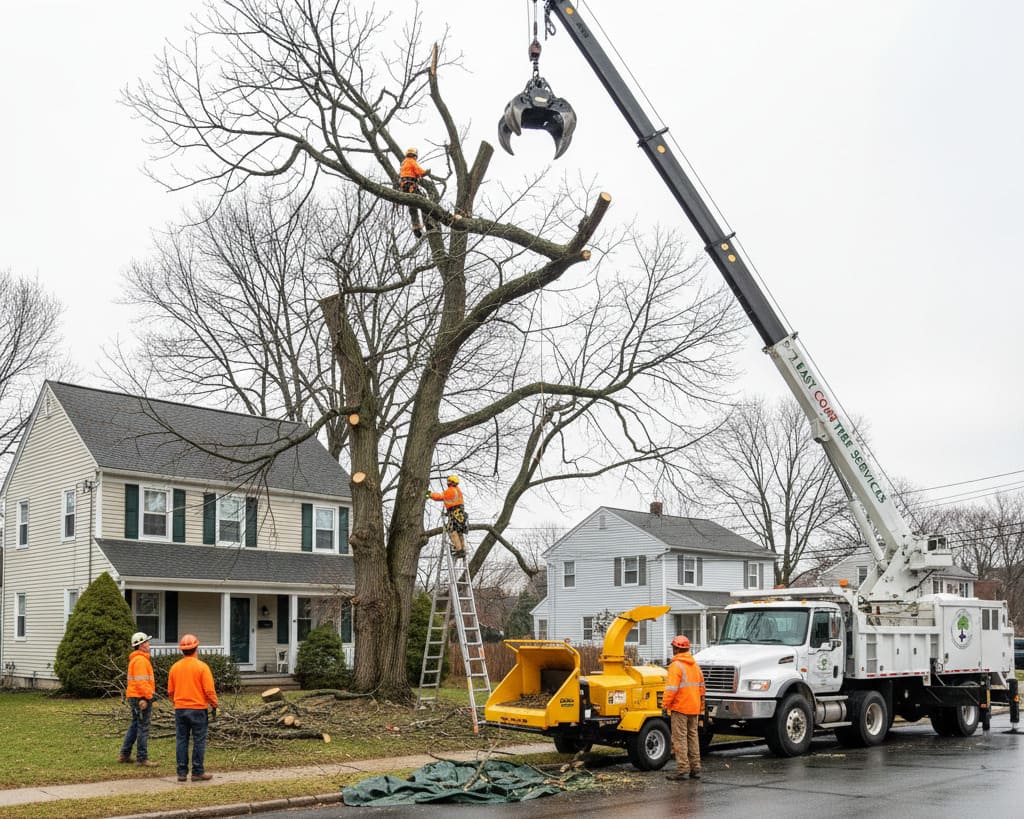
For a nonurgent tree removal in New England, late fall through winter is often one of the easiest times to schedule the work. After leaf drop, we can see the tree’s structure clearly, landscaping is less active, and firm or frozen ground may reduce the impact of equipment on a yard.
We would not wait for winter just because the calendar says it is the “best” season, though.
If a tree has developed a major crack, started shifting at the roots, suffered serious storm damage, or is threatening a house, the condition of the tree matters more than the month.
When we plan tree removal at East Coast Tree Service, that is the distinction we make first: can this tree safely wait, or does it need attention now?
Late Fall Through Winter Is a Good Planning Window, Not a Deadline
A lot of New England tree-removal advice gives homeowners a date range such as November through March.
That is a useful starting point.
It is not a rule that makes removal in April or July wrong.
Once deciduous trees lose their leaves, we have an unobstructed view of limbs, trunk unions, previous failures, and the space around the canopy. On a tree that needs to be dismantled in sections, that visibility can make planning easier.
Winter can also mean less activity around gardens, planting beds, and lawns.
The biggest variable, however, is the property itself.
A firm December yard may give us excellent equipment access. A February thaw can leave the same yard soft enough that we need ground protection or a different access plan.
That is why our tree service in North Reading, MA starts with an on-site look rather than a seasonal rule.
Frozen Ground Can Help Protect the Yard, When the Ground Is Actually Frozen
Heavy equipment needs support.
Bucket trucks, chippers, cranes, loaders, and trucks all place weight on the property. When soil is saturated or soft, repeated traffic can leave ruts and compact the surface.
Firm frozen ground can change that.
Residential tree work still has its own constraints.
We may have septic components, landscaping, retaining walls, narrow gates, slopes, underground utilities, or a driveway that controls how we approach the tree.
And winter ground does not stay frozen every day.
We look at conditions when the job is actually scheduled.
Leaf-Off Trees Are Easier to Read From the Ground
Removing leaves does not make a tree automatically safe to work on.
It does reveal more of the structure.
From the ground, we can often see branch unions, broken tops, hanging wood, old pruning wounds, trunk defects, and the path that sections would need to travel during removal more clearly after leaf drop.
That is one reason our tree removal service in North Reading, MA identifies late fall and winter as useful periods for planned removals.
We still inspect the tree before choosing a method.
A leafless dead tree with brittle wood can be more difficult to climb than a healthy summer tree covered in foliage.
Visibility helps us plan. It does not replace an assessment.
Dormancy Matters Less for Full Removal Than It Does for Pruning
Homeowners sometimes hear that trees should be removed in winter because the tree is dormant.
Dormancy is a bigger consideration when the tree is staying.
If we are pruning, we care about how the tree will respond to cuts, the species, disease pressure, and the timing of new growth.
If the entire tree is being removed, the main seasonal questions are different.
We care about canopy condition, access, ground firmness, surrounding landscaping, weather, and how safely the wood can be handled.
That is why we do not postpone a necessary removal simply because the tree is actively growing.
A Hazardous Tree Does Not Get Safer While We Wait for Winter
If the tree is sound enough to remain in place, planning ahead gives us options.
A tree that is already failing is different.
Warning signs that can change the timeline include a new lean, soil lifting around the root plate, a widening trunk crack, a major storm break, large suspended limbs, or a tree that has fallen partly onto another structure or tree.
Our 24/7 emergency tree service handles trees that have become unstable and cannot reasonably be left until an ordinary appointment.
We would not tell a homeowner with an actively shifting tree in June to leave it until January for the sake of easier winter access.
We first deal with the condition that exists now.
Storm Damage Changes the Calendar Fast
New England weather has a habit of turning planned tree work into emergency work.
Snow and ice can add load to branches. Strong wind can expose root problems or turn an existing structural defect into a break.
Sometimes the tree survives the storm but does not come out of it in the same condition.
A trunk can split.
A major leader can remain partly attached.
Roots may lift on one side of the tree.
In those cases, our storm damage tree cleanup in North Reading is based on what is still supporting the tree and what could move next.
Waiting for a more convenient season can be reasonable after minor damage.
It makes less sense when the remaining structure has changed enough that another failure could affect the house, driveway, parked vehicles, or people using the property.
Spring Tree Removal Is Possible
Spring gets a bad reputation in articles about removal because thawing soil can be wet and soft.
That is a real concern on some properties.
It is not a reason we refuse to remove trees in spring.
If access is firm, the tree needs to come down, and the site can support the equipment, the project can move forward.
When soil is soft, we may change the access route, use ground protection, change equipment, or wait for better conditions when the removal is not urgent.
Spring can also be a useful time to see whether a tree that looked questionable over winter is actually producing normal foliage.
A tree that appears bare in February is not necessarily dead.
Before taking down a tree for health reasons, we want the diagnosis to make sense.
Active Bird Nests Can Affect a Nonurgent Spring or Summer Removal

There is one seasonal issue homeowners sometimes overlook.
Birds may be actively nesting in trees during the warmer months.
That does not mean every tree removal has to stop from spring through summer.
It means we should not treat nesting wildlife as if it is invisible.
If a nonurgent removal contains an active protected nest, the work may need to be delayed or adjusted until the nest is no longer active.
A genuine safety emergency can require a different conversation with the appropriate wildlife authorities.
Summer Removal Has One Advantage: We Can See What Is Actually Leafing Out
A fully leafed canopy is heavier and visually denser than the same deciduous tree in winter.
It also tells us something.
Dead branches stand out when the surrounding canopy is green.
Sparse foliage, dieback, a section that failed to leaf out, or abnormal color can help show which parts of a tree are declining.
That can matter when a homeowner is unsure whether the whole tree needs to come down.
Sometimes the problem is confined to a few branches and tree trimming is enough.
Sometimes the condition is more widespread and removal becomes the better choice.
We want to make that decision from the tree in front of us rather than from a general rule about summer.
Fall Gives Us a Useful Window Before Winter Storms
Fall can work very well for removal, especially after leaf drop.
We get many of the same visibility advantages as winter without relying on frozen ground or working through snow.
There is also a planning advantage.
Fall gives us a chance to evaluate dead or weakened trees before winter storms increase the chance of branch or tree failure.
The ground still controls the job.
A dry late-autumn property can offer excellent access.
Weeks of rain can produce the opposite result.
We plan around what the site can handle.
Winter Does Not Guarantee a Lower Tree Removal Price
You may find articles saying winter is the cheapest time to remove a tree.
We would not promise that.
A tree-removal estimate is based much more directly on the job itself.
Height, diameter, condition, access, proximity to structures, rigging requirements, crane use, cleanup, wood handling, and stump work all affect the scope.
Our Billerica tree service uses that same site-specific approach. We inspect the tree and property before giving a quote.
Winter may provide more scheduling flexibility during quieter stretches.
Then a heavy snow or wind event can fill an emergency schedule overnight.
Season can influence availability. It does not determine the price by itself.
Planned Removal Is Different From Emergency Removal
There is a practical financial reason to have a known problem inspected before it becomes an emergency.
Scheduled removal gives us time to evaluate access, determine which equipment fits the site, plan the drop or rigging area, coordinate around structures, and put the work on the calendar.
Emergency work begins after the conditions have changed.
A tree may already be resting on a house.
A driveway can be blocked.
A cracked trunk may need to come down before another section releases.
At that point, speed and immediate hazard management become part of the scope.
If you already know a dead or compromised tree has to be removed and it can still be scheduled normally, planning before storm season gives us more options.
Stump Grinding May Follow a Different Schedule
Taking the tree down and grinding the stump are related services, but they do not always have identical site requirements.
The tree may need to come down immediately while the stump can safely remain for a later visit.
Deep snow, frozen soil, underground utilities, rocks, steep terrain, or access limitations can affect stump work.
Our stump grinding service in North Reading can be included when conditions and access make sense.
We would rather separate the work than delay an unsafe tree solely because the stump is inconvenient to grind that week.
Do Species Change the Best Time for Removal?
Species matter because wood characteristics, branching, brittleness, decay patterns, and size affect how we take a tree apart.
We are more cautious about turning species-specific pruning advice into removal deadlines.
For example, advice about pest or disease timing can vary by state and by the actual presence of a disease in that region.
We still pay attention to pests, disease, and movement of potentially infected material.
But we would not tell every Massachusetts homeowner that an otherwise safe tree has to be removed by one calendar date.
The condition of that particular tree and current local guidance deserve more weight.
What About a Dead Tree?
If a tree is confirmed dead, waiting rarely improves its condition.
The question is how much exposure it creates where it stands.
A dead tree deep in a wooded portion of a property with no nearby targets is a different situation from a dead tree over a roof or driveway.
Dead wood can become less predictable as deterioration progresses.
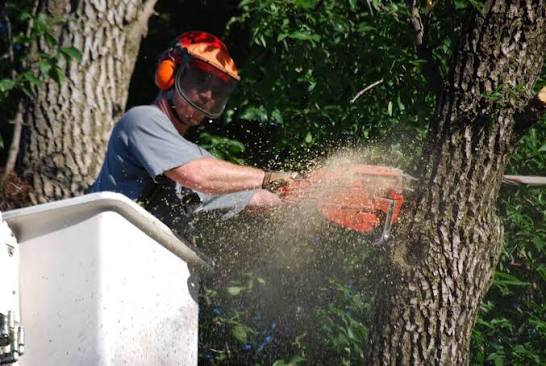
That is why we evaluate what is underneath the tree, how it can be accessed, and whether the remaining structure is suitable for climbing or requires a bucket truck, crane, or different removal setup.
The “best time” for that tree may have much more to do with its location than the season.
Can a Tree Be Removed in Snow?
Yes, depending on the weather and site.
Ordinary winter conditions do not automatically stop tree work.
What matters is whether crews and equipment can work safely and whether we have a stable setup.
Heavy snowfall, ice, poor visibility, high wind, or inaccessible driveways can change a scheduled job.
If weather makes the planned method unsafe, we reschedule.
An emergency tree may require a different response depending on what has failed and what areas of the property can be safely reached.
Does Winter Removal Protect Nearby Plants?
It can reduce disturbance to some landscaped areas.
Perennials may be dormant, vegetable gardens may be empty, and deciduous shrubs may have less foliage around the work zone.
That gives crews more physical space on some properties.
It does not eliminate the need for protection.
We still plan around ornamental plantings, lawns, fences, septic areas, hardscaping, and whatever needs to remain when the tree is gone.
On soft ground, mats and equipment placement can matter more than the season itself.
The Best Season Depends on Why the Tree Is Coming Down
A tree being removed for a future patio gives us scheduling flexibility.
A dead pine leaning toward a bedroom does not.
That difference matters more than trying to rank every month from best to worst.
For planned tree removal in Massachusetts, late fall through winter often gives us favorable working conditions. Leafless structure is easier to see, landscaping is quieter, and firm ground may protect the property from equipment traffic.
Spring, summer, and early fall are still workable when site conditions allow.
If the tree is unstable, storm-damaged, or actively threatening something below it, we evaluate the hazard rather than waiting for a preferred season.
How We Decide When to Schedule Your Tree
When we inspect a tree, we look at why removal is being considered and whether delaying the work changes the risk.
We also look at access, soil conditions, utility conflicts, structures below the canopy, equipment placement, cleanup, and the remaining landscape.
From there, we can tell you whether waiting for a better seasonal window has a practical benefit.
If you are planning a nonurgent removal in Reading, North Reading, Billerica, Tewksbury, or another community we serve in eastern Massachusetts, late fall and winter are good times to get the property evaluated and the work on the calendar.
If the tree is cracked, shifting, storm-damaged, or already falling, do not pick a month from an article and wait for it.
Call East Coast Tree Service at (781) 518-8014. We can inspect the tree, look at access and surrounding property, and determine whether the job can be scheduled normally or needs faster attention.