

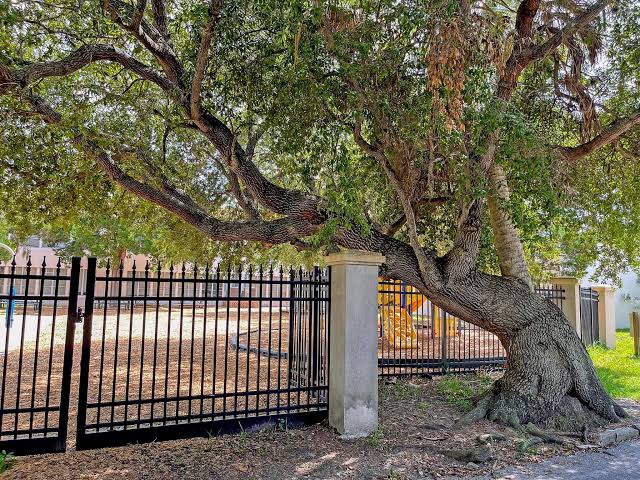
In Massachusetts, responsibility starts with the trunk. If the trunk stands entirely on one property, that owner generally owns the tree even when branches and roots cross the line. If the trunk itself straddles the property boundary, both property owners have rights in the tree, and one neighbor should not remove or seriously alter it on their own.
That sounds simple until the fence is not on the legal boundary, the trunk widens across both yards, roots are lifting a driveway or a storm puts half the crown on the neighbor’s garage.
When we are called for tree work near a property line, we separate the tree problem from the ownership problem first.
We can inspect the tree and plan the work.
We cannot decide where your legal boundary lies or give one homeowner permission to remove a tree that belongs partly or entirely to someone else.
Tree Ownership in Massachusetts Follows the Trunk
Massachusetts courts look to the location of the trunk when determining tree ownership.
Branches do not decide it.
Roots do not decide it.
The direction the tree leans does not decide it.
If the trunk grows entirely from your neighbor’s land, the tree remains your neighbor’s tree even if half the canopy extends over your yard.
That distinction is the starting point for most questions about tree property line law in Massachusetts.
A Fence Is Not Automatically the Property Line

This is where tree jobs can go wrong before a saw is started.
An old fence may have been built inside one owner’s lot.
A hedge may follow a convenient line rather than the surveyed boundary.
A stone wall may be close to the line without establishing exactly where a disputed trunk sits.
Parcel-map apps are useful for orientation but are not substitutes for a survey when inches matter.
If removing the tree depends on whether the trunk is six inches onto one lot or actually crosses the boundary, settle that question before authorizing the work.
A licensed land surveyor is the right professional when the legal property line itself is uncertain.
What If the Trunk Actually Crosses the Property Line?
Massachusetts has addressed this situation directly.
When a healthy tree straddles the boundary, each adjoining owner has an ownership interest in the portion of the tree located on that owner’s land.
Neither neighbor should treat their half of the trunk as though it were an independent tree.
The practical rule is straightforward: one owner cannot take action on their side that injures the boundary tree as a whole.
That means complete boundary tree removal in Massachusetts should start with agreement between both property owners.
Get the Agreement in Writing Before Removing a Boundary Tree
A conversation over the fence is better than no conversation.
For a removal, written approval is better.
The agreement should identify the tree and make clear that both owners consent to the work.
If access through one property is needed, address that too.
The point is not to turn a routine tree job into a legal contract negotiation.
It is to avoid reaching removal day with one homeowner saying yes and the other saying they never approved it.
At East Coast Tree Service, the customer is responsible for confirming ownership and obtaining the permissions required for the work.
We do not survey the boundary for the customer.
Shared Tree Responsibility Does Not Automatically Mean a 50/50 Bill
Ownership rights and payment arrangements are not the same question.
Two neighbors may agree to split pruning or removal equally.
One may offer to pay because that owner wants the work.
They may reach another arrangement based on access, cleanup or the reason the tree needs attention.
Massachusetts tree law does not give us a simple contractor formula saying every boundary-tree invoice must be divided in half.
Agree on cost responsibility before scheduling the job.
What If the Trunk Is Entirely on the Neighbor’s Property?
Now we are in a different legal situation.
Massachusetts follows what is commonly called the Massachusetts rule for healthy trees.
If a healthy neighbor’s tree sends branches over your yard or roots into your property, the tree owner generally is not required to cut them back simply because they cross the boundary.
You have a right of self-help on your own property.
That means you may cut back the encroaching portion to the property line.
Can I Cut Branches Over My Property Line in MA?
Generally, yes.
If the trunk belongs entirely to the neighbor and a healthy branch extends into your airspace, Massachusetts law allows you to trim the portion over your property.
The cut stops at the property line.
That does not give you permission to walk into the neighbor’s yard to make a better cut from their side.
It also does not make the rest of the tree yours.
For larger limbs, there is another question before the chainsaw comes out: what happens to the remaining tree after that branch is removed?
Legal Permission and Good Pruning Are Not the Same Thing
The legal property line is not always the right location for a pruning cut from an arboricultural standpoint.
Imagine a large limb that crosses the boundary several feet from its attachment to the trunk.
Cutting it exactly at the property line may leave a long stub.
That can be poor pruning even though the property line defines how far your unilateral right reaches.
The better solution may be to speak with the tree owner and get permission to make the appropriate cut at the branch attachment.
That protects the tree and usually gives both properties a better result.
Do Not Enter the Neighbor’s Property Without Permission
Massachusetts recognizes the right to trim encroaching growth from your own property.
It does not give you general permission to step over the line and work on the neighbor’s land.
For routine tree work, get permission before anyone enters the neighboring property.
That includes a climber, bucket, crane setup, ground crew or equipment access.
There can be narrow emergency circumstances where property law treats entry differently, but that is not a reason to assume access during an ordinary pruning job.
Neighbor Tree Roots in Massachusetts Follow the Same Basic Self-Help Rule
Roots can be more complicated than branches because you cannot see the entire structure.
Massachusetts case law has long recognized the adjoining owner’s right to cut roots that intrude onto their property.
That does not mean cutting them is always a good idea.
A root may contribute to both tree health and anchorage.
Removing a large root close to the trunk can destabilize a mature tree or create a large wound.
If the root is lifting pavement, approaching a foundation or interfering with construction, have the root and tree evaluated before trenching along the property line.
Do Not Turn a Root Dispute Into a Tree-Failure Problem
Suppose a mature oak belongs to your neighbor but a major root crosses under your planned driveway.
Legally, the root is on your property once it crosses the boundary.
Physically, it is still part of a large tree.
Cutting several structural roots to make room for excavation can change how that tree responds to wind.
If the tree can reach either house, that matters.
Before a contractor cuts major roots, we want the tree, distance from the trunk, root size and surrounding targets considered together.
A Healthy Neighbor’s Tree Is Usually Different From a Dangerous Tree
The Massachusetts rule protects owners from claims based solely on the natural growth of a healthy tree.
That includes ordinary overhanging branches, roots and natural debris.
A seriously unhealthy or defective tree is a different situation.
Massachusetts case law recognizes that a dangerous tree can create liability when its condition makes failure foreseeable and the person responsible for the property knew or reasonably should have known about that condition.
This is why the question changes from “Whose side is the trunk on?” to “What was wrong with the tree before it failed?”
A Dead Tree Is Not Automatically a Negligence Case
Dead, decayed and badly damaged trees deserve attention.
But legal liability still depends on the facts.
Was the defect visible?
Had a large limb already failed?
Had someone inspected the tree?
Was the owner told about the problem?
How long had the condition existed?
Was the eventual failure related to that defect?
We can document observable tree condition.
We do not decide negligence.
Written Notice Helps, but It Is Not a Magic Switch
If you are concerned that a neighbor’s tree could hit your house, putting the concern in writing can create a useful record.
Include what you are seeing.
Identify the tree.
Take dated photographs from your own property.
If a qualified tree professional has evaluated the condition, keep that documentation.
A written notice can help establish that the concern was communicated.
It does not automatically make the neighbor liable for every future branch failure, and Massachusetts law does not require one particular form of certified letter before a dangerous-tree case can exist.
What Should You Document on a Dangerous Neighbor Tree?
Photograph the whole tree first.
Then photograph the condition that concerns you from a safe location.
That might include:
- a recently moving root plate;
- a large dead crown;
- a major open crack or split;
- a failed structural limb;
- advanced visible decay;
- a tree that changed lean after a storm.
Also photograph what the tree could reach.
A defective tree in the back of a large wooded parcel presents a different consequence than the same defect over a bedroom or driveway.
Do Not Diagnose a Hazard From Age or Lean Alone
A large old tree is not automatically dangerous.
Neither is every leaning tree.
Some trees have grown at an angle for decades.
We pay more attention to a lean that recently changed, especially when soil is lifting or cracking around the roots.
The same applies to cavities.
A hollow area deserves evaluation, but it does not create an automatic removal order.
Condition, remaining structure and location matter.
Can You Force a Neighbor to Remove a Healthy Tree?
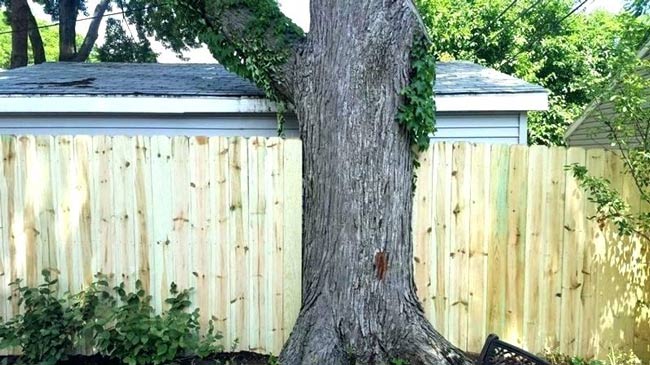
Generally, not simply because it shades your yard, drops leaves, extends roots or blocks a view.
Massachusetts courts have repeatedly protected the right of a landowner to maintain a healthy tree on their own property.
The neighbor’s ordinary remedy for branches and roots that cross the property line is self-help from their own side.
If the tree is unhealthy or a dispute involves an unusual hazard, property damage or threatened failure, that can move beyond the ordinary healthy-tree rule.
At that point, legal advice may be appropriate.
Leaves, Sap and Small Natural Debris Are Part of the Healthy-Tree Rule
Massachusetts courts have also dealt with ordinary debris from healthy trees.
Leaves, small branches and sap naturally cross property lines.
The fact that they create cleanup work does not by itself make the tree owner negligent.
That is different from a known defective limb hanging over a neighbor’s house.
Tree condition still matters.
What Should Happen to Branches After You Trim Them?
If you arrange pruning from your side of the line, plan for the resulting brush and wood to be handled on your side unless the neighbor has agreed otherwise.
Do not toss cut material across the fence because you believe it “belongs” to the tree owner.
The better approach is simple: decide on cleanup before work starts.
On a professional job, the scope should make clear whether brush is chipped, hauled away or left for the customer.
Unauthorized Tree Cutting Can Become Expensive
Massachusetts General Laws Chapter 242, Section 7 addresses willful cutting or destruction of trees on another person’s land.
Willful violations can expose the cutter to three times the assessed damages.
The statute also recognizes a different situation when someone had good reason to believe the land was theirs or believed they were lawfully authorized. In that circumstance, damages may be single rather than triple.
That is still not a good outcome.
If the line is disputed, a survey costs much less than cutting the wrong mature tree.
Do Not Assume a Tree Company’s Presence Solves the Ownership Question
A contractor arrives because a customer requested tree work.
That does not transfer legal ownership of the tree.
It also does not settle a disagreement between neighbors.
East Coast’s current terms require the customer to obtain the permissions, easements, approvals and authorizations needed for the requested work.
If the neighbor contests ownership while we are trying to remove a boundary tree, the legal issue needs to be resolved before the work continues.
What If a Healthy Tree Falls Across the Property Line?
A healthy tree can fail in severe wind, saturated soil, snow or ice.
The fact that the trunk began on the neighbor’s property does not automatically make that neighbor responsible for damage on your side.
For property damage, the homeowner whose property was hit will commonly begin by contacting their own insurer.
The insurer can then evaluate the cause, coverage and whether there is a basis to pursue another party.
Our job is to handle the tree and document the physical work.
We do not decide which insurance company ultimately pays.
What If the Tree Was Obviously Dangerous Before It Fell?
Then the liability question changes.
A tree that was visibly dead, badly decayed, previously shedding major limbs or already identified as dangerous may create a negligence issue if the responsible owner knew or reasonably should have known about the problem and failed to respond.
That does not mean every dead limb makes the owner liable.
The defect has to connect to the loss.
Insurance companies and attorneys deal with that determination.
We can provide photos, estimates, invoices and observations related to the tree work.
Fallen Tree Responsibility Is Not the Same as Tree Ownership
A tree can belong entirely to one person while the financial consequences of a storm loss are handled under another person’s insurance policy.
That surprises homeowners.
Tree ownership answers whose tree it was before failure.
Insurance answers how a covered loss is handled.
Negligence asks whether someone’s conduct or failure to act created legal responsibility.
Do not combine all three questions into “the trunk was in their yard, so they owe me.”
Our guide to homeowners insurance and tree removal in Massachusetts goes deeper into the insurance side of that problem.
A Boundary Tree That Falls Can Be More Complicated
If the trunk actually straddled the property line before failure, the starting ownership situation is different from a tree that stood completely on one lot.
Do not assume that automatically means every cleanup or repair bill is split 50/50.
The tree’s condition, the agreement between the owners, insurance coverage and the circumstances of the failure can all matter.
For a disputed loss, let the insurers or attorneys determine financial responsibility while the tree contractor focuses on making the site safe.
Public Shade Trees Have Their Own Rules
A tree near the road may look like part of your front yard and still fall under Massachusetts public shade tree law.
Chapter 87 treats trees within a public way or on its boundaries as public shade trees.
Those trees generally cannot be cut, trimmed or removed by a private person without the required Tree Warden authorization.
If the tree is close to the street and you are unsure whether it lies within the public way, check before scheduling work.
Property-line permission from the neighbor does not override public shade tree requirements.
Wilmington Homeowners Should Check Roadside Trees Before Cutting
Wilmington has an active Tree Division and Tree Warden process for public shade trees.
Our tree service in Wilmington, MA page explains the local distinction between private-yard trees and trees that may fall under the Town’s public shade tree process.
If a boundary tree is also near a public way, there may be more than two parties whose approval matters.
That is another reason to establish status before removal.
Wetlands Can Create a Separate Permission Issue
Ownership is not the only regulation that can affect tree work.
A tree can be entirely yours and still stand in or near a regulated wetland or riverfront area.
Tree removal or vegetation disturbance in those locations may require municipal Conservation Commission review.
This comes up in eastern Massachusetts communities with brooks, ponds, wetlands and wooded residential lots.
If the tree is near a wet area, confirm environmental jurisdiction separately from the property-line question.
When Both Neighbors Agree on Pruning
These are usually the easiest jobs.
One neighbor owns the tree.
The other wants clearance.
Both agree that proper pruning is preferable to cutting everything exactly at the boundary.
With permission, we can evaluate the whole branch structure and determine where appropriate cuts can be made.
Our tree trimming service is a better fit when the tree can stay and the problem is limited to dead, damaged or poorly positioned branches.
Getting both owners on the same page before the crew arrives gives us more options.
When Both Neighbors Agree the Boundary Tree Should Come Down
Then we can plan the actual removal.
Access may come from one side.
The best equipment setup may be on the other.
Branches may extend over two roofs, fences or driveways.
Before the job, identify who authorized the work, where equipment may travel and who is paying for any optional stump grinding or separate cleanup.
The legal ownership issue should already be settled by that point.
Tree Removal Near Property Lines in Dracut
Residential lots in Dracut often put mature trees close to homes, driveways, fences and neighboring yards.
That can make a routine removal into a controlled sectional job where the useful drop zone ends at the property line.
Our tree removal service in Dracut, MA covers dead, damaged and structurally compromised trees as well as removals where nearby structures make access and control more involved.
When the tree is close to a boundary, we still need the customer to confirm they have authority for the requested work.
Property-Line Trees in Wilmington
Wilmington combines mature residential trees with public roads, wetlands, older neighborhoods and tight property layouts.
That creates situations where one tree can raise several questions at once.
Is it private or a public shade tree?
Is the trunk entirely on one parcel?
Are branches crossing a neighbor’s yard?
Is the tree near a wetland?
Those questions should be answered before a removal method is chosen.
Our Wilmington tree service page covers those local considerations in more detail.
Power Lines Change the Order of Operations
If a property-line tree is touching or tangled with electrical conductors, stay away.
Do not use the property-line rule as a reason to start trimming around wires.
The tree, ground, fence and nearby equipment can all become part of the electrical hazard.
Contact the appropriate utility or emergency services first.
Once the electrical issue is controlled, the remaining tree work can be evaluated.
A Storm-Damaged Boundary Tree May Need Immediate Stabilization
Storm damage can leave a tree split between two properties, partly supported by another tree or resting on a structure.
That is not the time for neighbors to stand beneath it arguing over whose half of the branch belongs to whom.
Keep people out of the failure zone.
Document the scene from a safe distance if possible.
Then address the immediate hazard.
East Coast Tree Service provides 24/7 emergency tree service for fallen, cracked and unstable trees throughout our service area.
The ownership and insurance questions can still be documented without exposing anyone to hanging wood.
Before You Schedule Property-Line Tree Work, Answer These Questions
Before we mobilize a crew, make sure you know:
- Where is the legal property line? If it is disputed, get it resolved before removal.
- Where does the trunk sit? Entirely on one lot or actually across the boundary?
- What work is being requested? Pruning, root cutting, complete removal or emergency stabilization?
- Has the other owner given permission when permission is needed?
- Will our crew or equipment need to enter the neighboring property?
- Is the tree near a public way, wetland or utility line?
- If it is hazardous, what documentation already exists?
That list prevents most of the confusion we see around property-line jobs.
We Can Assess the Tree, but We Do Not Settle the Boundary
At East Coast Tree Service, we can look at the tree’s condition, branches, roots, lean, cracks, decay, storm damage and surrounding property.
We can explain whether the physical work looks like pruning, removal or an emergency response.
We can plan how to control the tree around homes, fences and neighboring property.
What we cannot do is declare where a disputed legal boundary sits or decide which neighbor is legally liable for damages.
Those questions belong with a surveyor, insurer or attorney depending on the dispute.
Get the Ownership Question Right Before the First Cut
Property-line tree disputes become expensive when somebody starts cutting before they know what they are allowed to cut.
If the trunk is entirely on your neighbor’s lot, Massachusetts gives you substantial self-help rights over branches and roots that enter your property.
If the trunk itself crosses the line, the tree deserves a different approach because both property owners have rights in it.
And if a dangerous tree has already failed, ownership, negligence and insurance may become three separate questions.
East Coast Tree Service is a family-owned and operated tree company serving Reading, Tewksbury, Billerica and communities throughout eastern Massachusetts. We are fully insured and provide tree removal, trimming, stump grinding, storm cleanup and 24/7 emergency tree service.
If you have a tree near a property line and the ownership and permissions are already clear, call us at (781) 518-8014 to schedule an on-site estimate.