

If you’re asking, “Why is my tree dying?”, start with what changed around it before you start naming diseases. Trees in Massachusetts can decline after drought, excess water, root damage, construction, compacted soil, insects, disease or several of those problems acting together.
The symptom you notice first may not be where the problem started. A thin crown can trace back to roots damaged several years ago. Bark beetles may show up on a tree that was already stressed. Mushrooms can tell us a fungus is present without telling us exactly how much sound wood remains.
When we look at a declining tree, we want the symptoms, the species and the history of the property to agree before we decide what is happening.
Start With the Question Homeowners Usually Skip: What Changed?
Before testing bark or inspecting leaves, think backward.
Did you install a driveway, patio, pool or walkway?
Was a utility trench dug near the tree?
Did heavy equipment cross the yard?
Was soil added around the trunk?
Did somebody build a retaining wall nearby?
Has drainage changed?
Did another large tree come down and suddenly expose this one to more wind and sun?
Did the problem appear after an unusually dry or wet season?
Trees often respond slowly to root and soil damage. A mature tree may still produce a respectable canopy for several years while its root system becomes less capable of supporting new growth.
By the time the top starts thinning, the work that triggered the decline may feel unrelated.
If Several Trees Are Declining, Look for What They Share
Homeowners sometimes call us with a different question: why are my trees dying when several trees on the same property start looking bad?
That changes the investigation.
If different species begin declining after the same construction project, grade change or drainage problem, we look closely at the site.
If only ash trees are declining while neighboring oaks and maples look normal, species-specific pests move higher on the list.
If trees of several species turn brown after weeks of drought, weather and soil moisture deserve attention.
When multiple trees are involved, do not assume each one developed an unrelated disease at the same time.
Step Back Before You Walk Up to the Trunk
Our first look is usually from far enough away to see the entire crown.
We compare the upper canopy with the lower canopy and one side with the other. We look for sections that failed to leaf out, clusters of dead branches, unusually small leaves and areas that have become more open than they were in previous years.
A photograph from last summer can help more than people expect.
If you have an old real-estate listing, family photo or yard picture showing the same tree, compare crown density and major branches. Gradual decline is easier to see when you have an earlier reference.
Crown Dieback Tells Us Where to Look Next
A dead top can occur with root problems, vascular disease, drought stress, construction damage or injury lower on the stem.
One dead leader after a storm tells a different story from progressive upper-crown dieback over four growing seasons.
The same applies to one-sided decline.
If branches are dying primarily on one side, we inspect the trunk and roots on that side, but we do not assume there will be a perfect one-to-one connection.
The crown gives us a pattern.
It does not give us the diagnosis by itself.
Interior Leaf Loss Can Be Normal
Not every bare branch in the middle of a canopy means the tree is failing.
Leaves and small branches growing deep inside a dense crown receive less sunlight. Trees can shed some of that less productive growth while the exterior canopy remains healthy.
Evergreens also shed older interior needles.
What gets our attention is a change from the tree’s normal pattern: expanding dead areas, outer-crown dieback, unusually small foliage, entire branches failing to leaf out or thinning that becomes more noticeable each year.
The Scratch Test Can Tell You Whether One Twig Is Alive
A scratch test is useful when a deciduous tree has not leafed out and you want to know whether a reachable twig still contains living tissue.
Choose a small twig you can reach from the ground.
Use your fingernail to gently remove a tiny patch of outer bark.
Green or moist-looking tissue below the bark indicates that tissue is alive.
Dry brown tissue suggests that section has died.
Then stop and interpret what you actually learned.
You tested that twig.
You did not test the whole tree.
Do Not Climb to Find a Better Branch to Scratch
The material online sometimes tells homeowners to test the “mid-canopy.”
That is fine for somebody using professional access equipment.
It is not a reason to put a ladder under a questionable tree.
If the only branches you can reach are dead and you cannot safely inspect higher growth, that is where the home test ends.
We would rather evaluate the crown than have somebody climbing through potentially brittle wood to prove that one more twig is green.
Dead, Dormant and Declining Are Different Conditions
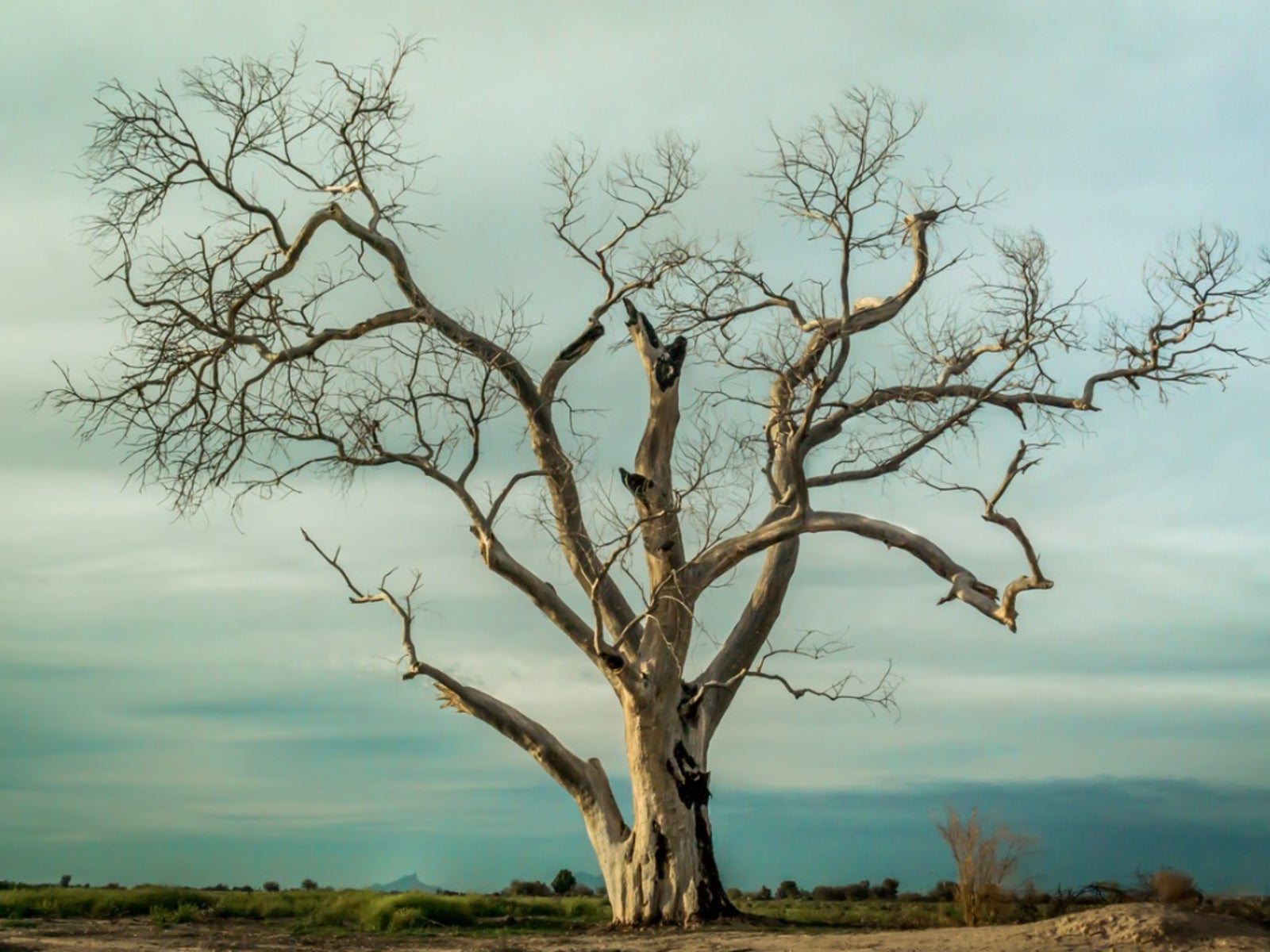
A leafless tree in January is not dying because it has no leaves.
Species also break dormancy at different times in spring.
Look at the buds and small twigs.
Firm buds and flexible living twigs can tell you the branch is still viable even when nearby species have already leafed out.
A declining tree may show a mixture: some living buds, some dead tips and progressively weaker growth.
That mixed condition is often more useful than a simple alive/dead label.
Move From the Crown to the Root Flare
The root flare is the area where the trunk widens into the major roots.
On an established tree, we generally want to be able to recognize that transition.
If the trunk disappears straight into the ground with no visible flare, several possibilities move onto the list.
The tree may have been planted too deeply.
Soil may have been added later.
Years of mulch may be covering the flare.
Girdling roots may be developing below the surface.
A missing flare is a reason to investigate the planting depth and root collar.
It is not proof of one specific problem.
Mulch Should Not Be Piled Against the Trunk
Mulch can help retain soil moisture, reduce mower damage and moderate soil temperature.
A deep cone against the trunk creates a different situation.
Constant moisture against bark can contribute to bark problems, and roots can develop in the mulch layer where they may eventually circle the trunk.
For an established landscape tree, we prefer a relatively shallow organic mulch layer spread broadly over the root zone and kept off the trunk.
You should still be able to see the root flare.
If every spring adds another layer to the same mulch mound, remove the excess before adding more.
Girdling Roots Can Hide Below the Soil Line
A tree can look reasonably healthy for years while a root grows across or around the trunk below grade.
As the trunk and root both expand, the contact can restrict normal stem development.
Higher in the tree, you may eventually see smaller leaves, early color, thinning or branch dieback.
Do not cut a large girdling root simply because you uncover one.
A mature root may contribute to water uptake and anchorage, and removing it without understanding the rest of the root system can create another problem.
Construction Damage Often Shows Up Late
This is one of the biggest reasons homeowners struggle to understand tree decline.
Tree roots occupy much more soil than the visible trunk suggests.
Excavation for a new driveway, foundation, utility line or retaining wall can remove roots even when the project never touches the trunk.
Heavy equipment can compact the remaining soil.
Grade changes can alter oxygen and moisture around roots.
The crown may not react immediately.
The tree can spend several seasons drawing on stored reserves before thinning becomes obvious.
So if you ask us why is my tree dying two years after construction, we still want to know what happened during that construction.
A Screwdriver Is Not a Soil-Compaction Meter
You may see advice telling you to push a screwdriver into the ground.
You can try that as a rough observation, but do not turn resistance into a diagnosis.
Dry soil can be hard.
Stony soil can stop the screwdriver.
Roots can stop it.
Different soil textures naturally behave differently.
What matters more is the site’s history.
Repeated machine traffic, stockpiled materials, construction grading and consistently poor root growth give us much stronger reasons to suspect compaction.
Too Much Water Can Produce Drought-Like Symptoms
A tree with brown leaf edges is not automatically thirsty.
Roots need both moisture and oxygen.
If the soil remains saturated for long periods, roots may lose function and become less able to supply the canopy.
From above, that can look a lot like drought: wilt, scorch, thinning foliage or premature leaf drop.
Before adding water to a declining mature tree, check whether the root zone is actually dry.
A low area that stays wet after every storm needs a different response from sandy soil that dries quickly.
A New Lean Matters More Than a Number of Degrees
There is no universal homeowner rule that says a tree becomes dangerous at 15 degrees.
Some trees have grown at an angle for decades.
We care much more about change.
If a previously stable tree begins leaning after wind or heavy rain, look at the soil from a safe distance.
Fresh cracking, raised turf or a root plate lifting opposite the lean can indicate root movement.
If that tree can reach a house, driveway, road or occupied part of the yard, keep people out of the area and have it inspected.
Now Look at the Bark, but Do Not Diagnose by Color
Bark gives us another layer of information.
We look for areas where bark has recently separated, open wounds, sunken lesions, cracking, dead tissue, sap flow and fungal structures.
Species matters here.
Some trees naturally develop flaky or peeling bark.
Others have deep furrows or dark plates as they mature.
A bark pattern that would look alarming on one species can be normal on another.
Black Tree Bark Diseases: There Is No Single “Black Bark Disease”
Searches for black tree bark diseases often start with a homeowner seeing a dark patch and trying to match it to a picture online.
Black bark is not a diagnosis.
Dead bark can darken.
Old wounds may turn nearly black when wet.
Fungal structures can be black.
Cankers can produce dark lesions.
Sap, moisture and surface growth can stain bark too.
We identify a suspected bark disease by looking at the tree species, location of the lesion, whether bark and cambium are alive around it, whether the area is expanding and what is happening in the crown.
If you are dealing with a defined lesion or sunken dead area, our guide to cankers on trees explains why different cankers need different management.
Peeling Bark Can Expose Dead Tissue
Large areas of bark separating from a species that normally keeps attached bark deserve attention.
The wood underneath may already be dead.
The cause can be mechanical injury, canker disease, decay, temperature injury or other damage.
Look at the boundary between attached living bark and the affected area.
We also want to know whether the canopy above that section is declining.
Do not pull loose bark away from the trunk simply to see how far the damage goes.
Fresh Cracks Change the Structural Question
A crack that opens into the wood is different from ordinary bark texture.
We pay particular attention to cracks through major branch unions, cracks that appeared after a storm and splits that appear to move when the crown is loaded by wind.
A tree can still have green leaves while a major structural union is failing.
At that point, the question is no longer simply whether the tree is biologically alive.
We need to know whether it can support the wood above the defect.
A Cavity Does Not Come With an Automatic Removal Percentage
You may have read that a cavity becomes unsafe after it reaches a specific fraction of the trunk diameter.
Real trees are not that simple.
Location matters.
Remaining sound wood matters.
The way loads move through the trunk matters.
Cracks, decay, root condition and the target below the tree matter too.
A cavity deserves evaluation, especially at the lower trunk or a major union, but we do not make a removal decision from one percentage measured with a tape.
Mushrooms at the Base Deserve Attention
Mushrooms or perennial conks growing directly from the root flare, trunk or major roots can be signs of wood-decay fungi.
Some species are strongly associated with particular types of root, butt or trunk decay.
That makes fungal identification useful.
What we do not say is, “There is a mushroom, so the tree is hollow and has to come down.”
The amount and location of decay still have to be evaluated.
A tree can have a green crown while decay develops in nonliving central wood or roots.
That is why the crown alone cannot clear a tree with significant basal fungal activity.
Some Fungi Are More Concerning Than Others
UMass documents several wood-decay fungi on Massachusetts trees, including Ganoderma species and other root- and trunk-rot organisms.
The fruiting body can sometimes be the only visible sign that decay is present.
For other infections, advanced decay may exist without a visible conk at all.
Take clear photographs when the fruiting body is fresh.
Include the top, underside and the place where it attaches to the tree or ground.
Do not kick it off before the tree is assessed if identification may help.
Sap, Holes and Sawdust Can Point Toward Insects
Tiny holes, frass or sawdust around the bark can suggest boring insects.
Sap may also collect around insect entry points.
Those signs tell us to look closer, but they do not prove insects started the decline.
Stressed trees can become more attractive or vulnerable to certain borers.
A drought-stressed or root-damaged tree may therefore have both an insect problem and an older site problem underneath it.
Treating the insect alone will not rebuild damaged roots.
Identify the Tree Before You Identify the Pest
Species narrows the list quickly.
If you have an ash tree with crown thinning, emerald ash borer belongs in the conversation because the insect is established throughout Massachusetts.
If you have a beech with dark banding between the leaf veins, beech leaf disease deserves attention.
If you have an eastern hemlock with white cotton-like material on its twigs, the pest list changes again.
If you are not sure whether the tree is a red, sugar or Norway maple, our Massachusetts maple identification guide can help you narrow that down before you start comparing disease photos.
Beech Leaf Disease Is Now a Massachusetts-Wide Issue
Beech leaf disease is no longer a problem limited to one corner of the state.
For beech trees, look for dark bands developing between leaf veins.
Affected foliage may later become curled, thickened or leathery, and heavily affected trees can develop a thinner crown and branch dieback.
Brown beech leaves hanging into winter are different.
Beeches commonly retain dead leaves after the growing season, so that trait alone does not diagnose beech leaf disease.
Emerald Ash Borer Changes the Outlook for a Declining Ash
A declining ash deserves faster species-specific attention because emerald ash borer is well established in Massachusetts.
Watch for thinning in the crown, bark splitting, increased woodpecker activity and characteristic galleries under loose bark.
Treatment decisions depend heavily on how advanced the infestation and canopy decline have become.
A large ash beside a house or driveway should not be left until most of its crown has become brittle before somebody evaluates it.
Leaf Spots Can Look Worse Than the Tree’s Actual Condition
A leaf covered in black or brown spots gets attention quickly.
Some foliar diseases can cause early leaf drop and make a tree look terrible for part of the summer while the trunk and roots remain sound.
We separate foliage condition from structural condition.
One season of spotted leaves is different from several years of smaller foliage, reduced shoot growth, canopy thinning and branch death.
Look at how much of the tree is affected and whether the pattern repeats.
Leaf Scorch Can Have Several Causes
Brown edges and tips often get labeled drought stress.
Drought is one possibility.
Root injury, excessive heat, salt, poor drainage and other conditions can interfere with water movement too.
That is why “give it more water” can be the wrong response.
If the soil is already wet, additional irrigation will not solve the problem.
If My Trees Are Dying After Construction, Where Should I Look?
Start with the root zone rather than the leaves.
Find the new pavement, trench, retaining wall, fill soil or excavation.
Think about where machines traveled and where materials were stored.
Look for changes in grade around the trunk.
Then compare the timing.
A tree that started thinning two or three years after roots were cut may be showing the delayed consequence of that work.
By the time branch dieback appears, simply watering the tree may not restore the root system that was removed.
How to Help a Dying Tree Depends on Why It Is Declining
There is no single treatment for a dying tree.
If soil is dry, appropriate watering may help.
If the root flare is buried, correcting that condition may become part of management.
If dead branches are isolated, selective pruning may be appropriate.
If a confirmed pest is involved, species-specific treatment may be possible.
If the trunk is structurally compromised or the root plate is failing, more fertilizer or irrigation does not fix the safety problem.
The diagnosis comes before the treatment.
Water the Root Zone, Not the Trunk
During dry periods, established trees benefit from moisture in the soil where active roots are growing.
Dumping water directly against the bark is not the goal.
How often you water depends on soil type, rainfall, tree size, drainage and how established the tree is.
We do not use one calendar schedule for every property in Reading, Tewksbury and Billerica.
Check the soil first.
Then supply moisture slowly enough that it enters the root zone rather than running off the surface.
Mulch Helps When You Can Still See the Tree Base
A broad layer of organic mulch can protect roots and conserve soil moisture.
Keep it relatively shallow and away from direct contact with the trunk.
If you cannot see where the trunk widens into the root flare, do not automatically add more mulch.
Find the flare.
Years of accumulated mulch can hide planting problems and encourage roots to grow where we do not want them.
Do Not Fertilize Because a Tree Looks Tired
Poor color does not automatically mean nutrient deficiency.
Damaged roots may be unable to take up water normally.
Poor drainage may interfere with root function.
Disease can produce chlorosis or reduced growth.
Adding fertilizer without understanding the cause may have little benefit and can complicate an already stressed root zone.
If nutrients are genuinely suspected, soil conditions and the tree’s species give us a better basis for the decision.
Pruning Can Help When the Problem Is Localized
A tree does not need to be perfect to be worth keeping.
Dead or damaged branches can often be removed while the main trunk and root system remain serviceable.
Selective pruning may also reduce a branch hazard or correct certain structural problems.
Our tree trimming service looks at what needs to come out without removing healthy canopy simply to make the tree look dramatically different.
A stressed tree still depends on its living foliage.
We do not want to remove large amounts of functioning crown without a reason.
There Is No Universal “50% Dead” Removal Rule
Canopy condition matters, but a percentage cannot make the entire decision.
A tree with extensive irreversible crown loss may have little reasonable path back.
Another tree with less visible crown loss may have a serious crack or root problem that creates a greater structural concern.
We look at the cause of dieback, amount and distribution of living crown, trunk condition, roots, species and what the tree could hit.
That gives us a better removal decision than a single number.
A Living Tree Can Still Be Structurally Unsafe
Green cambium and green leaves answer one question: living tissue remains.
They do not tell us whether the structure is sound.
A tree may continue producing leaves around a lower-trunk cavity.
A split union may support foliage right up until it fails.
A moving root plate can occur on a tree whose crown is still green.
This is why the scratch test should never be used to “prove” that a leaning or cracked tree is safe.
When Removal Starts Making More Sense
We become more likely to recommend removal when the tree has problems that cannot reasonably be corrected or monitored at an acceptable level.
Examples include widespread irreversible decline combined with structural defects, major root failure, a severe active trunk split, extensive decay in a load-bearing area or a dead tree that can reach an occupied structure.
Our current tree removal service in Tewksbury handles trees affected by decay, root failure, storm damage and structural instability.
The removal method comes after we understand what is wrong with the tree and what surrounds it.
Some Trees Need Faster Attention
Move people away from the area if a tree has recently shifted at the roots, a major stem is actively splitting, a large broken limb is suspended overhead or the tree has fallen onto a structure.
Do not put a ladder under it.
Do not try to pull hanging wood down with a rope from underneath.
East Coast Tree Service provides 24/7 emergency tree service for fallen, cracked, leaning and unstable trees.
If electrical lines are involved, keep away from the tree and conductors and contact the utility or emergency services as appropriate.
Tree Diagnosis in Tewksbury
Tewksbury properties can contain mature oaks, maples, pines, hemlocks and other trees growing around homes, older roads and developed lots.
When one starts declining, we look at more than the foliage.
We want to know whether roots have been disturbed, whether drainage has changed, what species we are dealing with and whether the problem affects health, structure or both.
Our tree service in Tewksbury, MA includes trimming, removal, stump grinding and emergency work when the inspection shows that physical tree work is needed.
Tree Diagnosis in Billerica
We use the same process when evaluating trees in Billerica.
A thinning maple near a recently widened driveway deserves a different investigation from an ash losing crown to emerald ash borer or a white pine that shifted after saturated soil and high wind.
Our tree service in Billerica, MA covers removal, pruning and related tree work when the condition of the tree calls for it.
The first goal is still to understand the problem rather than deciding on the service before we inspect the tree.
Take These Photos Before You Call
If you can do it safely from the ground, photograph the entire tree first.
Then take a picture of the root flare and lower trunk.
Photograph any crack, cavity, peeling bark or fungal growth.
If leaves are showing symptoms, include both sides of a representative leaf and a wider image showing where those leaves occur in the crown.
Those pictures are much more useful together than a close-up of one black spot with no tree or species context.
The Best Home Diagnosis Ends With a Better Question
You do not need to name the fungus or insect before calling us.
The useful homeowner questions are simpler:
When did the change start?
Is it getting worse?
Is one part of the tree affected or the whole crown?
Did anything happen around the roots?
What species is it?
Does the trunk or root plate show a structural change?
What can the tree hit if something fails?
Those answers help separate a tree that needs monitoring from one that may benefit from pruning, one that needs a closer health assessment and one that has become a removal problem.
East Coast Tree Service is a family-owned and operated company serving Reading, Tewksbury, Billerica and communities throughout eastern Massachusetts. We are fully insured and provide tree removal, trimming, stump grinding, storm cleanup and 24/7 emergency tree service.
If you are looking at a tree that keeps thinning, dropping branches or developing changes at the trunk or roots, call us at (781) 518-8014 to schedule an on-site estimate.