Tree Removal in Amesbury, MA
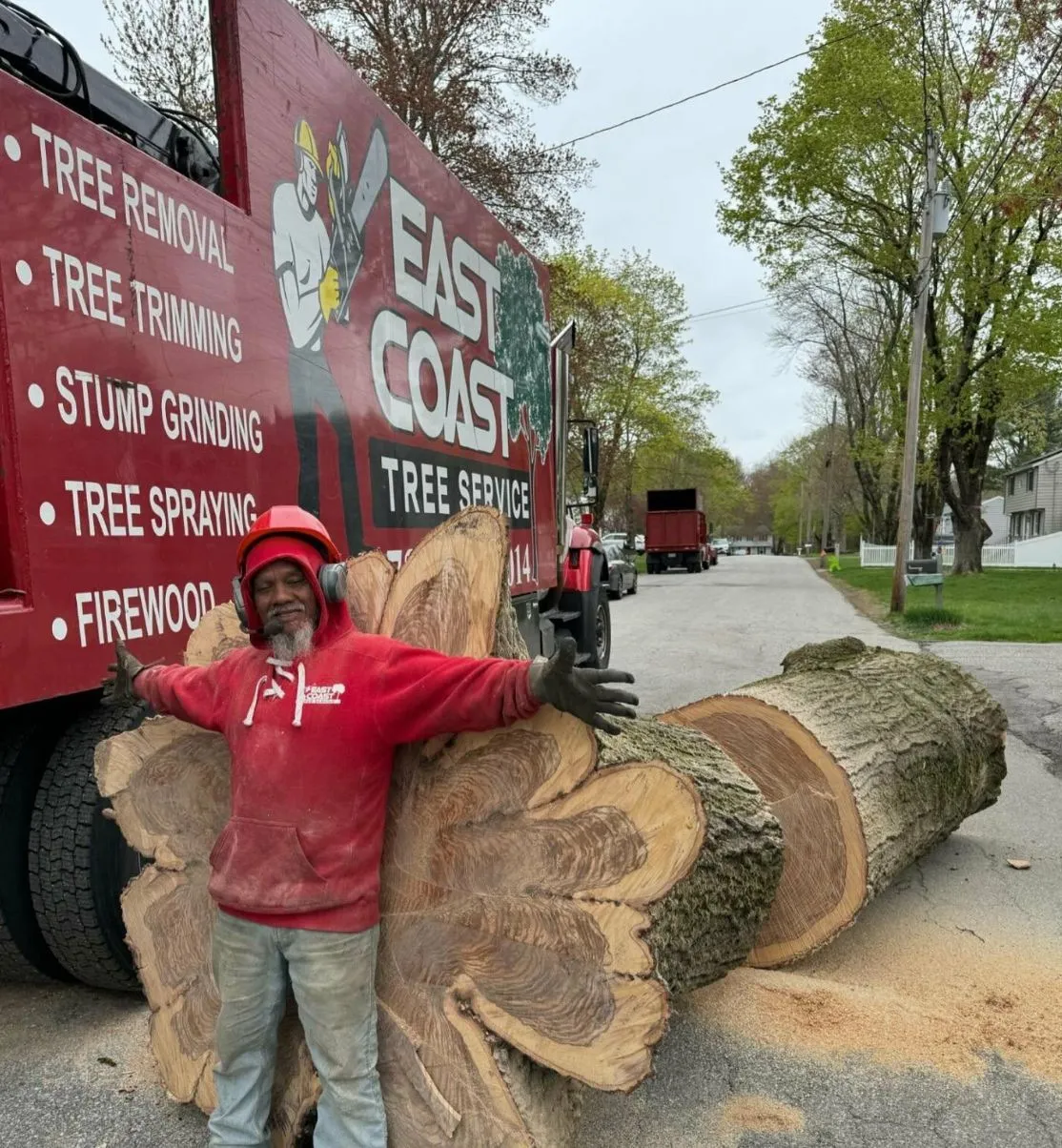
East Coast Tree Service LLC provides tree removal in Amesbury, MA for dead, hazardous, storm-damaged, oversized, and difficult-access trees. We handle straightforward removals along with trees close to houses, garages, fences, driveways, utility lines, landscaping, and other areas where controlled rigging or crane assistance may be the better approach.
Our team includes multiple ISA Certified Arborists, East Coast Tree Service is a member of the Tree Care Industry Association (TCIA), and the company is fully insured and licensed for the work it performs. Free on-site estimates are available, full cleanup is included, financing options are available, and our 24/7 emergency service responds to Amesbury tree emergencies within up to one hour.
Call (781) 518-8014 for a free tree removal estimate in Amesbury.
- Multiple ISA Certified Arborists on our team
- TCIA Member
- Fully insured and licensed
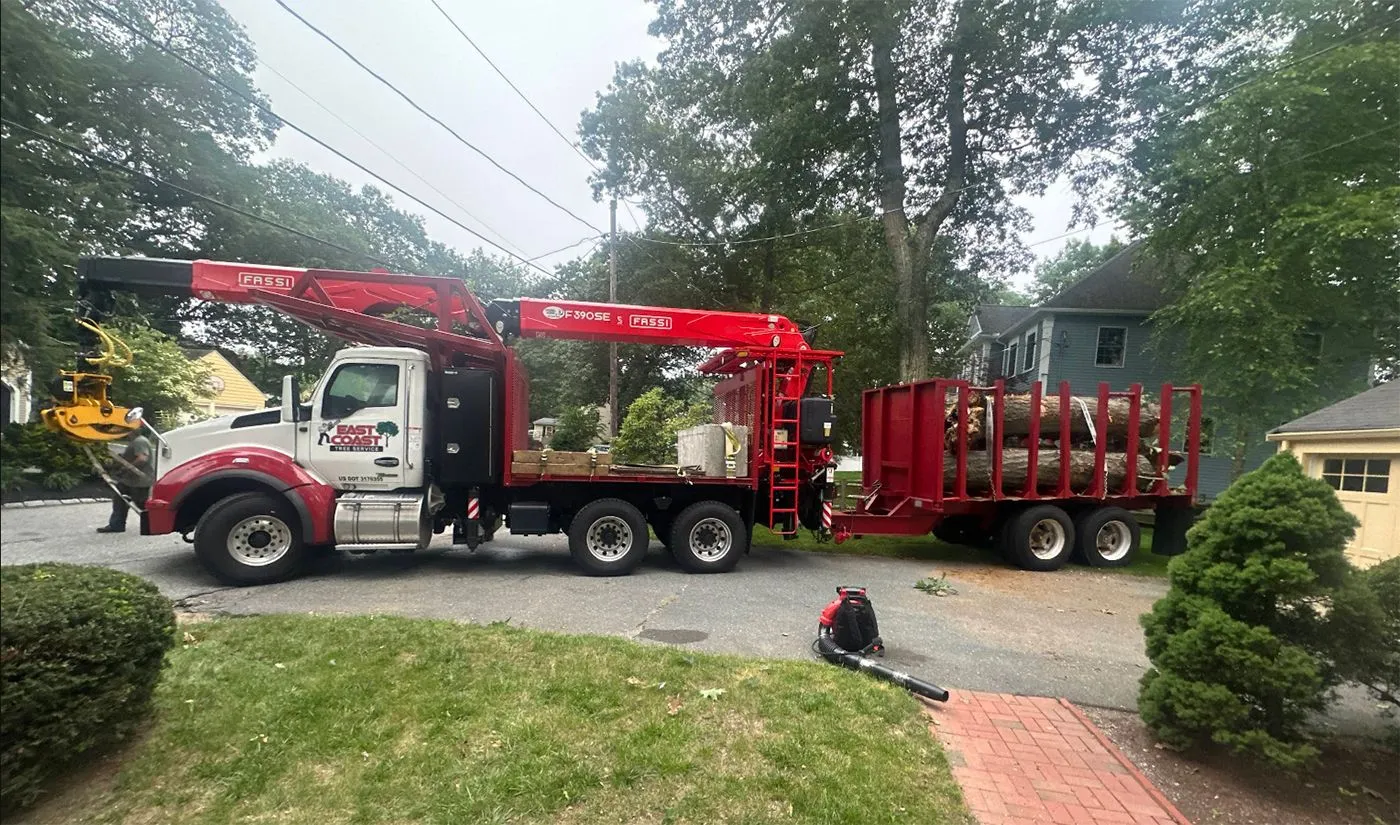
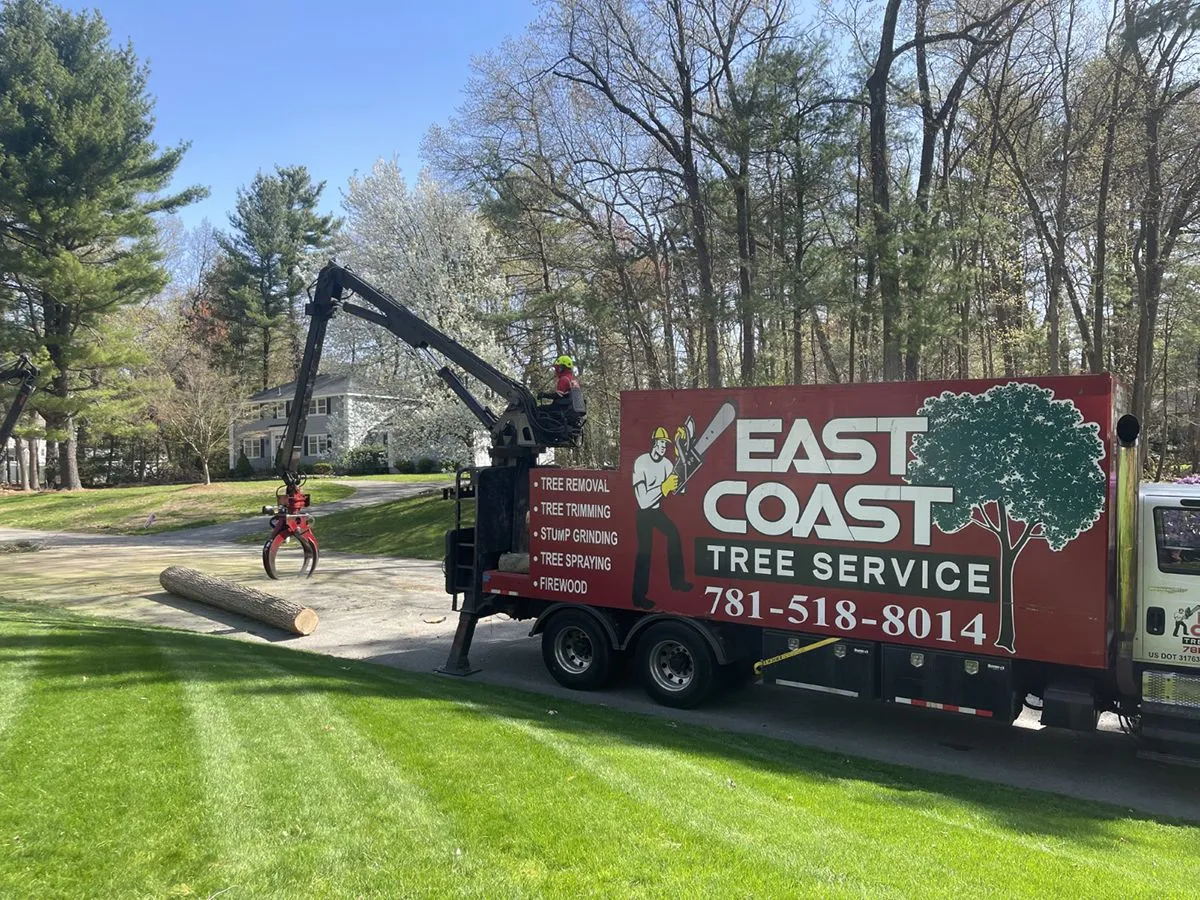
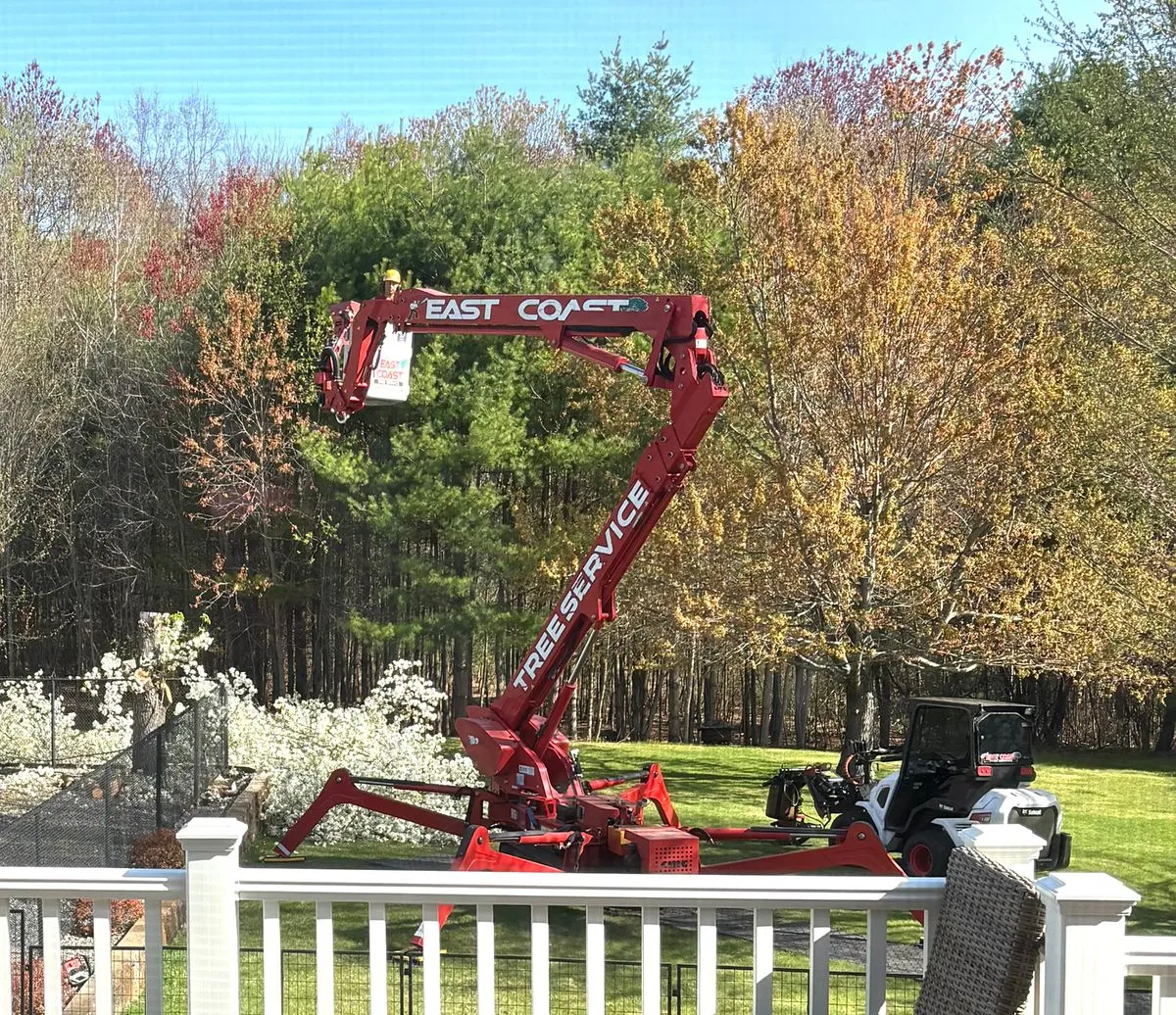
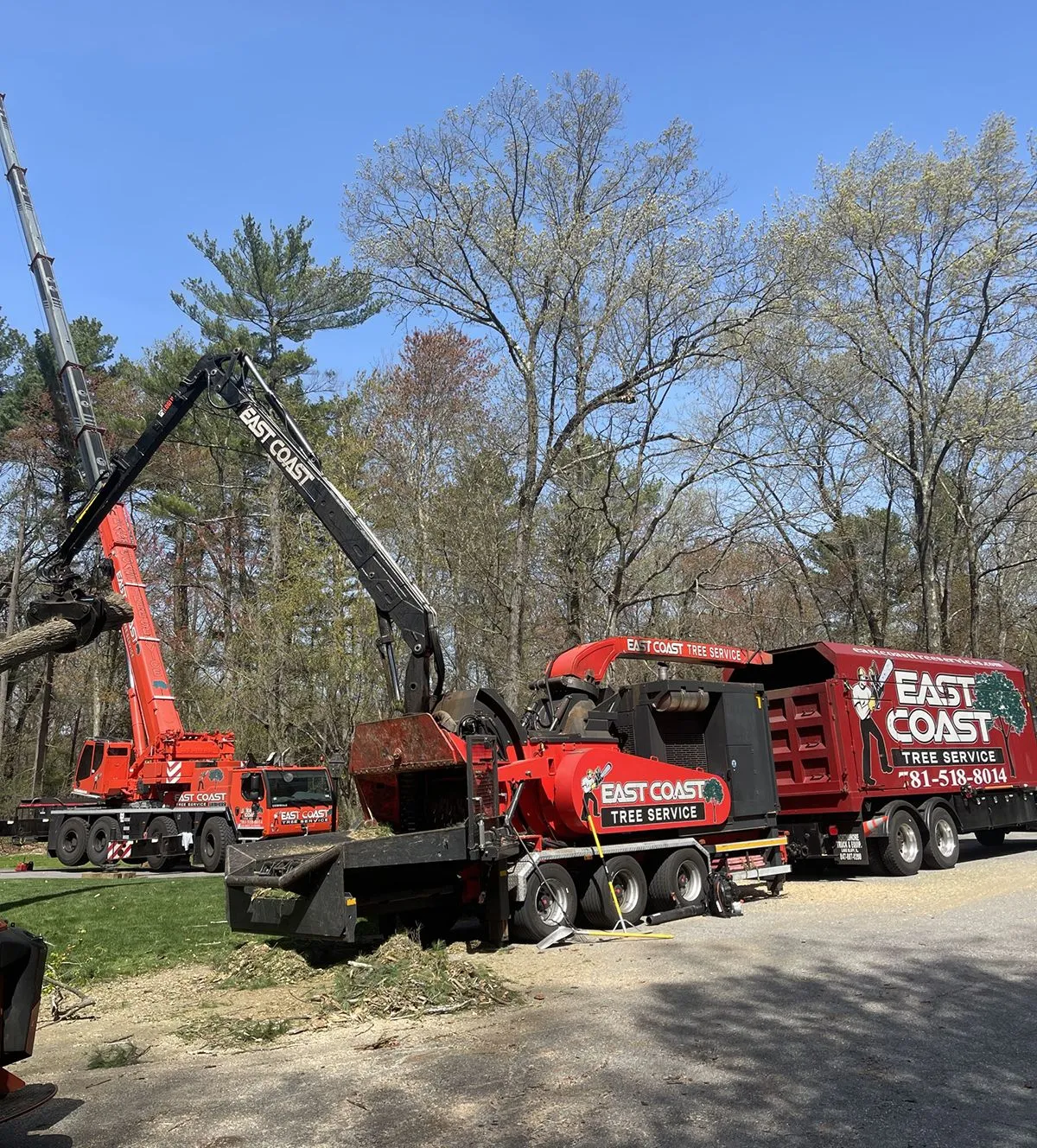
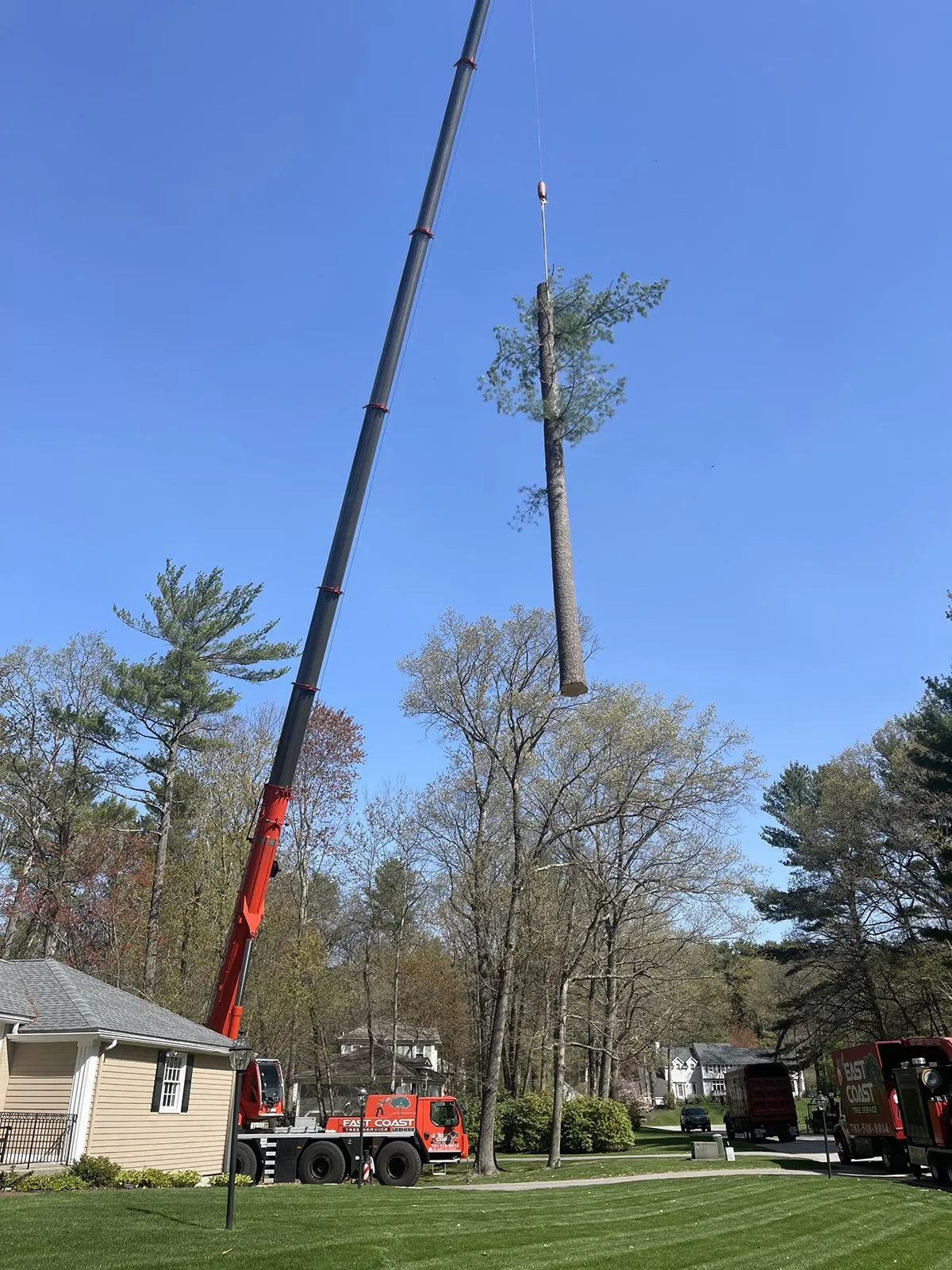
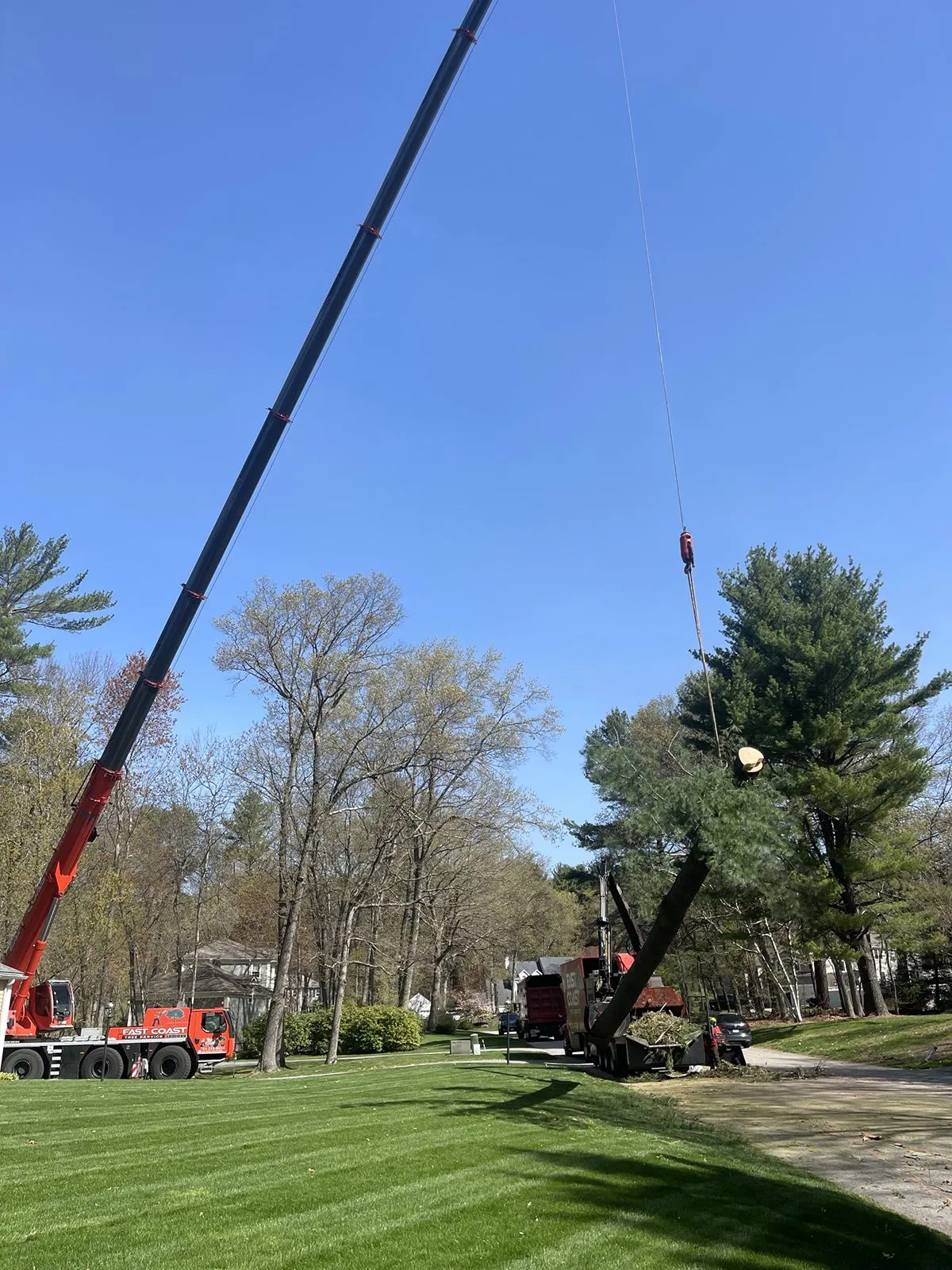
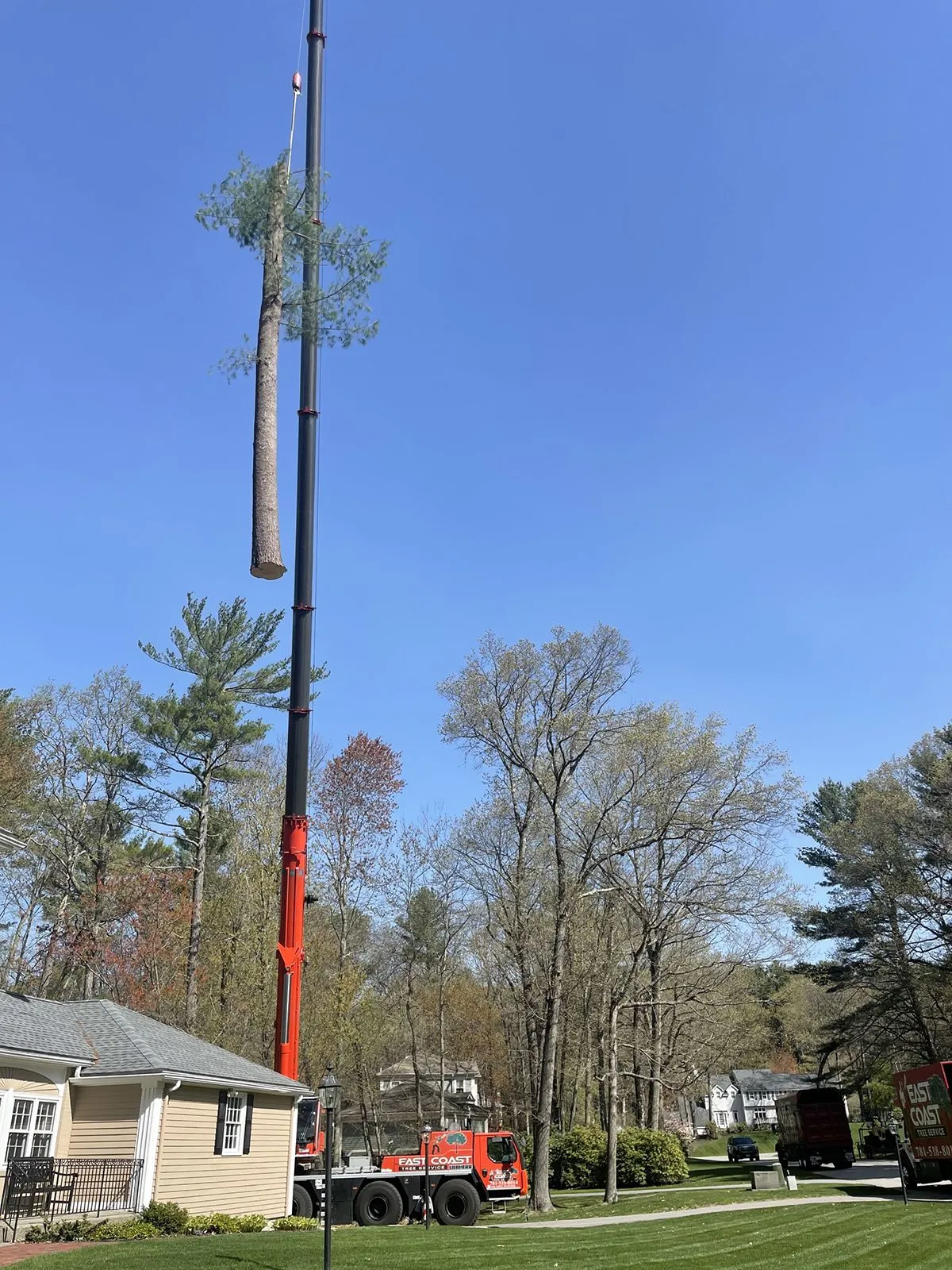
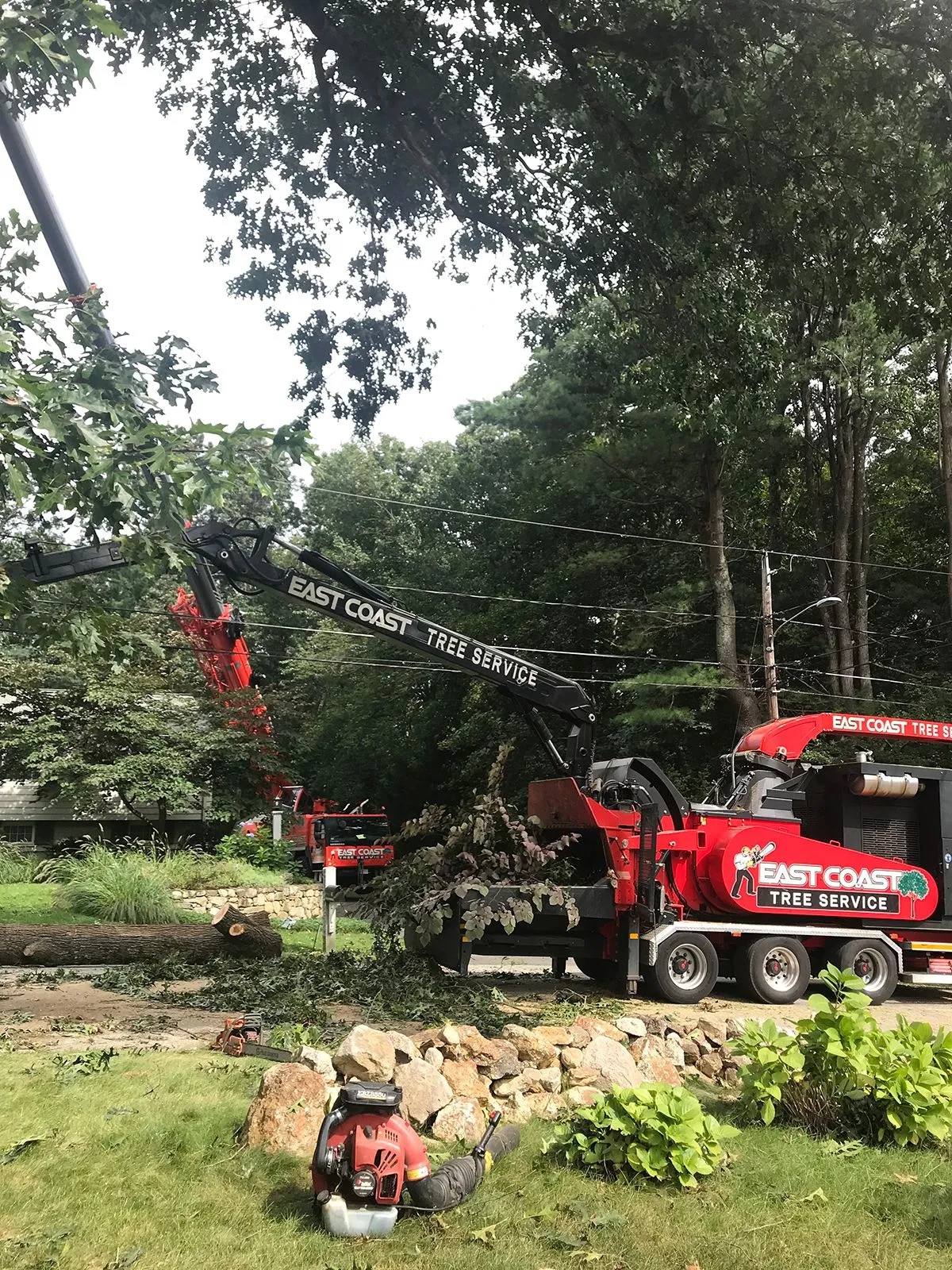
- Crane-assisted removals
- Full cleanup included
- Financing available
- 24/7 emergency service
- Emergency response within up to one hour
Tree Removal Is One of Our Main Areas of Work
A tree does not have to be lying on the ground before removal becomes appropriate. Advanced decay, a shifting root plate, a worsening lean, major storm damage, a split trunk, or large dead sections over a frequently used area can change the decision while the tree is still standing.
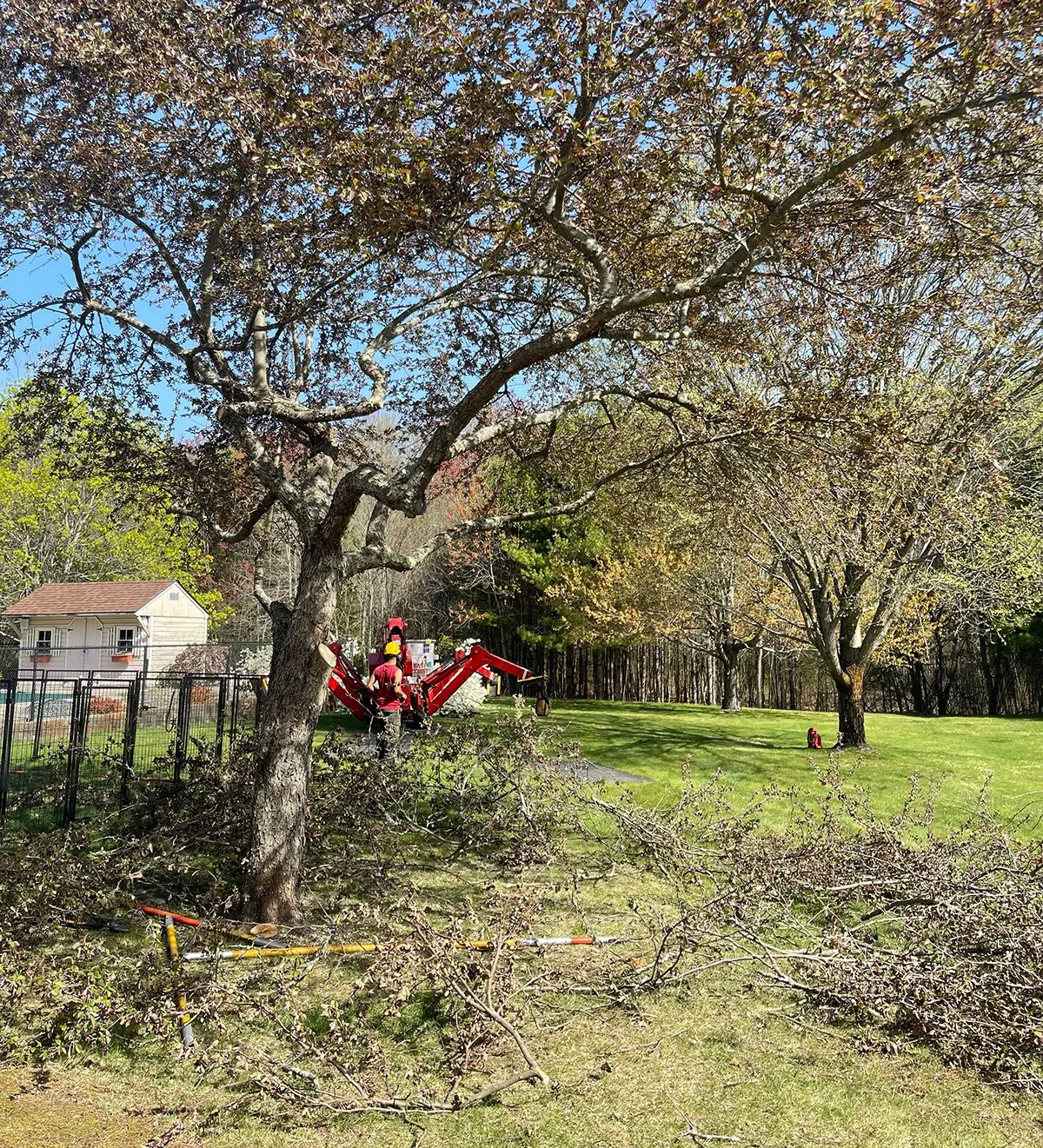
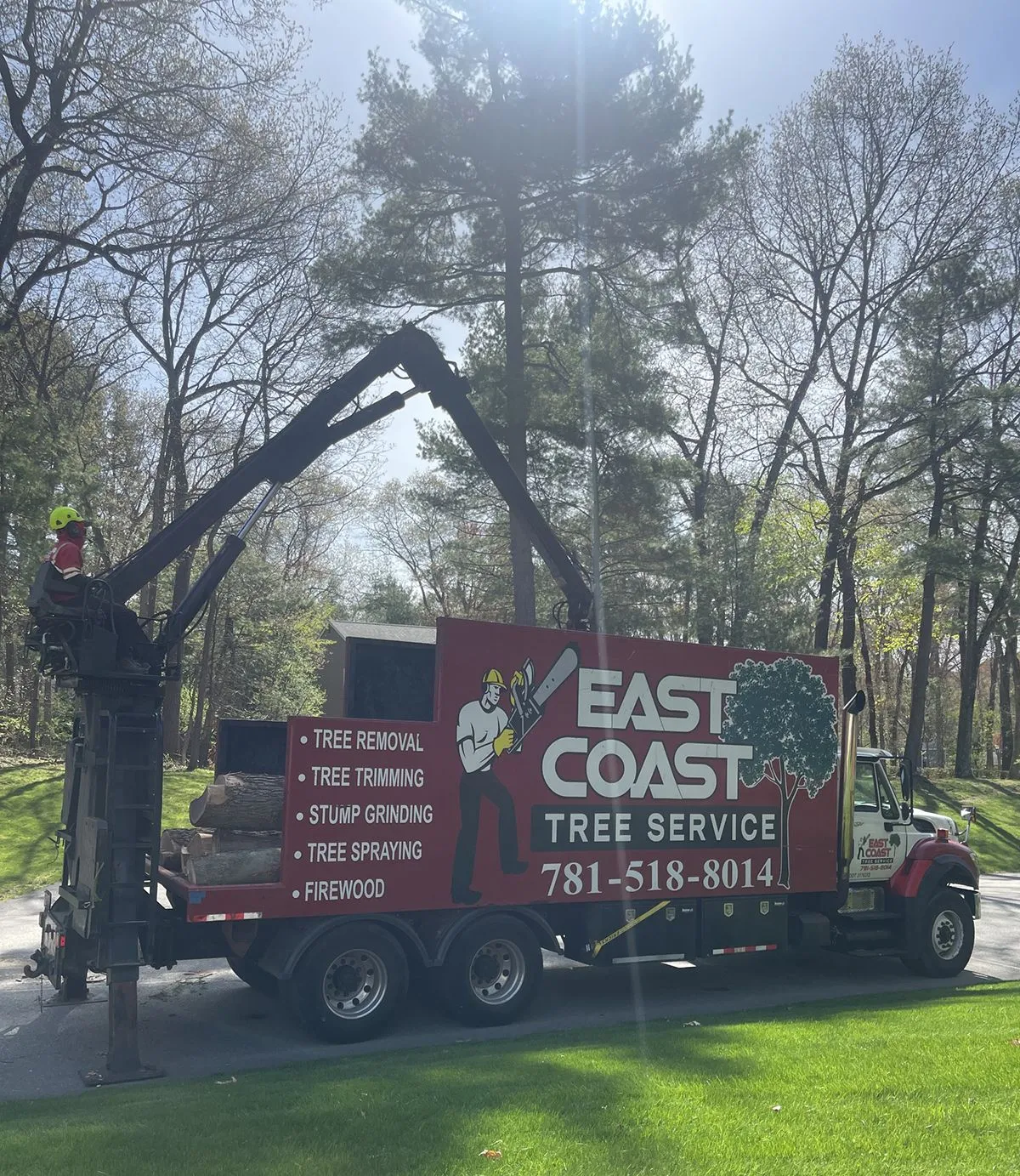
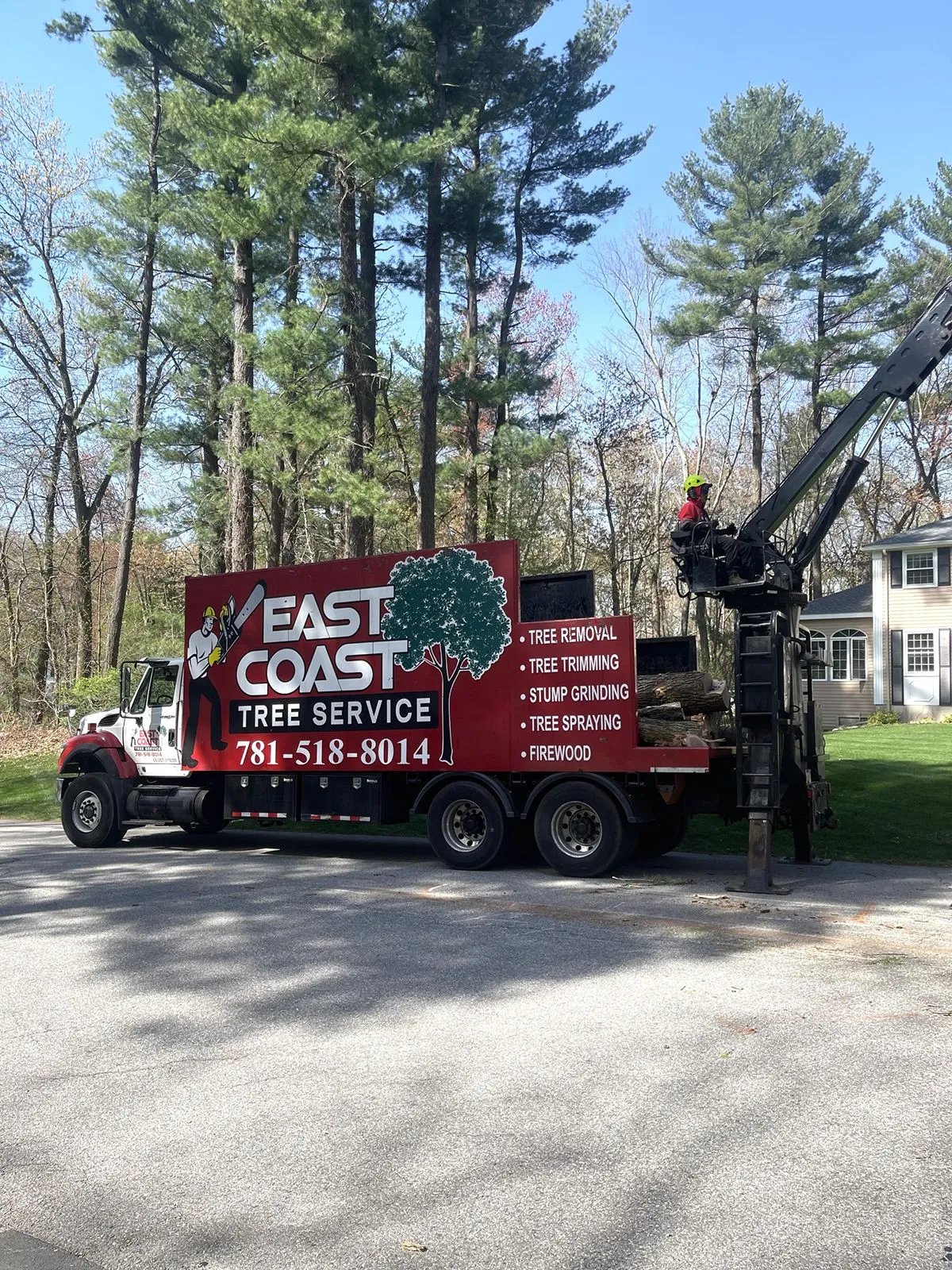
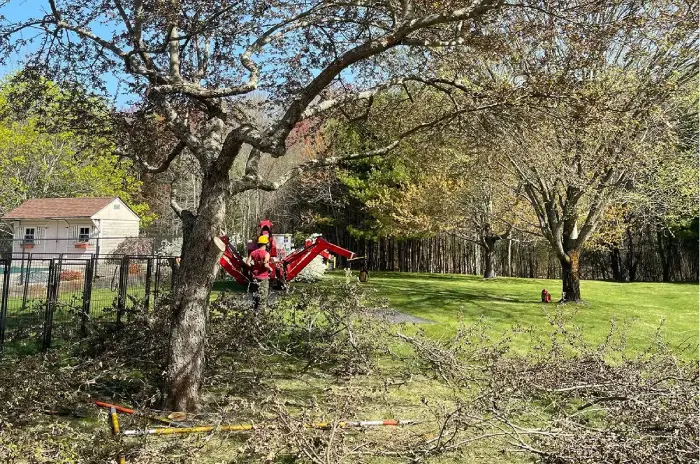
East Coast Tree Service looks at the entire site before deciding how the removal should be handled. Tree height and trunk diameter matter, but so do canopy weight, structural condition, available drop space, nearby buildings, neighboring property, overhead obstacles, equipment access, and the route the wood will take once it comes out of the canopy.
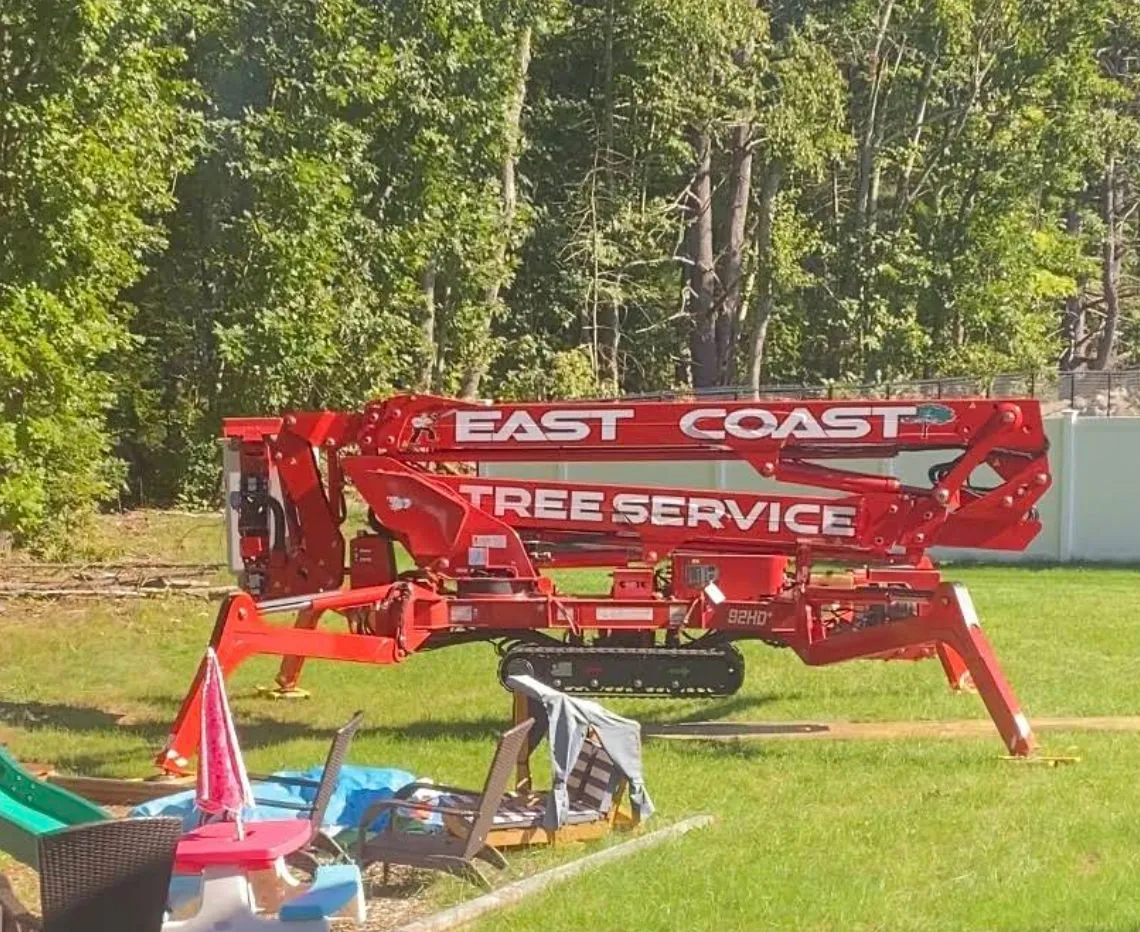
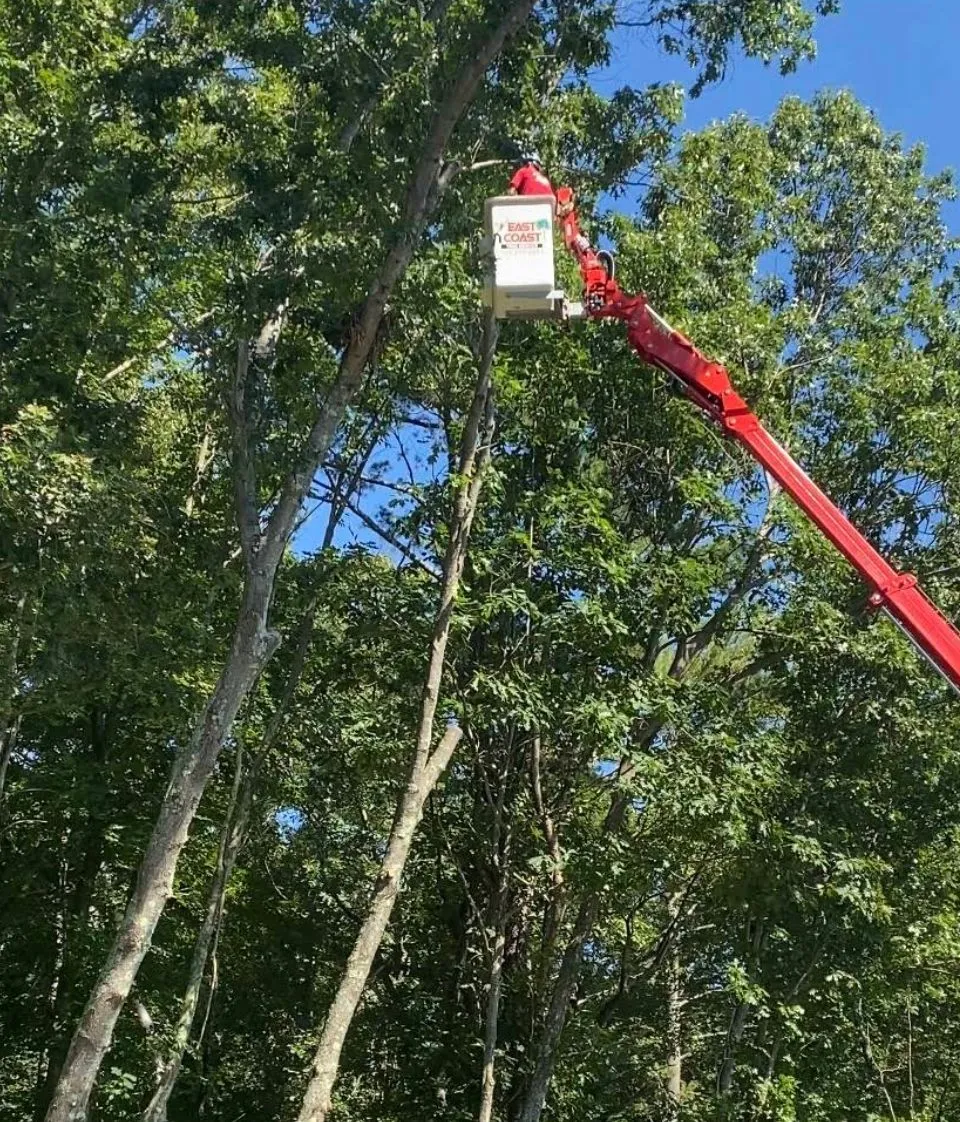
That becomes especially relevant on properties where a mature tree has grown alongside the house for decades. The tree may be large enough that simply dropping sections is no longer practical. Rigging, bucket access, sectional dismantling, or a crane can provide more control.
When Removal Makes More Sense Than Trimming
Pruning can solve a branch-level problem. It cannot correct every structural defect affecting an entire tree.
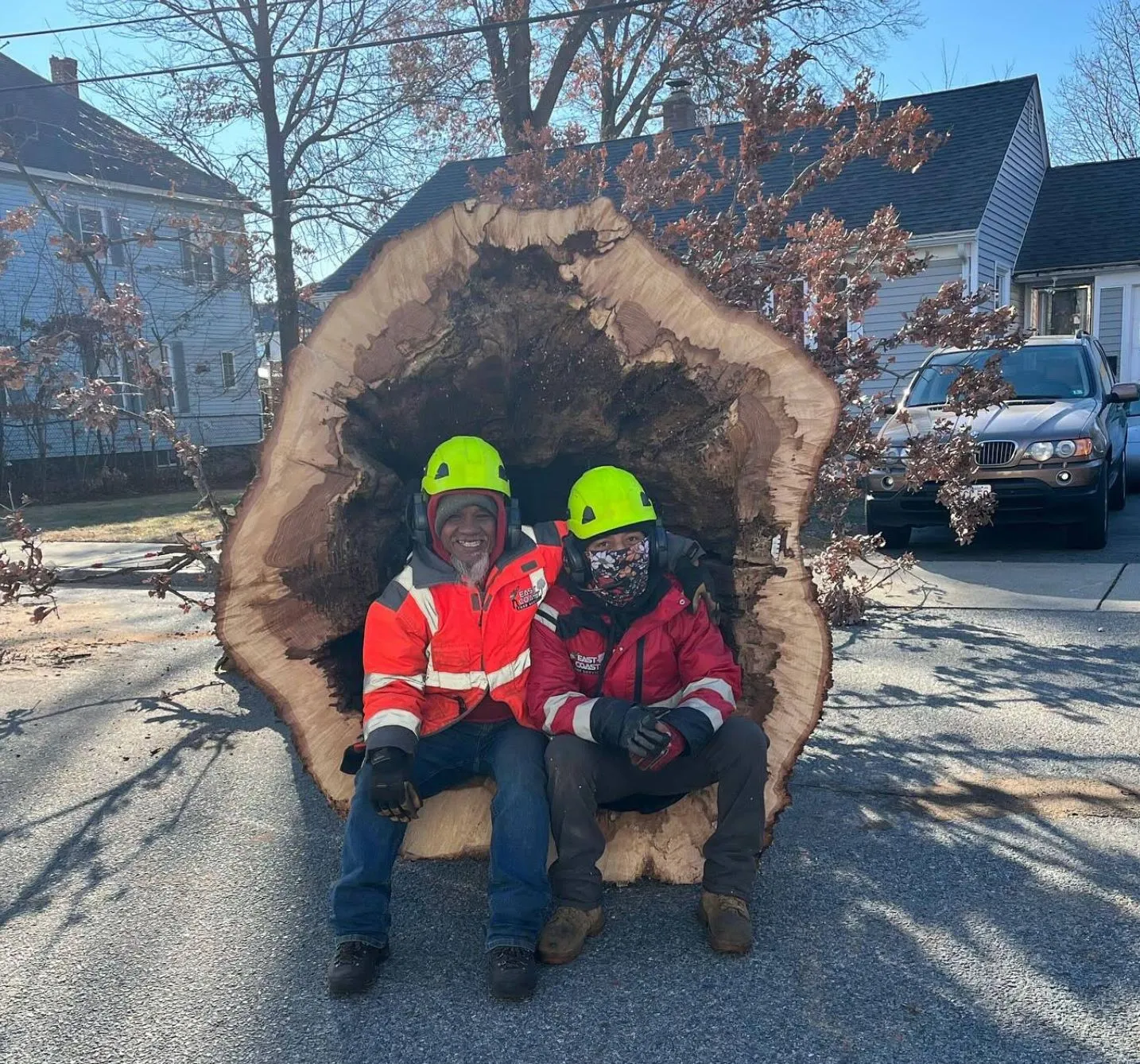
Removal may be considered when a tree is dead, has major trunk or root decay, has partially uprooted, developed a severe lean, suffered major storm failure, or stands in a location where its remaining structure creates an unacceptable hazard to buildings or people below.
The decision should be based on the individual tree rather than its species or age alone. A mature oak can remain stable for decades under the right conditions. Another tree of similar size may have extensive internal decay or root damage that changes the recommendation entirely.
Crane-Assisted Tree Removal in Amesbury
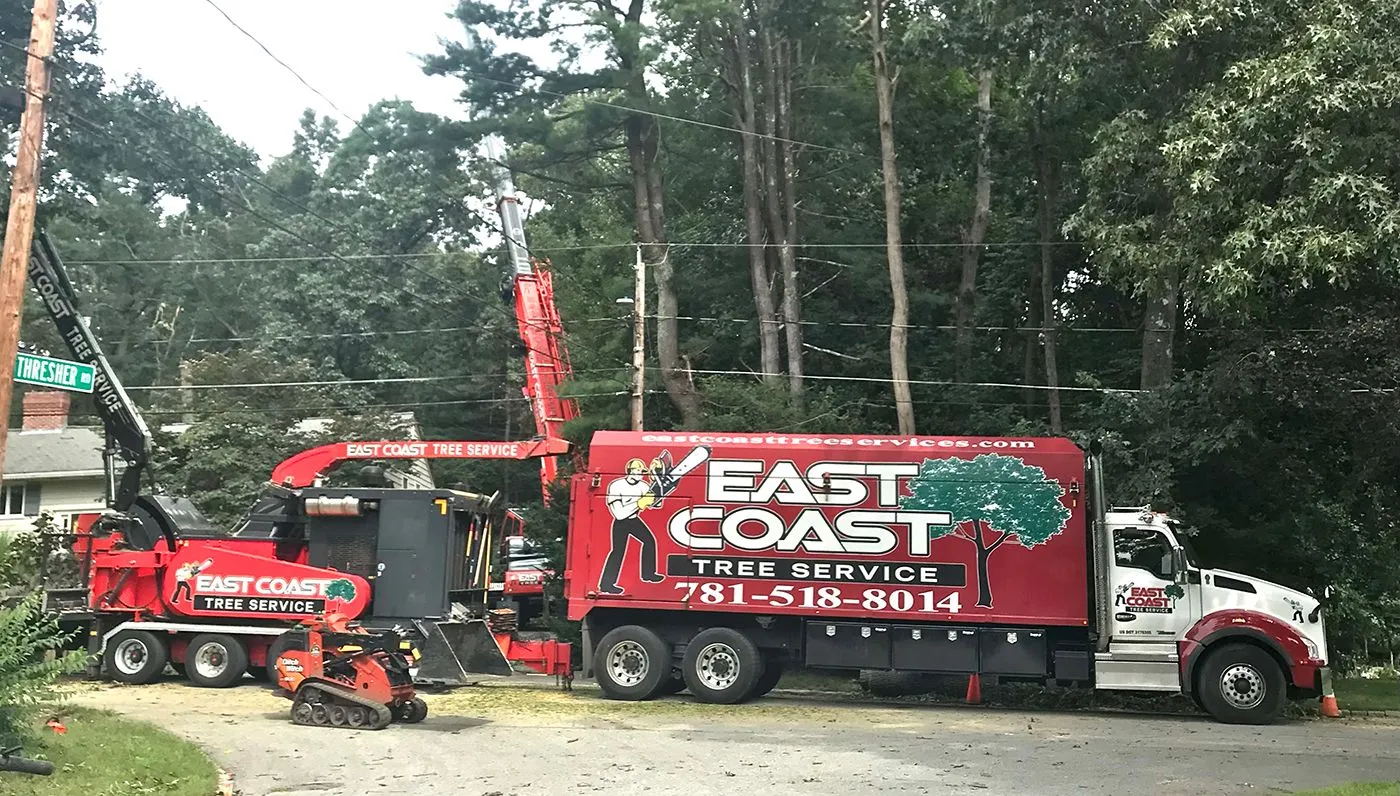
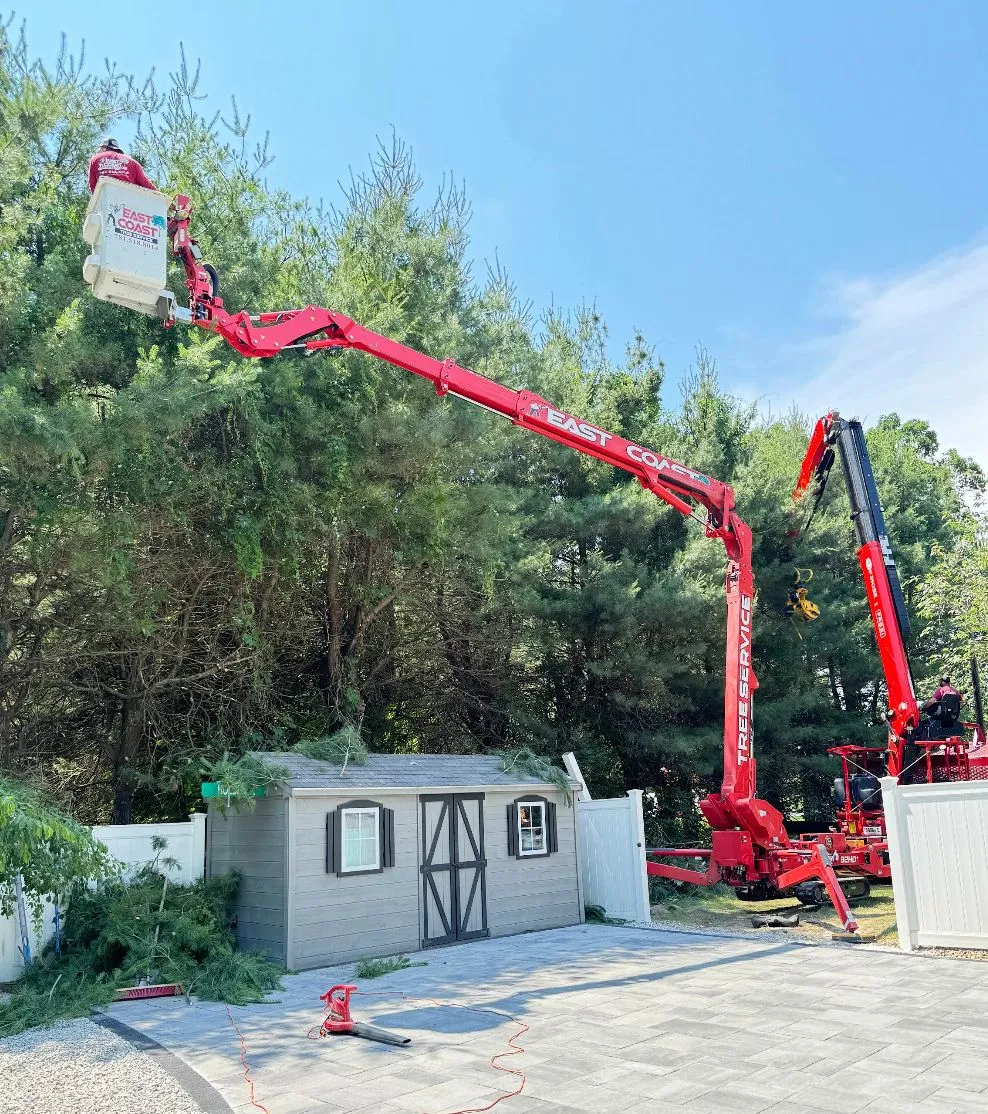
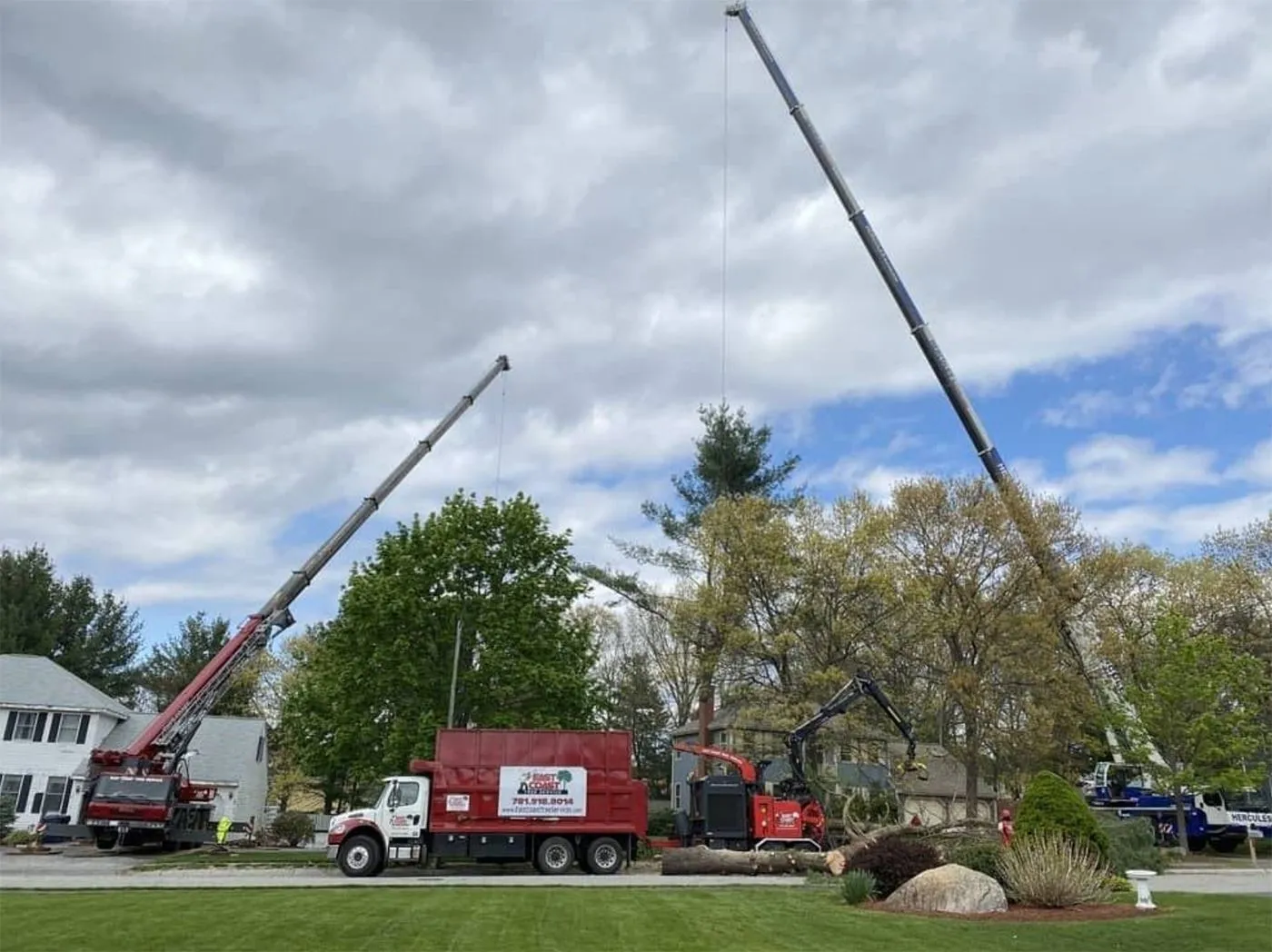
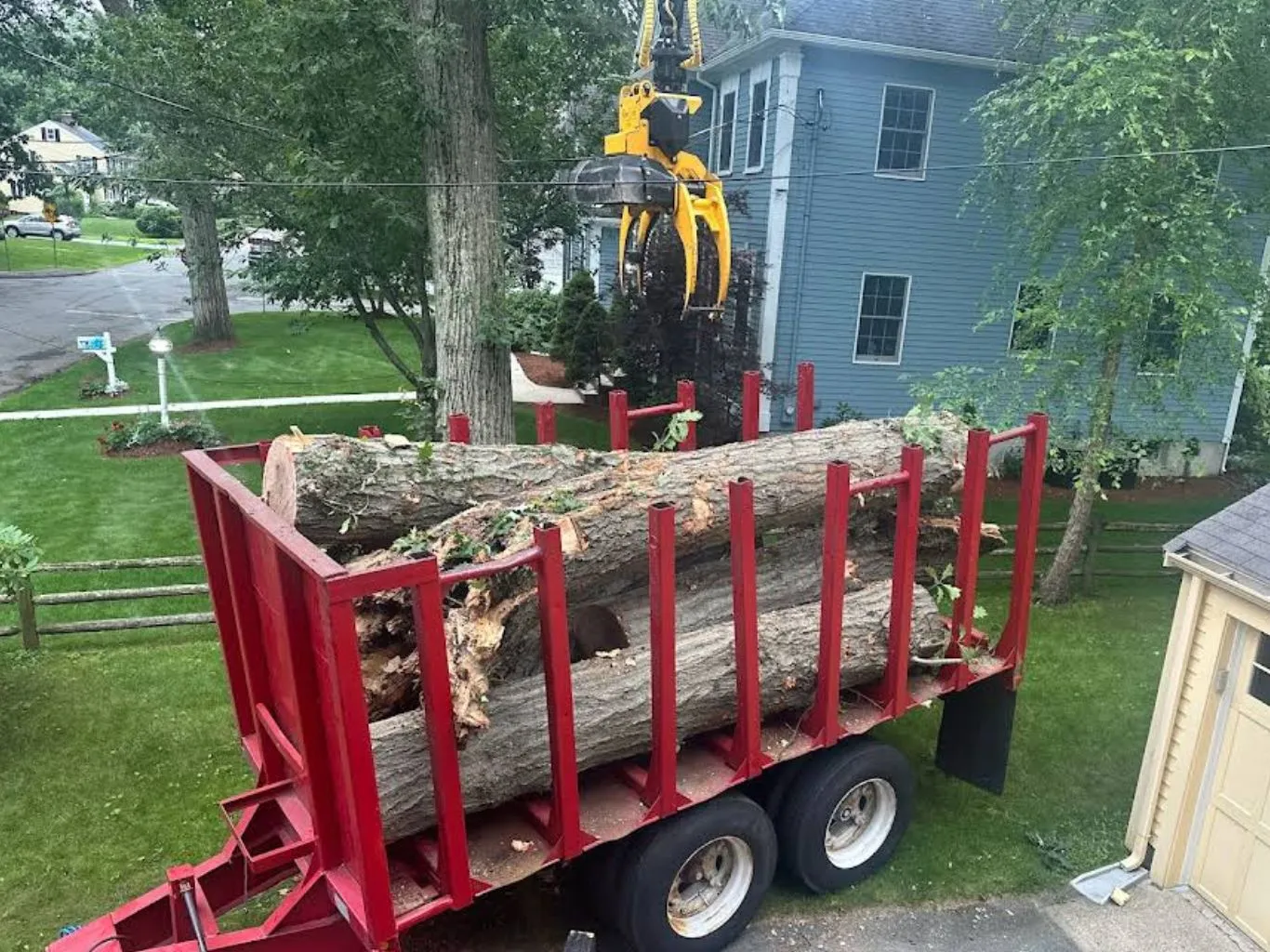
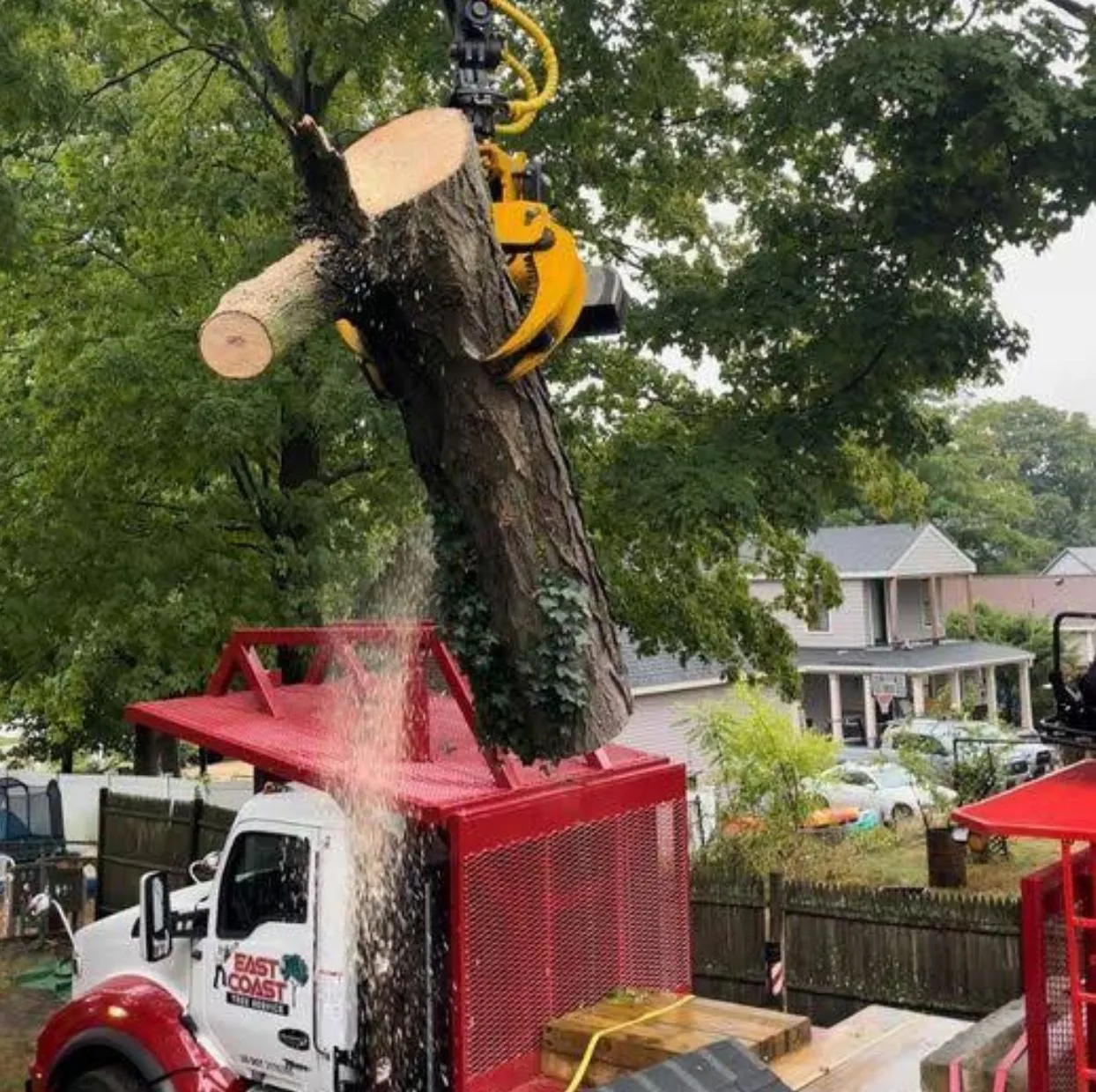
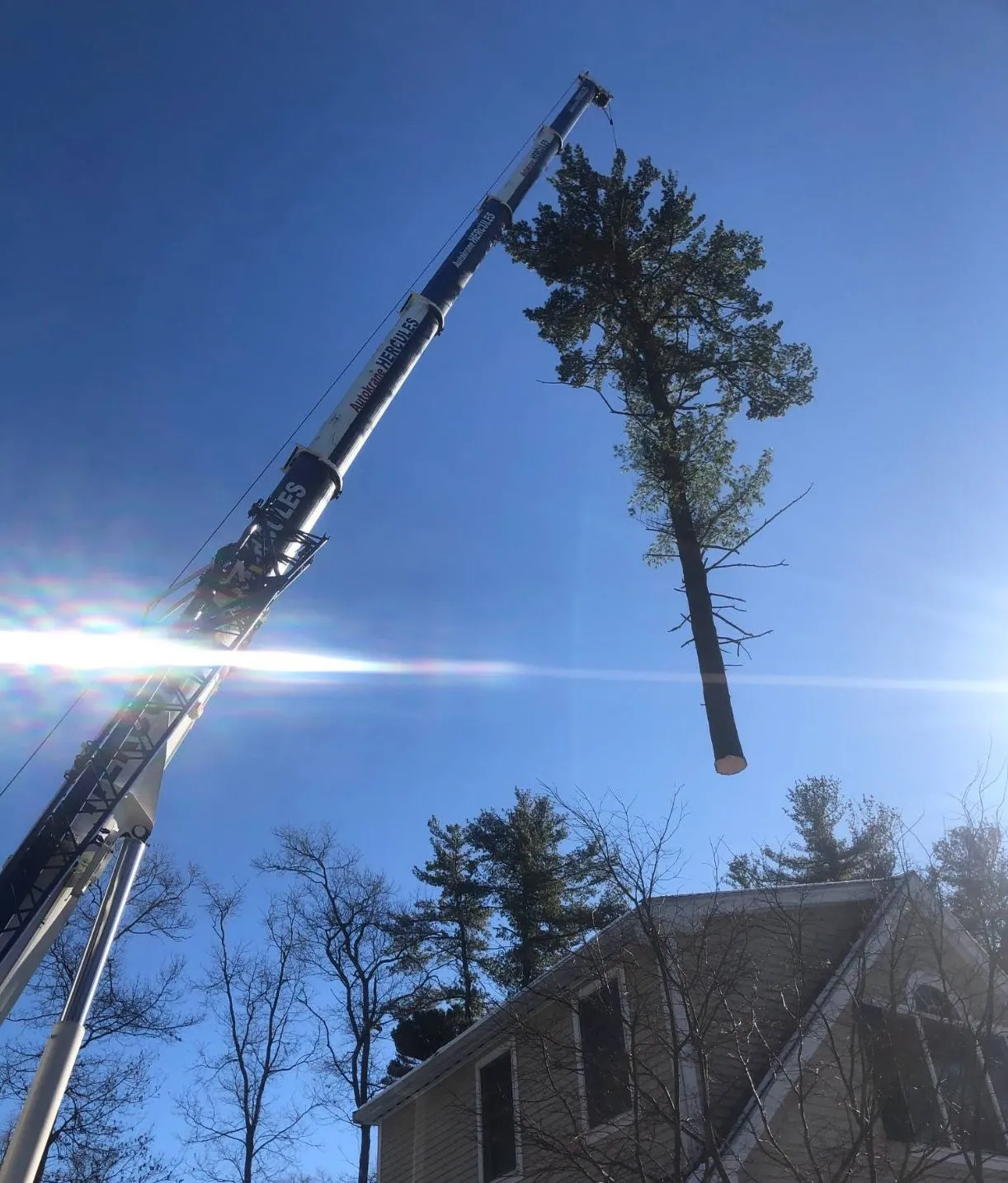
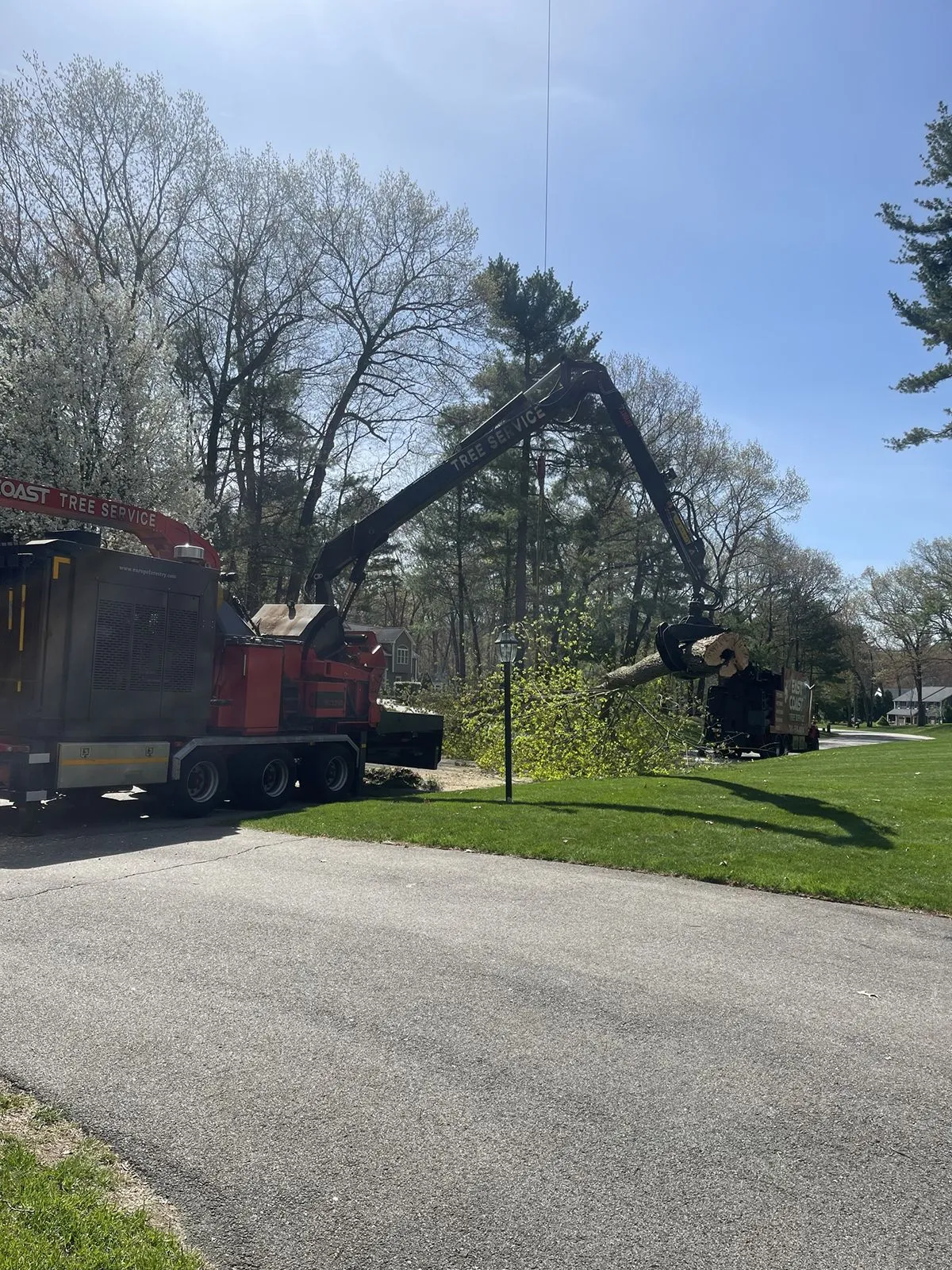
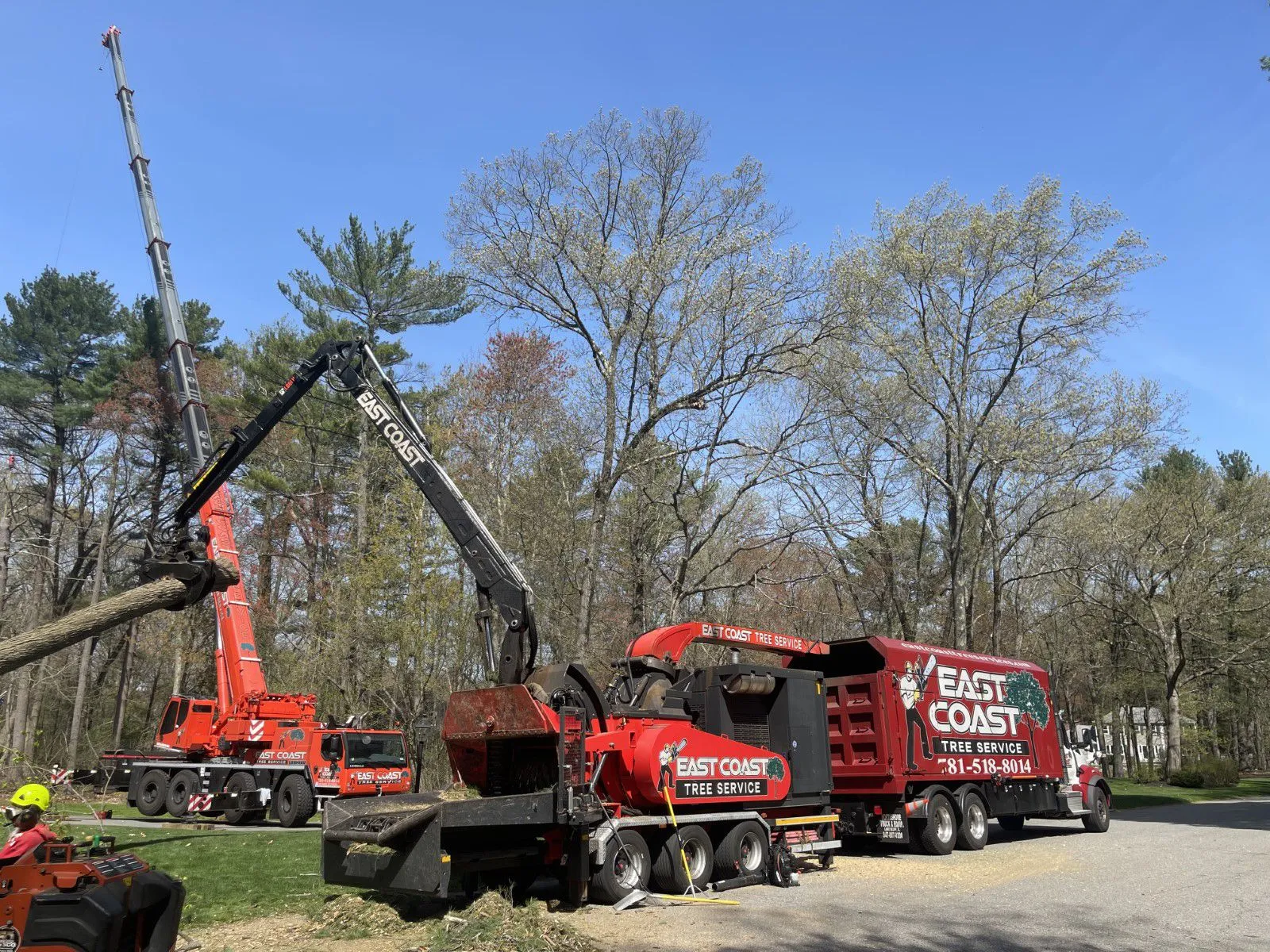
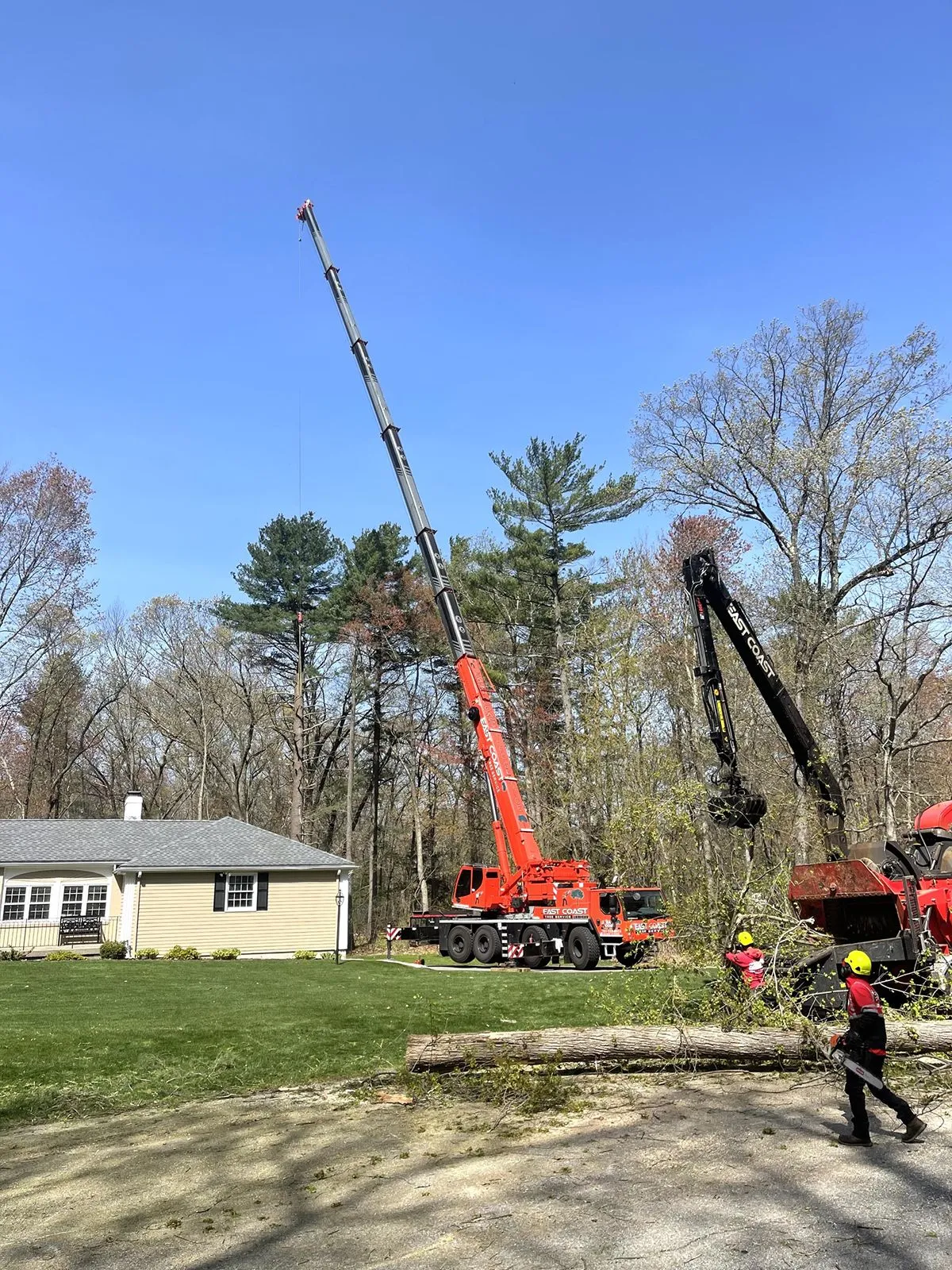
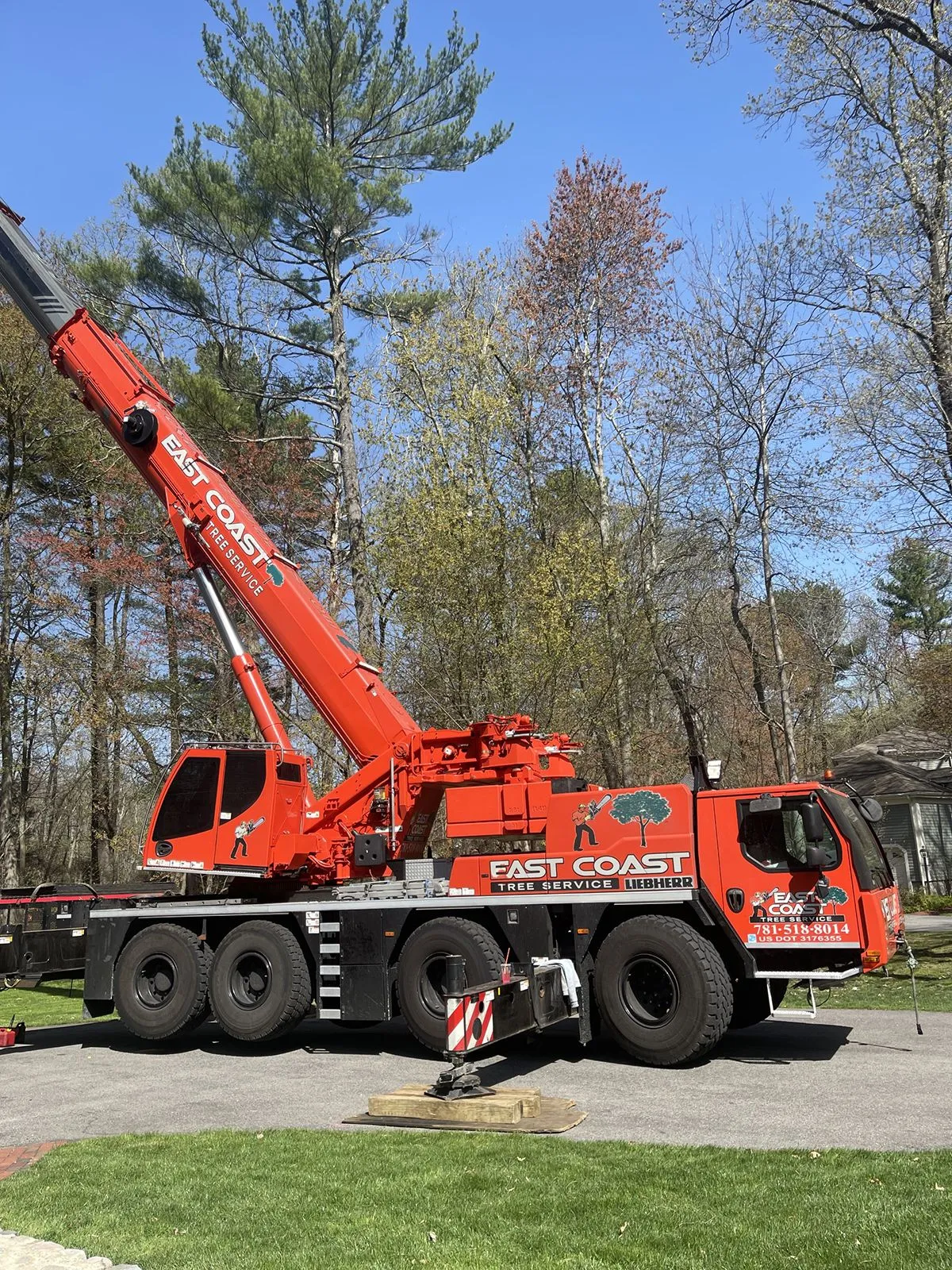
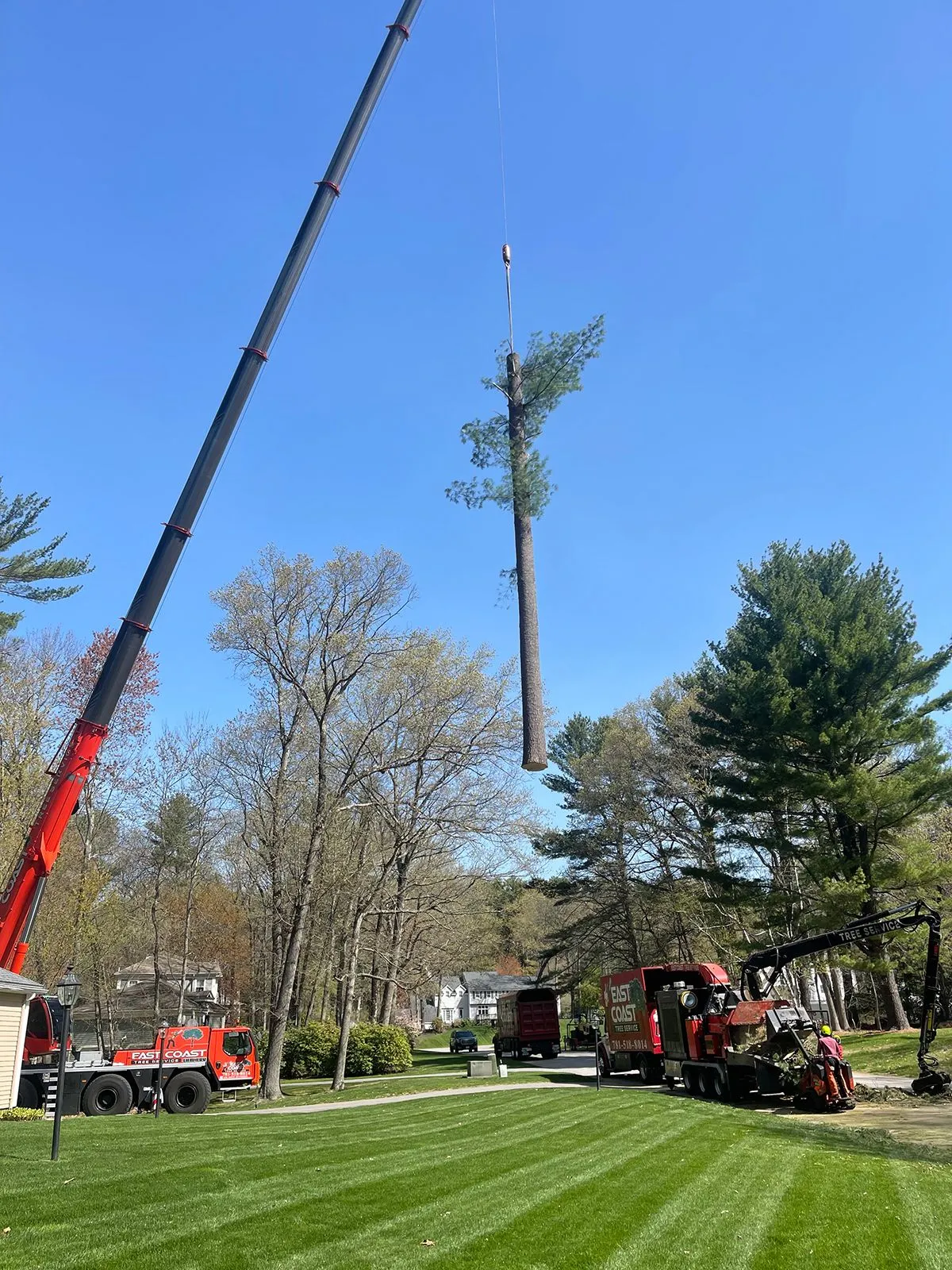
A crane gives the crew another way to control heavy sections when the space below a tree cannot be used as a normal drop zone. Limbs or trunk sections can be secured before the cut and lifted to a processing area instead of being lowered through roofs, fences, gardens, or other obstacles.
That can be useful for tall trees behind homes, large sections extending over structures, storm-damaged trees that are unsafe to climb, and properties where conventional rigging would require moving heavy material through a tight yard.
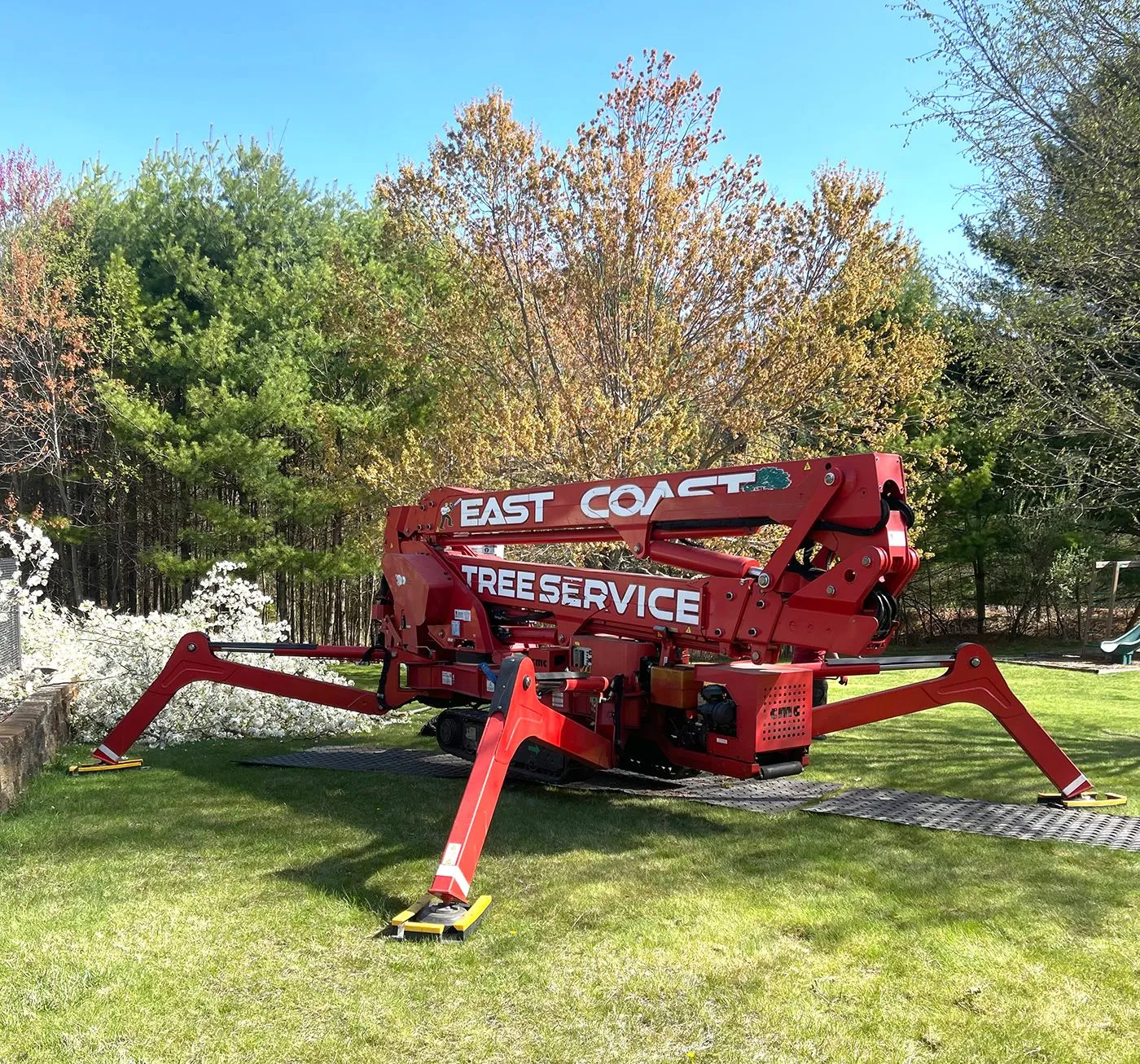
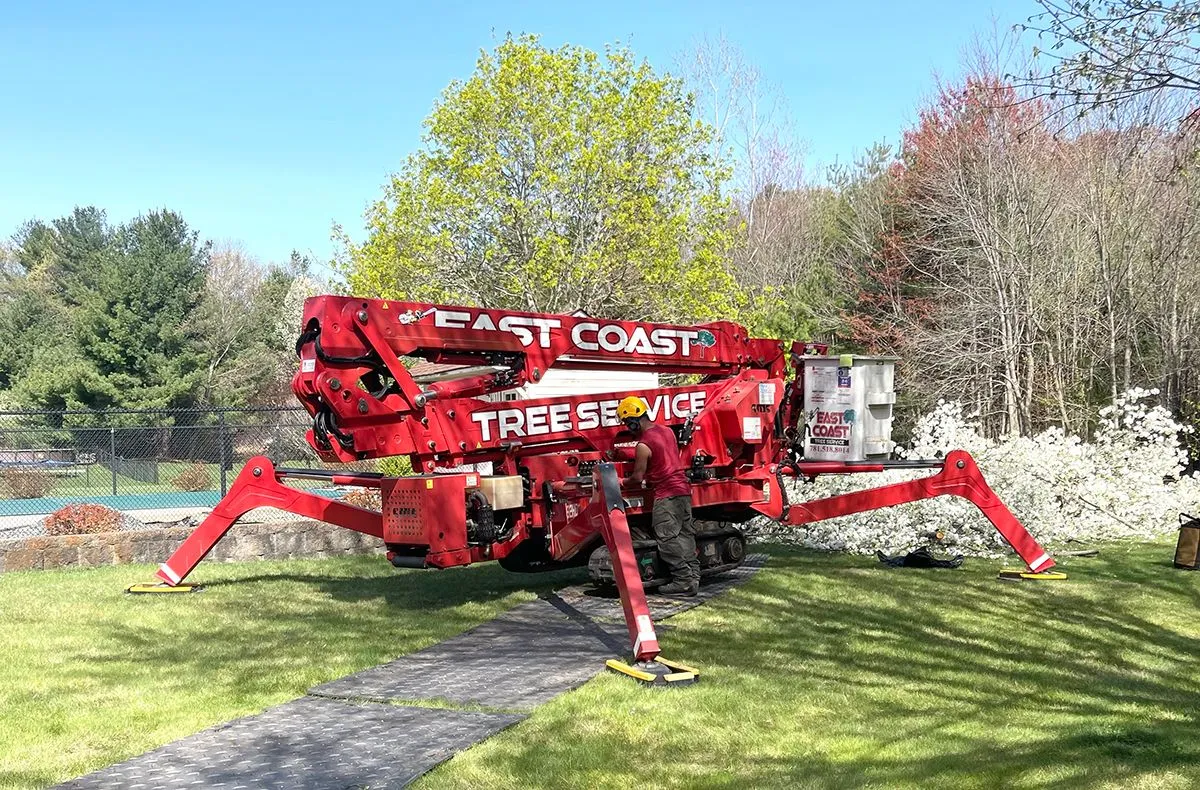
Crane removal still depends on the property. Setup room, crane reach, overhead lines, ground conditions, tree weight, surrounding buildings, and access all affect whether a crane is the right tool.
Learn more about our crane capabilities.
Protecting Amesbury’s Older Homes and Established Properties
Amesbury’s housing and street patterns range from compact neighborhoods around downtown and the old mill areas to larger wooded properties closer to the city’s open spaces. Mature trees may stand beside older homes, stonework, narrow driveways, sheds, garages, or property lines where there is little room for error.
Before a removal begins, the crew needs to identify what sits below and around the canopy. Equipment position, rigging points, landing areas, crane reach, fences, hardscape, and the route used to remove wood all influence the plan.
No responsible tree company should promise that moving heavy equipment across a property can never leave a mark. The better question is how the contractor plans to control sections, choose access, and limit avoidable impact to lawns, driveways, landscaping, and structures.
Tree Removal Permits and Regulations in Amesbury
A tree located entirely on ordinary private upland property is not automatically subject to the same process as a tree near wetlands, a river, a public way, or other regulated land. Location matters.
Trees Near Wetlands, Lakes, Rivers, and Streams
Amesbury has extensive wetlands and waterways. The Conservation Commission administers the Massachusetts Wetlands Protection Act along with the Amesbury Wetlands Protection Ordinance and local regulations.
The City states that work near protected resources may require a wetland permit before the project begins. Amesbury also identifies unauthorized alterations within 100 feet of a wetland or lake, or 200 feet of a river or stream, as potential wetlands violations.
This is relevant around areas associated with the Merrimack River, Powow River, Lake Gardner, ponds, streams, and low-lying wetland systems throughout the city. A homeowner should not assume that a tree is outside Conservation Commission jurisdiction simply because the trunk is located on private property.
Public Shade Trees
Massachusetts General Laws Chapter 87 governs public shade trees. Trees within a public way can fall under the authority of the municipal Tree Warden rather than being treated as ordinary private trees.
If a tree is close to the roadway, sidewalk, public property line, or another regulated area and ownership is unclear, verify its status with Amesbury Public Works or the appropriate city department before work is scheduled.
Official resources:
Amesbury Wetland Regulations and Permits
and
Massachusetts General Laws Chapter 87.
What Does Tree Removal Cost in Amesbury, MA?
Tree removal pricing changes quickly once access, tree condition, and surrounding property are considered. A third-party Amesbury cost guide places the average tree removal around $711, with a published range of roughly $266 to $1,146. The same source estimates an average emergency removal around $1,066.
Those figures are general market estimates and are not East Coast Tree Service pricing. Large trees, crane work, hazardous conditions, restricted access, complex rigging, multiple removals, and extensive processing can move the cost well beyond a general citywide average.
A tall tree in an open portion of a property may require less handling than a smaller tree positioned between a house, fence, and neighboring yard. That is why pricing by height alone often gives homeowners the wrong expectation.
Factors that change a tree removal estimate
- tree height and trunk diameter;
- dead, decayed, split, or storm-damaged wood;
- access for trucks, lifts, cranes, and chippers;
- distance from houses, garages, fences, and neighboring property;
- rigging or crane requirements;
- amount of material to process and remove;
- stump grinding;
- number of trees in the project; and
- emergency conditions.
East Coast provides free on-site estimates so the quote can reflect the actual tree, property, and requested scope.
Multiple ISA Certified Arborists on Our Team
ISA Certified Arborist is an individual credential issued through the International Society of Arboriculture. Hiring a company that performs tree removal does not automatically mean the business has certified arborists on staff.
East Coast Tree Service employs multiple ISA Certified Arborists. The company is also a member of the Tree Care Industry Association.
Owner Tom FitzPatrick has more than 25 years of experience in the tree-care industry. He holds an Associate of Science in Arboriculture and Community Forest Management from the Stockbridge School of Agriculture at UMass Amherst and founded East Coast Tree Service LLC in 2016.
Read more about the company on our About Us page.
Insurance and Tree Removal Liability
Large-tree removal can put workers, equipment, suspended wood, neighboring property, and structures inside the same working area. Homeowners should ask about insurance before comparing contractors only by price.
East Coast Tree Service is fully insured and carries general liability and workers’ compensation coverage.
This matters on any property, but the question becomes even more relevant where a tree stands close to an older home, garage, fence, road, or neighboring yard. Customers who need current insurance documentation can request it before the work begins.
Seasonal Tree Removal in Amesbury
Tree removal can be performed throughout the year when tree condition, weather, access, and ground conditions allow the work to proceed safely. Winter does not automatically rule out removal.
Cold weather can freeze the ground and change equipment access. It can also bring snow and ice that make climbing, lifting, or moving material more difficult. Spring thaw and heavy rain can produce the opposite problem: soft or saturated soil that changes root stability and how heavy equipment can move across a property.
Summer thunderstorms and strong winds can produce sudden limb failures, while fall and winter nor’easters can bring combinations of wind, rain, wet snow, and ice. A tree that develops a fresh lean, visible root movement, a new trunk split, or a suspended major limb after a storm should be evaluated rather than waiting for another weather event.
24/7 Emergency Tree Removal in Amesbury
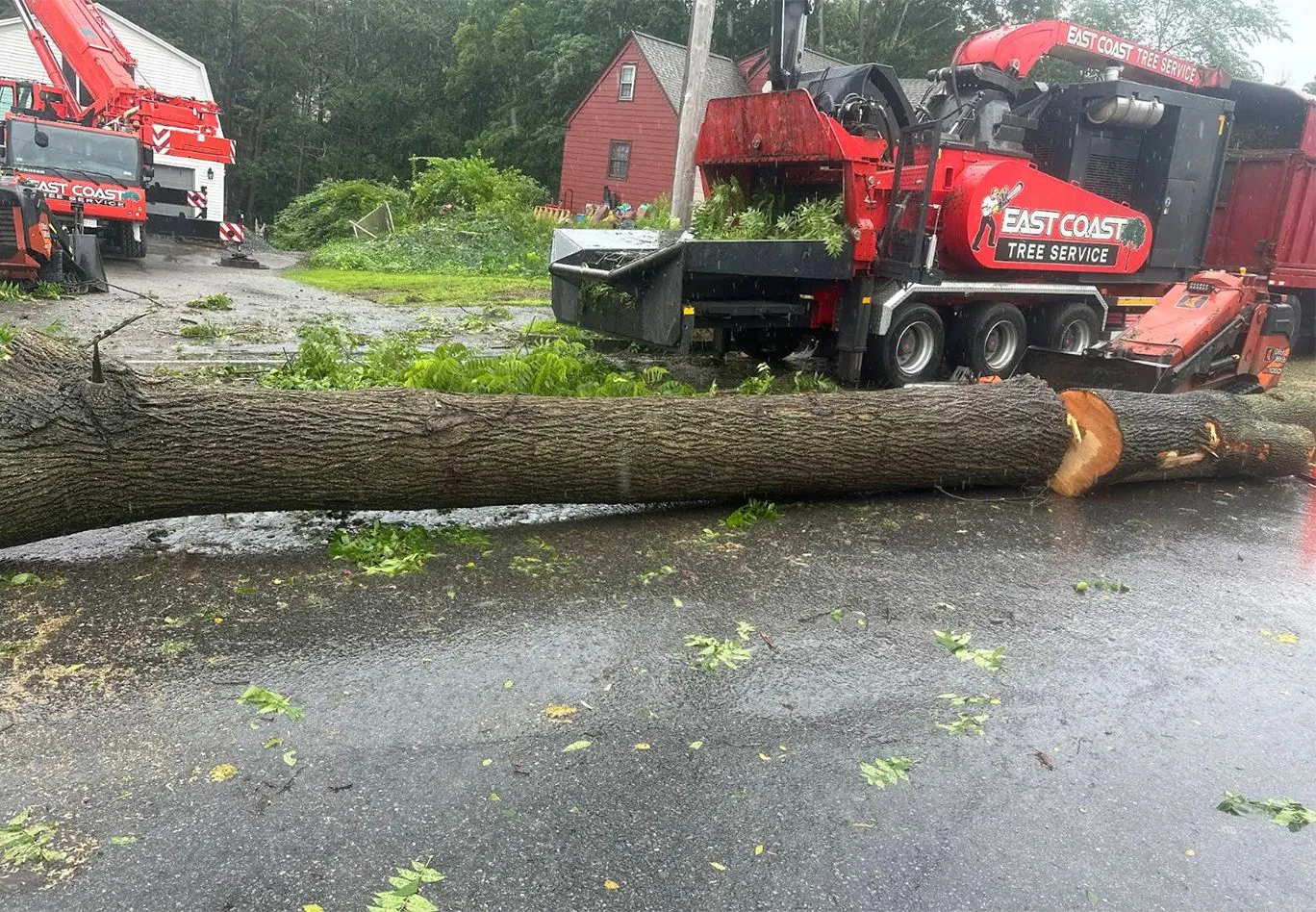
A fallen tree blocking a driveway, a tree on a house, a partially uprooted trunk, or a heavy limb hanging above an occupied area requires a different response from scheduled tree work.
East Coast Tree Service provides 24/7 emergency tree service in Amesbury and responds to emergency calls within up to one hour.
When calling, explain whether the tree is still standing, what it is touching, whether access is blocked, and whether power lines are involved. If tree material is touching an electrical line, stay away from the area and contact the utility or emergency authorities before approaching it.
See our tree removal and emergency service page for more information.
Cleanup and Stump Grinding After Tree Removal
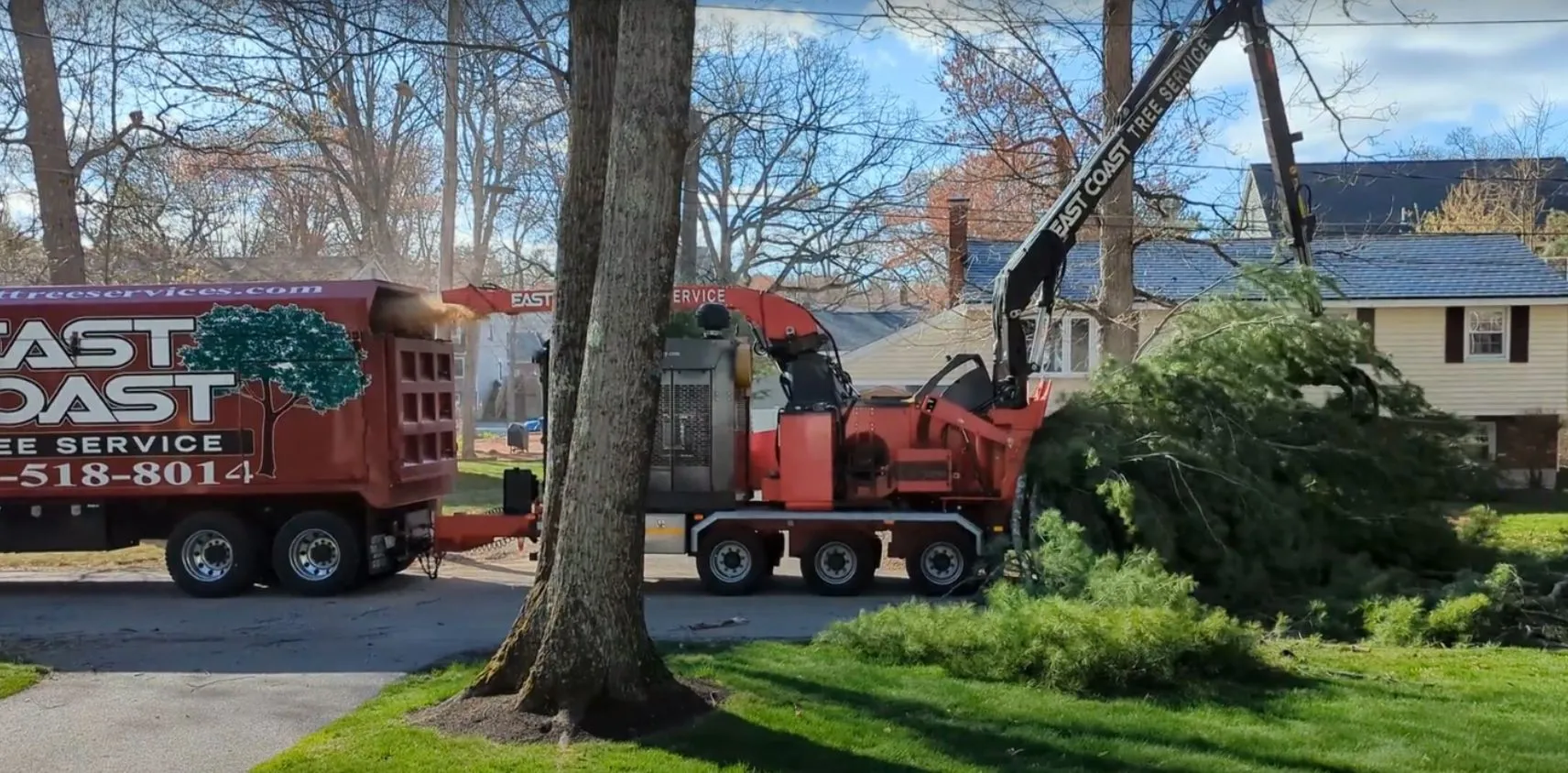
The work does not end when the trunk reaches the ground. East Coast Tree Service includes cleanup with its tree service.
The project scope should identify how branches, debris, larger wood, and other material will be handled. If the stump also needs to go, stump grinding can be included in the project planning.
Stump diameter, root flare, access, surrounding hardscape, underground utilities, and the intended use of the area all influence how the stump is handled. Learn more about our stump grinding services.
Real Customer Feedback From an Amesbury Job
East Coast Tree Service has public customer feedback tied specifically to Amesbury. One Facebook review published on our site describes the crew removing dead ash trees and trimming hemlocks near a fence in Amesbury, with the customer commenting on the result after the work was finished.
This is the type of local proof we prefer to use. We will not label a general review from another town as an “Amesbury customer” simply to make a location page look more local.
Amesbury, MA: Roads, Rivers, and Local Landmarks
Amesbury sits in Essex County at the Massachusetts-New Hampshire border and has unusually direct regional access for a city its size. I-95 and I-495 pass through the area, Route 110 provides the main east-west connection toward Merrimac, Salisbury, and the coast, and Route 150 runs north-south through the city. Downtown Amesbury grew around the Powow River and its old mill district, while the Merrimack River defines much of the city’s southern edge.
The city’s downtown still carries its industrial history through former textile, iron-working, and carriage-manufacturing buildings. The paved Amesbury Riverwalk begins around the downtown area and connects into a larger trail network toward Salisbury and Newburyport. From the major highways, Route 110 and Route 150 provide the most direct connections into the center and surrounding residential streets.
Lake Gardner sits close to downtown on High Street. The lake has a public beach and trails that connect along the shoreline toward Battis Farm and the Powow River Conservation Area. The eastern and northern sides include undeveloped conservation land, woods, and open space. These wet areas are part of the reason a tree project that looks like routine private-property work may need a closer look at Conservation Commission jurisdiction.
Woodsom Farm on Lions Mouth Road is another good picture of Amesbury’s landscape. The city describes open rolling meadows, wetlands, and stands of birch, beech, and oak, with the Powow River along the western boundary. From downtown, Lions Mouth Road provides the local approach to the property. The transition from open field to wooded and wet ground is similar to the variety found on larger residential parcels around the city.
Along the Merrimack River, Lowell’s Boat Shop at 459 Main Street remains a working boat shop and museum tied to Amesbury’s long dory-building history. Main Street follows the river side of the city and connects this older developed corridor with downtown. Properties in this part of Amesbury can have a very different removal environment from open sites farther north: tighter setbacks, neighboring structures, older landscaping, and limited staging can all affect equipment choices.
Amesbury Weather and What It Means for Large Trees
Amesbury has the seasonal pattern expected in northeastern Massachusetts: cold winters, warm and humid summers, precipitation throughout the year, and rapid weather changes during spring and fall. Its position near the Merrimack Valley and only a short distance inland from the North Shore also puts the area in the path of Atlantic storm systems and nor’easters.
Winter tree problems often come from combinations rather than temperature alone. Wet snow adds weight to broad or weak branch structures. Ice adds another load. Wind then acts against a canopy that is already carrying more weight than usual. Freeze-thaw cycles can also keep ground conditions changing over the course of the season.
Spring brings thawed and often saturated soil. That can matter when a root system is already compromised. Summer thunderstorms bring a different type of loading: short periods of strong wind, heavy rain, and sudden branch failure. By fall, tropical remnants and nor’easters can put fully developed canopies under sustained wind before the trees are completely dormant.
Weather alone does not make a healthy tree hazardous. It exposes weaknesses that are already present. Fresh soil movement at the base, cracking, hanging limbs, sudden lean changes, cavities, or major storm damage deserve more attention than the fact that a storm simply passed through Amesbury.
Common Trees and Vegetation Around Amesbury
Amesbury’s municipal conservation records show a mixed New England landscape rather than one dominant tree type. Woodsom Farm includes birch, beech, and oak, while city land-stewardship documents identify species such as eastern hemlock, red maple, black cherry, shagbark hickory, paper and yellow birch, American beech, pitch pine, Eastern white pine, and red cedar.
Environmental field documentation from Amesbury also records northern red oak, white oak, black birch, red maple, American beech, shagbark hickory, and Eastern white pine. Sugar maple is another familiar hardwood across this part of northern Massachusetts, particularly on suitable well-drained sites.
These trees do not create the same removal problem. A mature red oak can carry heavy spreading limbs and dense wood. An Eastern white pine can create substantial working height and long sections of trunk. Mature maples can develop multiple leaders and broad crowns. Birch and beech present their own branch and trunk characteristics.
Species provides context, but removal decisions still come back to the individual tree: its roots, trunk condition, canopy structure, lean, decay, access, and what is located underneath it.
Financing Options for Tree Removal
Tree removal is sometimes planned months in advance. Storm damage and newly identified hazards are not as cooperative with household budgets.
East Coast Tree Service offers financing options for qualifying tree service projects. Financing is subject to the applicable program’s approval requirements, terms, and current availability, so ask about the options when requesting your estimate.
Tree Removal Near Amesbury and Neighboring Communities
East Coast Tree Service also works throughout communities surrounding Amesbury. Property owners can find local information for tree service in Haverhill, MA, tree service in Georgetown, MA, and tree service in Boxford, MA.
Request a Free Tree Removal Estimate in Amesbury, MA
If you have a dead tree, a large oak or pine close to a structure, storm damage, a tree near a wet area, or a removal that may need crane assistance, an on-site evaluation is the right place to start.
East Coast Tree Service will evaluate the tree, access, surrounding property, equipment requirements, cleanup scope, and stump work requested before providing the estimate.
Call (781) 518-8014 to request your free tree removal estimate in Amesbury, MA.
For fallen or unstable trees that create an immediate hazard, emergency service is available 24/7 with response within up to one hour.