

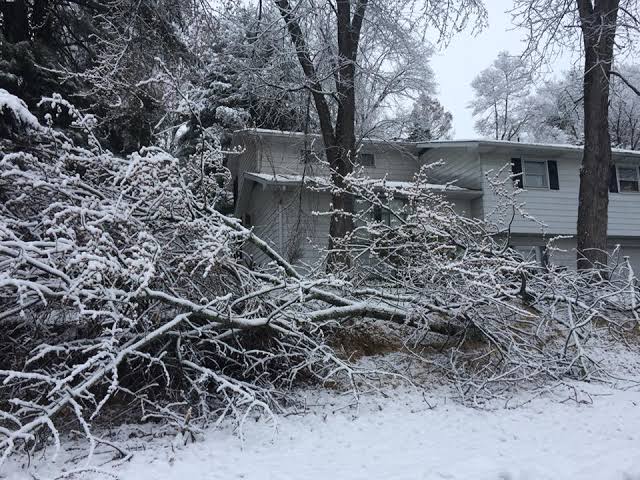
Ice on tree branches can cause serious damage when freezing rain adds enough weight to bend limbs, split branch attachments, or break sections of the crown. A tree doesn’t have to be dead or visibly rotten to lose a large branch during an ice storm. Long limbs, weak unions, exposed crowns, and the amount of ice and wind involved all affect what happens. For homeowners in Chelmsford, Dracut, Reading, and surrounding Massachusetts communities, the safest response is to stay clear of ice-loaded trees, look for damage from a distance, and have unstable limbs evaluated after conditions allow.
At East Coast Tree Service, we provide tree trimming, storm damage cleanup, tree removal, and emergency tree services throughout eastern Massachusetts. We work with homeowners who need help addressing broken branches, damaged trees, and conditions that may affect nearby buildings, driveways, and other parts of their property.
Ice storms are difficult because the tree can change throughout the event. A branch that held its weight for several hours may break after additional freezing rain or a gust of wind. Damage can also remain hidden in the crown after the ice melts.
Why Does Ice Cause Tree Branches to Break?
Freezing rain forms when liquid precipitation reaches a surface cold enough for the water to freeze on contact.
As the ice coating grows around twigs and branches, it adds weight throughout the crown.
That extra load creates bending forces, particularly on branches that extend a long distance from the trunk.
When the applied stress exceeds the strength of the wood or its attachment, the branch can bend permanently, crack, or separate.
Wind can make the loading more difficult because an already weighted branch must respond to additional movement.
The amount of ice matters, but it isn’t the only factor. Two neighboring trees can experience the same freezing rain and suffer very different damage because their crowns and branch arrangements are different.
How much ice does it take to break a tree branch?
There is no single thickness that guarantees branch failure.
The National Weather Service uses ice-accumulation thresholds to issue winter weather alerts. In many locations, approximately one-quarter inch of ice is associated with ice storm warning criteria, although thresholds vary by forecast area.
That is a weather-warning reference, not a measurement of the strength of every tree.
Some small or poorly supported branches may fail with less accumulation. Other trees can withstand much greater amounts.
The danger increases as ice continues building, particularly when wind develops or the tree already has structural problems.
You can review the National Weather Service Boston’s winter weather definitions for information about local alerts.
1. Ice Adds Weight Along the Entire Branch
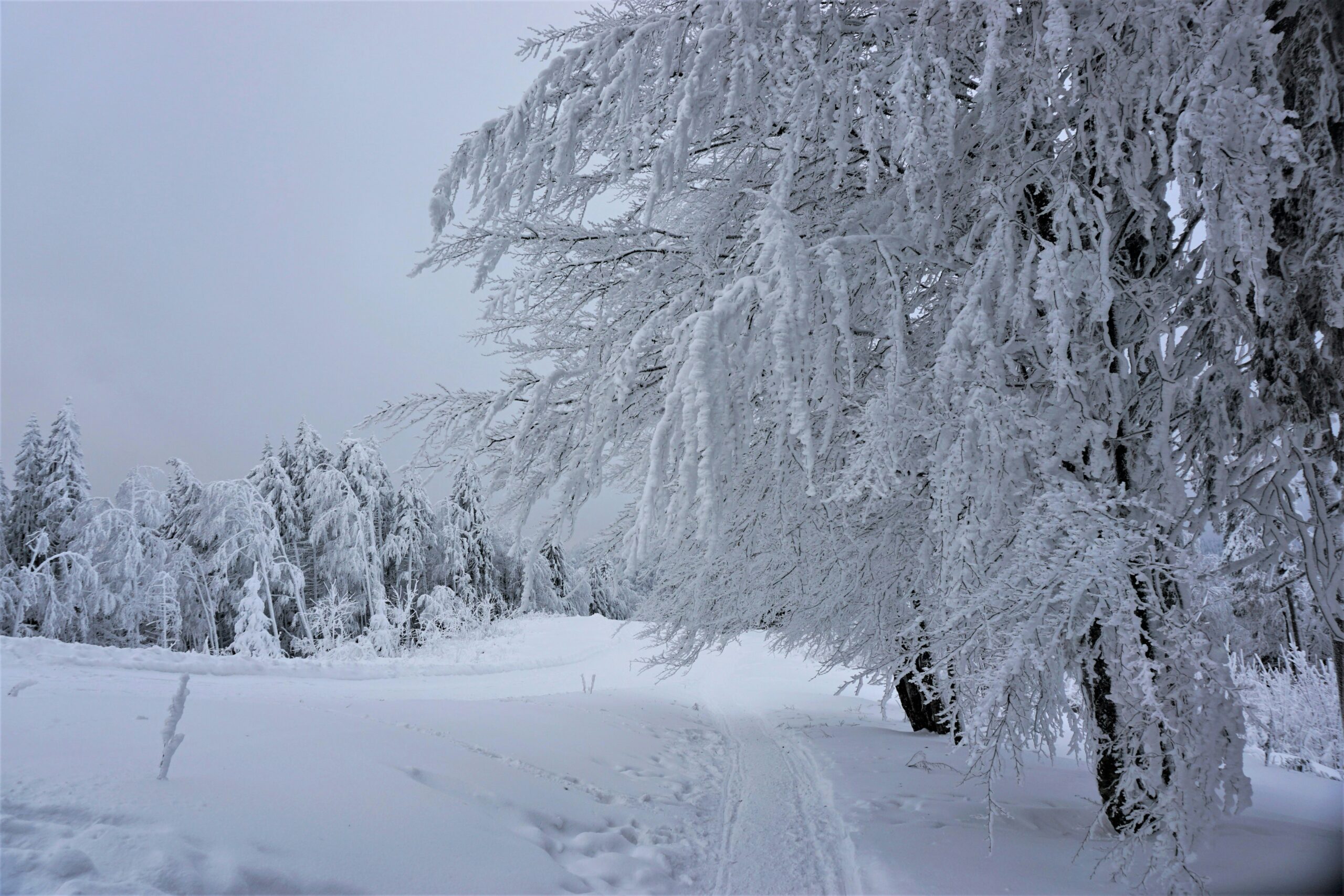
A tree branch supports its own weight under normal conditions.
During an ice storm, frozen precipitation adds weight to the smaller twigs, secondary branches, and larger limbs.
A mature tree with an extensive crown has many surfaces where ice can accumulate.
That added mass can create substantial stress even when the trunk and branch attachments appear sound.
The problem becomes more pronounced when the freezing rain continues for several hours.
Each additional layer increases the load that the branch must support.
Why can a healthy branch suddenly snap?
Wood has limits. A branch may be healthy but unable to withstand the weight applied during an extreme event.
Research on a major October 2011 snowstorm in Massachusetts illustrates this point.
Researchers Brian Kane and John Finn examined 1,764 trees on the University of Massachusetts Amherst campus after the storm. Most observed branch failures were not associated with an obvious structural defect.
That study involved wet snow rather than freezing rain, so its results should not be treated as measurements of ice accumulation. It does show why heavy precipitation loading can break branches that looked normal beforehand.
We recommend looking beyond visible decay when evaluating a tree’s exposure to winter storms.
2. Long, Horizontal Limbs Experience Greater Leverage
The position and length of a branch affect how added weight acts on it.
A long limb extending over a driveway places much of its weight at a distance from the trunk.
When ice collects on its outer twigs and secondary branches, that additional weight increases the bending force acting closer to the branch’s attachment.
The farther the load is distributed from the supporting point, the more demanding the mechanical conditions can become.
This helps explain why large, spreading crowns can be vulnerable during freezing rain.
Does a larger branch always mean a stronger branch?
No.
A thicker limb generally has more structural wood, but it may also be much longer and support a greater number of smaller branches.
Those smaller branches add surface area where ice can collect.
The relationship between branch diameter, length, crown structure, and loading is more complicated than simply comparing which limb looks thicker.
The Massachusetts snowstorm study found that branch dimensions and the accumulated surface area of secondary growth helped explain breakage patterns.
For mature trees with long limbs over buildings, we recommend assessing the branch architecture rather than relying on size alone.
3. Weak Branch Attachments Can Split Under Ice Loading
Some trees develop two large stems or branches that grow closely together.
When bark becomes trapped between the connecting stems, the attachment may contain what arborists call included bark.
That condition can interfere with the development of a strong wood-to-wood connection.
Under heavy ice loading, the attachment may split apart.
However, a narrow V-shaped union is not enough by itself to determine that a particular tree is about to fail. The size of the stems, attachment structure, visible defects, and overall condition need to be considered.
What does a splitting branch union look like?
Warning signs can include a new crack where two large stems meet, separated bark, or an opening that was not present before the storm.
A fresh split involving the trunk or a major branch attachment deserves prompt attention.
If the affected stem could reach the house, driveway, or another occupied area, stay away from the possible fall zone.
Don’t attempt to tighten the stems with a rope, ratchet strap, or other improvised support.
The condition of the connection needs to be evaluated before deciding whether pruning, another intervention, or removal is appropriate.
4. Deadwood, Decay, and Old Storm Injuries Reduce Available Strength
Existing defects can make certain branches more vulnerable when ice accumulates.
A dead branch may have lost structural integrity through deterioration.
Wood decay can reduce the amount of sound material supporting a limb, while an old crack may leave a section of the branch weakened.
Ice adds loading to those existing conditions.
That doesn’t mean every cavity or old wound requires immediate removal. The location and extent of the defect matter.
We consider whether damaged wood affects the branch’s capacity to remain attached and what could be struck if it falls.
Can a tree survive with some dead branches?
Yes. A living tree can contain deadwood while the remainder of its crown continues growing.
Selective pruning may be appropriate when the dead branches create a concern or interfere with the intended use of the property.
A dead limb above a frequently used entrance deserves different attention from deadwood in an isolated area where a falling branch is unlikely to strike anything.
Our tree trimming services address damaged branches, deadwood, and other pruning needs based on the tree’s condition and location.
We wouldn’t recommend removing healthy branches indiscriminately because a tree has one dead limb.
5. Wide, Unbalanced Crowns Can Accumulate Ice Unevenly
The overall shape of a tree influences how freezing rain loads its branches.
Trees with broad, spreading crowns may have substantial lateral branch surface area.
That provides more opportunity for ice accumulation than the structure of some narrower, more upright trees.
Uneven growth can also matter.
A tree at the edge of a wooded lot may develop more branches toward the available sunlight, leaving one side of the crown considerably heavier than the other.
During an ice storm, that uneven distribution can contribute to different loading conditions across the tree.
Should an unbalanced tree be heavily thinned?
Not automatically.
Removing large amounts of living foliage can affect tree health and alter branch weight distribution.
Stripping interior branches while leaving most foliage at the tips, sometimes called lion-tailing, can create undesirable mechanical conditions.
We recommend identifying specific branches or attachments that need management rather than treating the entire canopy as something that must be opened up.
When appropriate, selective reduction pruning can shorten an overextended branch and reduce the leverage associated with its outer growth.
Whether that approach makes sense depends on the species, existing structure, and amount of living foliage that would be removed.
6. Leaves and Needles Change How Ice and Snow Accumulate
Evergreens retain foliage throughout winter, while most deciduous trees lose their leaves before the coldest months.
That difference affects how precipitation interacts with the crown.
Needles and branches provide surfaces for ice and snow accumulation. Some evergreen species have flexible branches that shed snow relatively well, but freezing rain may remain attached to those same surfaces.
Deciduous trees with lingering leaves can also accumulate more wet snow than they would after leaf drop.
Why do ice storms damage trees differently from wet snowstorms?
Wet snow can build up on leaves, needles, and branches. Depending on its consistency and the tree’s shape, some snow may slide off.
Freezing rain forms a coating directly on exposed surfaces, making it more difficult for the material to shed before temperatures rise.
Both conditions can produce large loads, but their accumulation and release patterns differ.
That’s why we don’t treat research on a heavy snowstorm as proof that every species will respond identically during freezing rain.
Which New England Trees Are More Vulnerable to Ice Storm Damage?
Research on ice storms identifies broad differences among tree species, but species alone cannot predict whether an individual tree will break.
A healthy tree with good structure may perform differently from a nearby tree of the same species that has extensive decay or weak major attachments.
| Tree Type | General Ice-Storm Consideration |
|---|---|
| Silver maple and other broad-crowned soft maples | Long lateral branches and some weak attachments can increase susceptibility |
| Willows and poplars | Crown structure and comparatively weak wood in some species can contribute to breakage |
| American and Siberian elms | Broad spreading crowns and substantial branch surface area can collect considerable ice |
| Eastern white pine | Needles and layered branching can retain ice; breakage patterns depend on loading and structure |
| Birches | Slender stems may bend dramatically; recovery depends on age, severity, and structural injury |
| White oak | Often comparatively resistant to ice damage, although large or damaged limbs can still fail |
| Spruce and hemlock | Some conical crown forms are relatively resistant, but severe ice loading can still cause damage |
The University of New Hampshire Extension’s research on ice-resistant trees discusses branch structure, crown shape, and species differences in more detail.
We recommend considering the individual tree and its position on the property instead of deciding to remove an entire species from a landscape.
Why Can White Pine Branches Break During Freezing Rain?
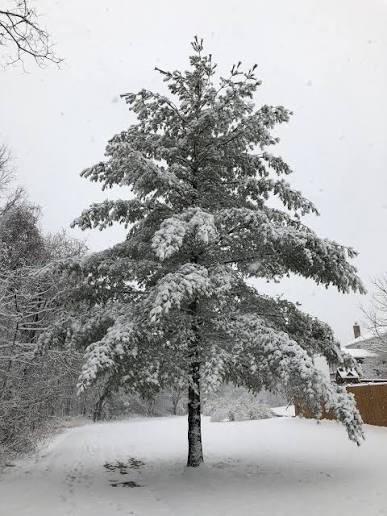
Eastern white pine is common across eastern Massachusetts.
Its long branches and layers of foliage can accumulate ice under certain conditions.
When loading becomes excessive, large limbs may break, particularly where there are structural defects or extensive horizontal growth.
However, white pine can respond differently to snow and to freezing rain.
Its flexible foliage and branches may shed some snow, while ice can remain attached to needles and twigs.
It would be inaccurate to describe every white pine as inherently unsafe or guaranteed to lose branches during an ice storm.
We look at the condition of the actual tree, the size and position of its limbs, and nearby structures when discussing maintenance.
What Should You Do While Ice Is Still on the Branches?
The safest approach is to stay out of the area beneath ice-loaded trees.
Branches can break without warning, especially when additional precipitation or wind changes the loading.
Do not stand underneath a tree to examine a crack or photograph the crown.
Keep vehicles and people away from branches that are bending substantially or have already fractured.
Should you shake the branches to remove ice?
No.
Striking or shaking frozen branches may cause them to break or release heavy ice unexpectedly.
We also recommend avoiding attempts to pull down damaged limbs with ropes, vehicles, or ladders.
A branch that is partly separated from the trunk can be under considerable tension and may move unpredictably.
What if a branch is touching a power line?
Stay away from the tree and the affected area.
Never assume a downed or hanging wire is de-energized.
Massachusetts emergency guidance advises treating downed wires as live and reporting them to emergency services.
Call 911 for an immediate electrical danger and contact the electric utility for the appropriate response.
Do not attempt to cut a branch touching electrical equipment or move debris that may be in contact with a wire.
What Should You Check After the Ice Melts?
After the storm passes and conditions are safe, begin with a visual inspection from a location outside the possible fall area.
You don’t need to walk under the tree to identify many of the conditions that warrant further attention.
Look for changes in the crown, including a new opening where a major limb used to be.
Check for broken branches caught in other parts of the tree and visible splits at major attachments.
Compare the tree’s current position with its previous lean if you have photographs or are familiar with its normal shape.
Freshly lifted soil or a sudden change in trunk position can indicate root-related movement.
Are hanging branches dangerous after the ice is gone?
Yes.
A broken limb may remain lodged in the crown even after the ice has melted.
Wind or further movement can dislodge it later.
These suspended limbs should be treated differently from loose branches already resting on open ground.
Keep the area beneath them clear until they can be evaluated and removed by appropriately trained personnel.
What if the tree lost a large section of its crown?
The next step depends on how much sound structure remains.
A tree with limited branch damage and a stable trunk and root system may be suitable for selective pruning.
Another tree may have lost a major structural stem, developed a large split, or suffered damage that makes preservation impractical at its location.
UMass Amherst recommends evaluating the remaining tree and its potential for recovery rather than treating every broken branch as a reason for complete removal.
You can review the UMass guidance on inspecting storm-damaged trees for additional information.
Can an Ice-Damaged Tree Recover?
Many trees can survive the loss of some branches.
Recovery depends on the extent of the damage, the condition of the remaining crown, the health of the roots, and whether major structural attachments remain intact.
We recommend distinguishing between a tree that needs damaged branches removed and one that has lost the structure required to remain at its present location.
A mature tree may need more than one season to develop new growth around the affected portions of its crown.
It may also need follow-up inspections or further pruning as its structure changes.
Should every torn branch be cut back immediately?
Broken branches that pose an immediate risk may require prompt professional attention.
But the appropriate pruning cut depends on the branch and the remaining attachment.
Cutting a damaged limb at an arbitrary point can leave a stub or create a larger wound than necessary.
For large branches, the weight of the remaining section also needs to be controlled during removal to avoid tearing bark or causing unpredictable movement.
We recommend having substantial storm-damaged branches handled by a professional tree crew rather than attempting to remove them from a ladder.
When Is Emergency Tree Removal Necessary After an Ice Storm?
Emergency work may be appropriate when a damaged tree or large limb presents a direct threat to people, structures, or access.
Examples include a tree resting on a building, a major split threatening an occupied area, a newly uprooted tree, or a large unstable limb suspended above an entrance.
Not every broken branch requires emergency removal.
Damage in an isolated part of a wooded lot may allow more time for evaluation than damage affecting a home or regularly used driveway.
We consider the tree’s condition and the consequences of additional movement when discussing the work.
Our tree services in Chelmsford, MA include storm-related tree removal, pruning, cleanup, and emergency tree care.
What if the tree is leaning after the storm?
A lean that has existed for years is different from a sudden change in position.
New leaning combined with lifted soil or exposed roots can indicate a loss of anchorage.
That condition requires careful evaluation, particularly when the tree could fall onto a house, road, or other occupied area.
Do not attempt to straighten or stabilize a mature tree using a vehicle or improvised cable.
Can Professional Pruning Reduce Ice Storm Damage?
Pruning can address selected structural concerns before winter.
Removing dead or damaged branches may eliminate known sources of falling wood.
Selective reduction pruning can sometimes decrease the leverage of an overextended limb.
Structural pruning of young trees can help develop more suitable branch arrangements as they mature.
However, no pruning plan can prevent every ice-related failure.
Healthy branches sometimes break when extreme loading exceeds their strength.
Should you thin the entire canopy before winter?
Not as a routine response to ice storms.
Thinning removes selected living branches and can change the amount of surface area available for accumulation.
But excessive thinning reduces foliage, alters weight distribution, and may weaken the tree’s long-term structure.
We recommend identifying specific pruning objectives rather than making the crown noticeably thinner without a reason.
Our tree trimming work focuses on the condition of the tree and the branches requiring attention.
What About Cabling and Bracing?
In some circumstances, a qualified arborist may recommend an engineered supplemental support system for a particular tree.
Cabling and bracing can help manage certain structural concerns when the tree is otherwise a suitable candidate for preservation.
These systems require appropriate design, installation, and ongoing inspection.
They do not guarantee that the tree will withstand all future storms.
We wouldn’t recommend installing an improvised cable or chain between major limbs.
The need for support should be established through an assessment, and the installation scope should be confirmed with the qualified provider.
Should You Remove Ice-Damaged Trees or Keep Them?
The decision should be based on the condition of the remaining structure and the tree’s location.
| Condition After the Storm | What It May Mean | Next Step |
|---|---|---|
| Small branches broken, crown otherwise intact | Localized storm damage | Assess pruning and cleanup needs |
| Several large branches damaged | Substantial crown injury | Professional evaluation of remaining structure |
| Major trunk union split | Possible structural instability | Keep clear and request prompt assessment |
| New lean with lifted roots | Possible loss of anchorage | Restrict access and seek urgent professional attention |
| Tree resting on a house or blocking critical access | Immediate property or access concern | Arrange emergency evaluation and removal as appropriate |
We recommend avoiding a removal decision based solely on the number of broken branches.
Some mature trees retain enough sound structure to justify preservation. Others have damage that cannot reasonably be managed near a building.
When a removal is needed in a confined location, the plan may require controlled handling of large tree sections and careful management of the surrounding area.
East Coast Tree Service also offers crane services for lifting and removal applications. The equipment selected for a specific tree depends on site access and the work required.
Does Tree Insurance Cover Damage From an Ice Storm?
Homeowners insurance may cover certain types of storm-related damage, but coverage depends on the policy and circumstances.
The rules can differ depending on whether a tree struck an insured structure, fell in an open yard, or blocked access.
We recommend documenting damage from a safe location and contacting your insurer before authorizing nonemergency work when you intend to submit a claim.
When a tree creates an immediate hazard, safety and appropriate emergency response take priority.
Keep copies of the estimate, invoices, and photographs that can be taken without entering a hazardous area.
Do not assume that every fallen branch or stump removal is covered simply because an ice storm occurred.
How Should You Prepare Trees Before the Next Ice Storm?
Start with trees close to the house, garage, driveway, and frequently used outdoor areas.
Look for known dead branches, previous storm damage, major cracks, and branches that have changed position.
We recommend a professional inspection when large mature trees have substantial limbs over structures or when a defect cannot be evaluated from the ground.
Appropriate maintenance may involve selective deadwood removal or structural pruning.
It may also involve monitoring a tree rather than making unnecessary cuts.
Does planting different tree species help?
Species diversity can reduce the likelihood that every tree on a property responds the same way to a storm.
When choosing replacement trees, consider the mature crown size, branch structure, available rooting space, and distance from buildings and utilities.
Ice resistance is one consideration among several.
A tree that tolerates freezing rain relatively well may still be unsuitable for a particular yard because of its mature size, soil requirements, or growing conditions.
Ice Storm Tree Cleanup in Chelmsford and Dracut, MA
East Coast Tree Service serves homeowners and businesses throughout eastern Massachusetts, including Chelmsford, Dracut, Reading, Tewksbury, and Billerica.
Our work includes tree removal, trimming, storm cleanup, and emergency tree services.
For properties in Chelmsford, we address damaged branches, fallen trees, and tree conditions that affect access or nearby structures.
In Dracut, our tree removal services cover storm-damaged trees and other situations where removal is appropriate.
We also work in nearby communities, including Reading and Stoneham.
If the tree has already lost a substantial limb, tell us whether the remaining branches are hanging, whether the trunk has split, and what stands beneath the damaged area.
Request an Ice Storm Tree Damage Assessment
If freezing rain has left broken limbs, a split trunk, or a tree that appears to have shifted at the roots, keep people away from the affected area until the condition can be assessed.
At East Coast Tree Service, we provide tree assessments, storm damage cleanup, trimming, and removal throughout eastern Massachusetts.
Call (781) 518-8014 to request an estimate.
Tell us where the tree is located, whether it is still covered in ice, and if the damage threatens a building, driveway, or other occupied area. We’ll discuss the situation and the appropriate next steps.
If wires are down or a tree is in contact with electrical lines, stay away and contact 911 and the utility before arranging ordinary tree work.