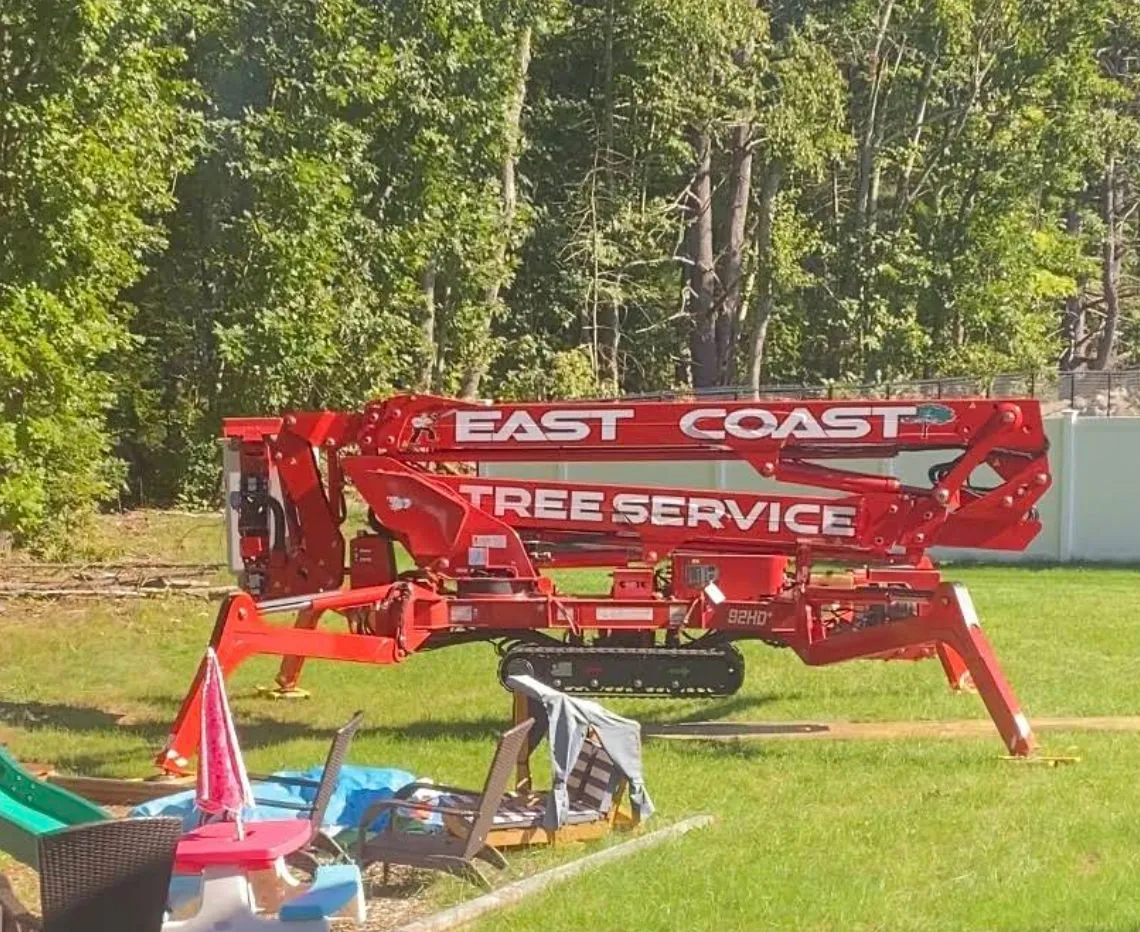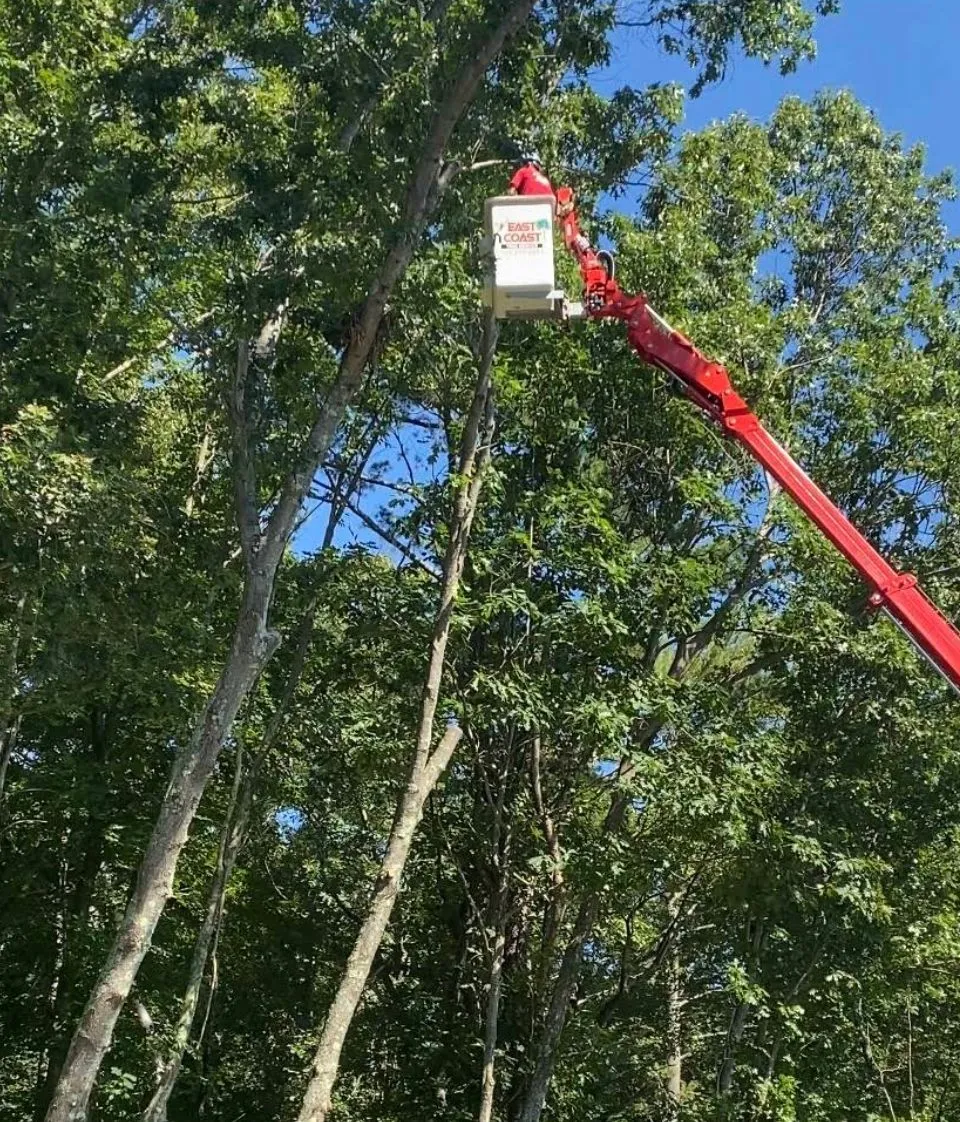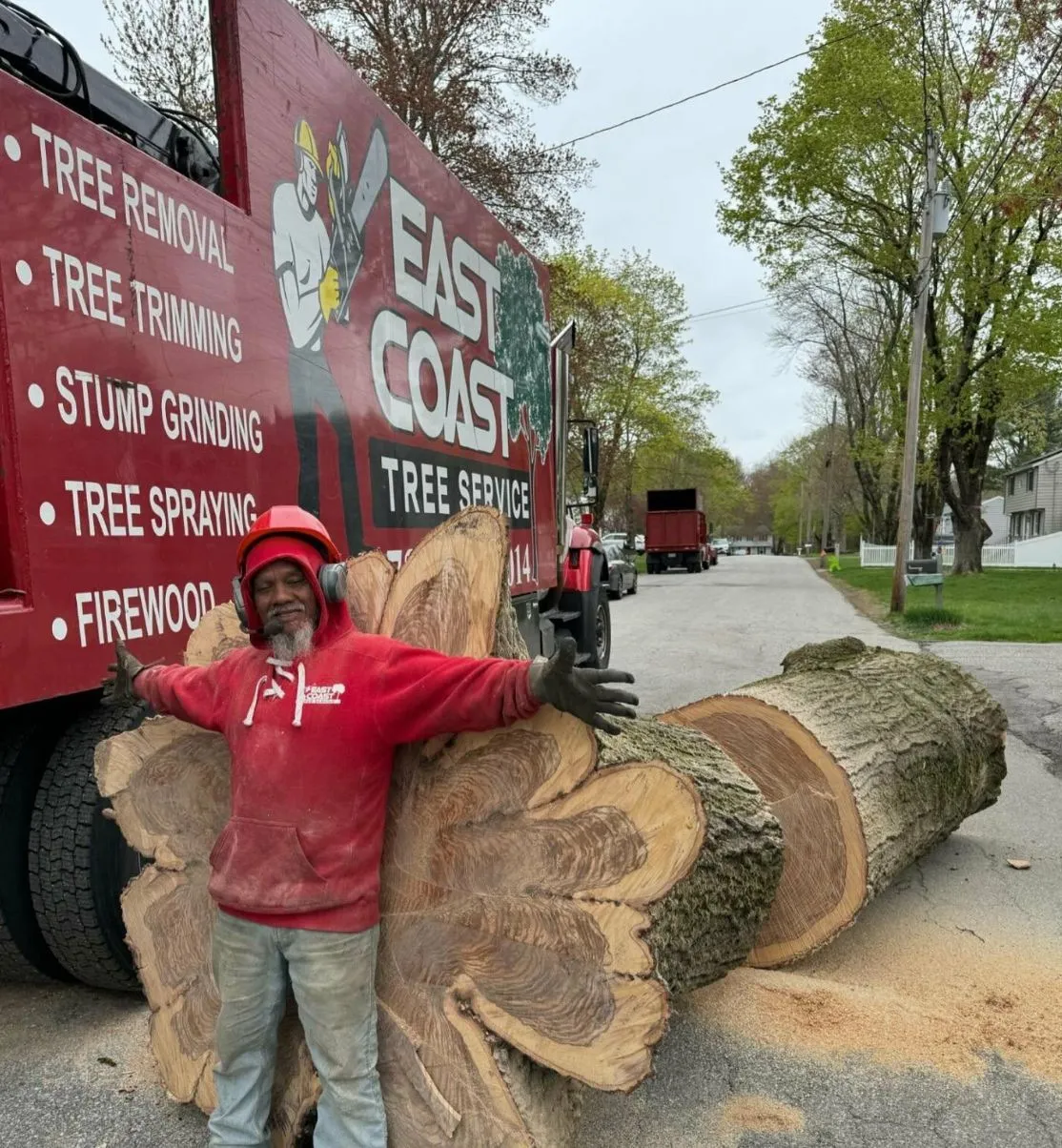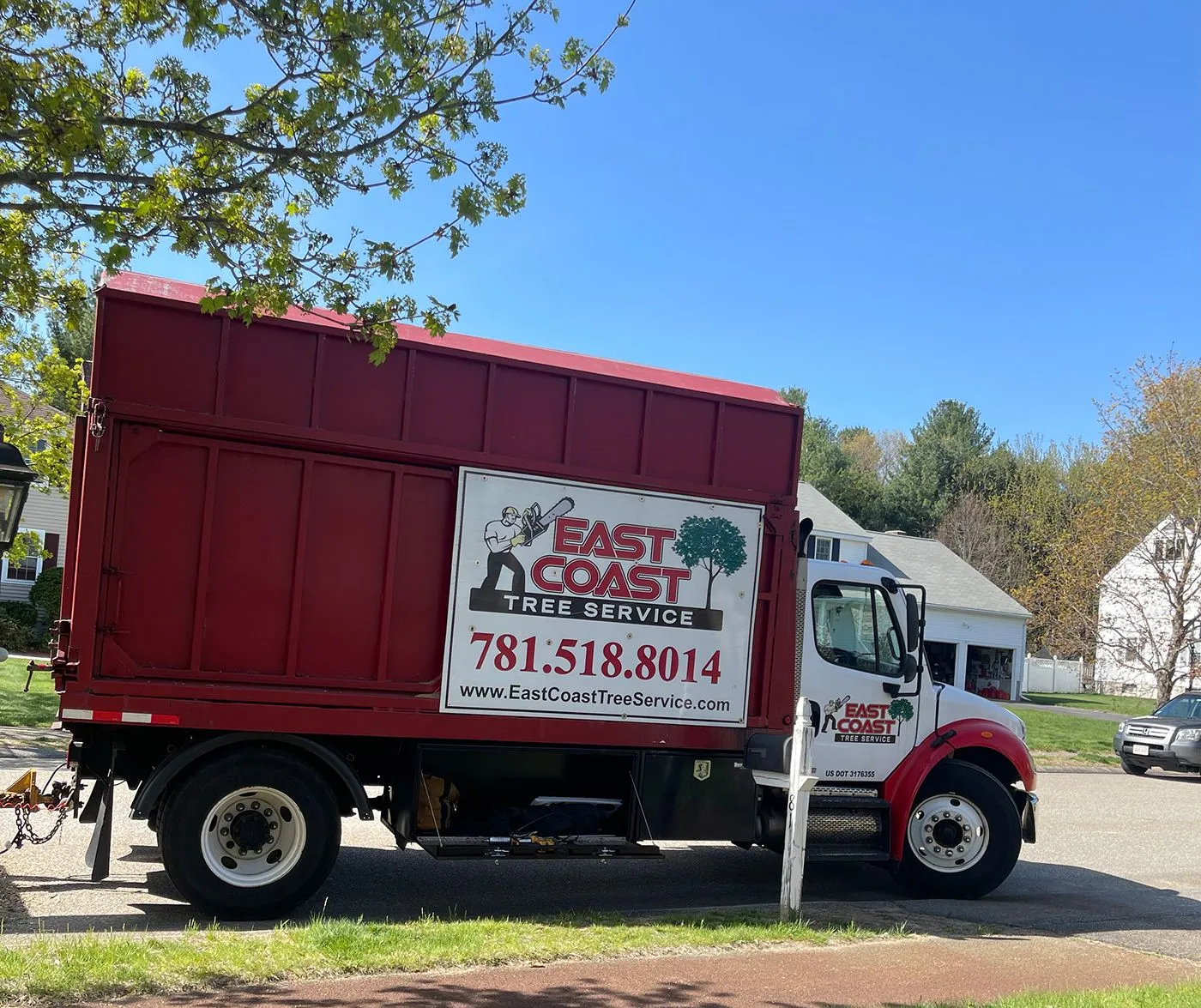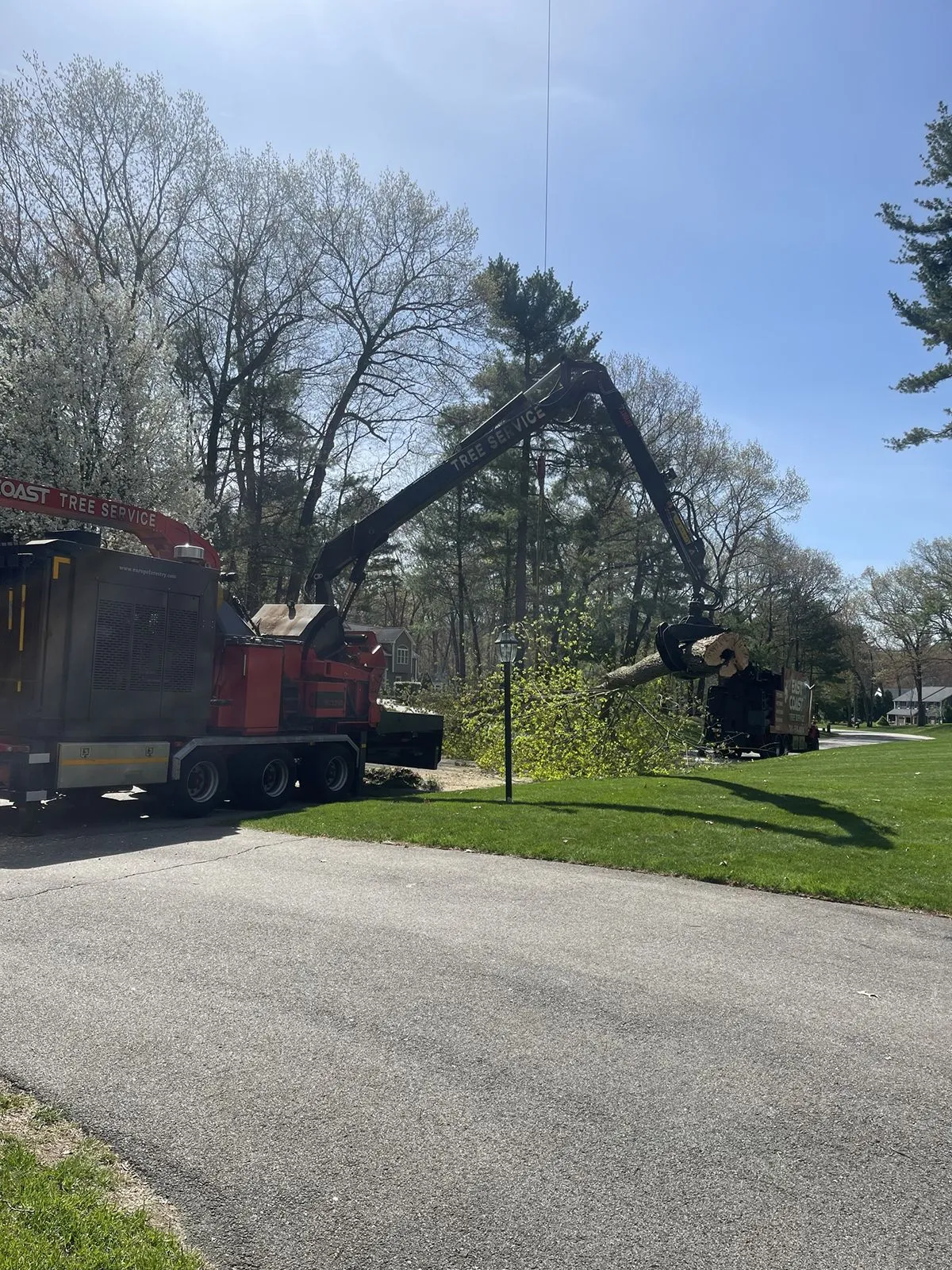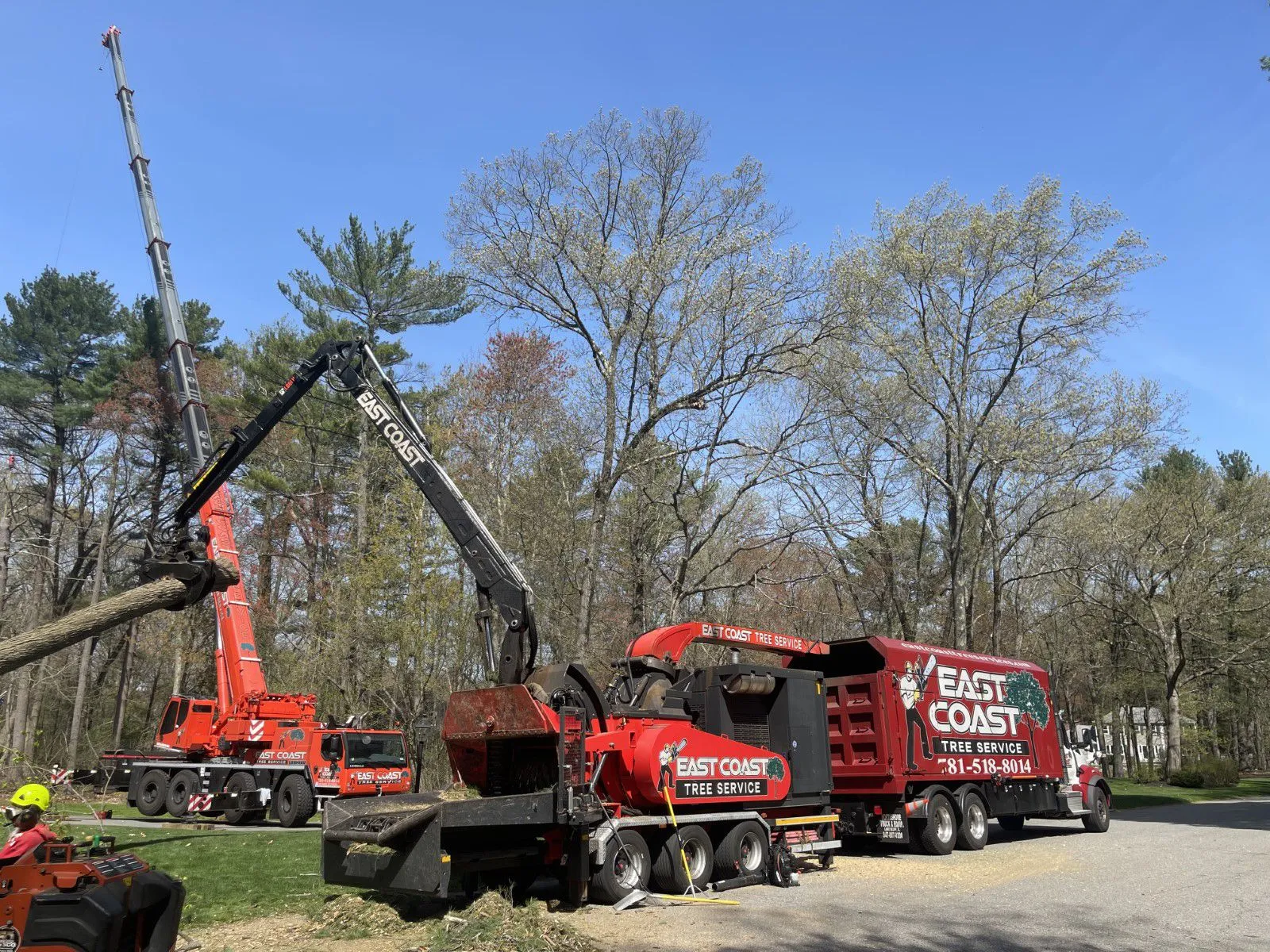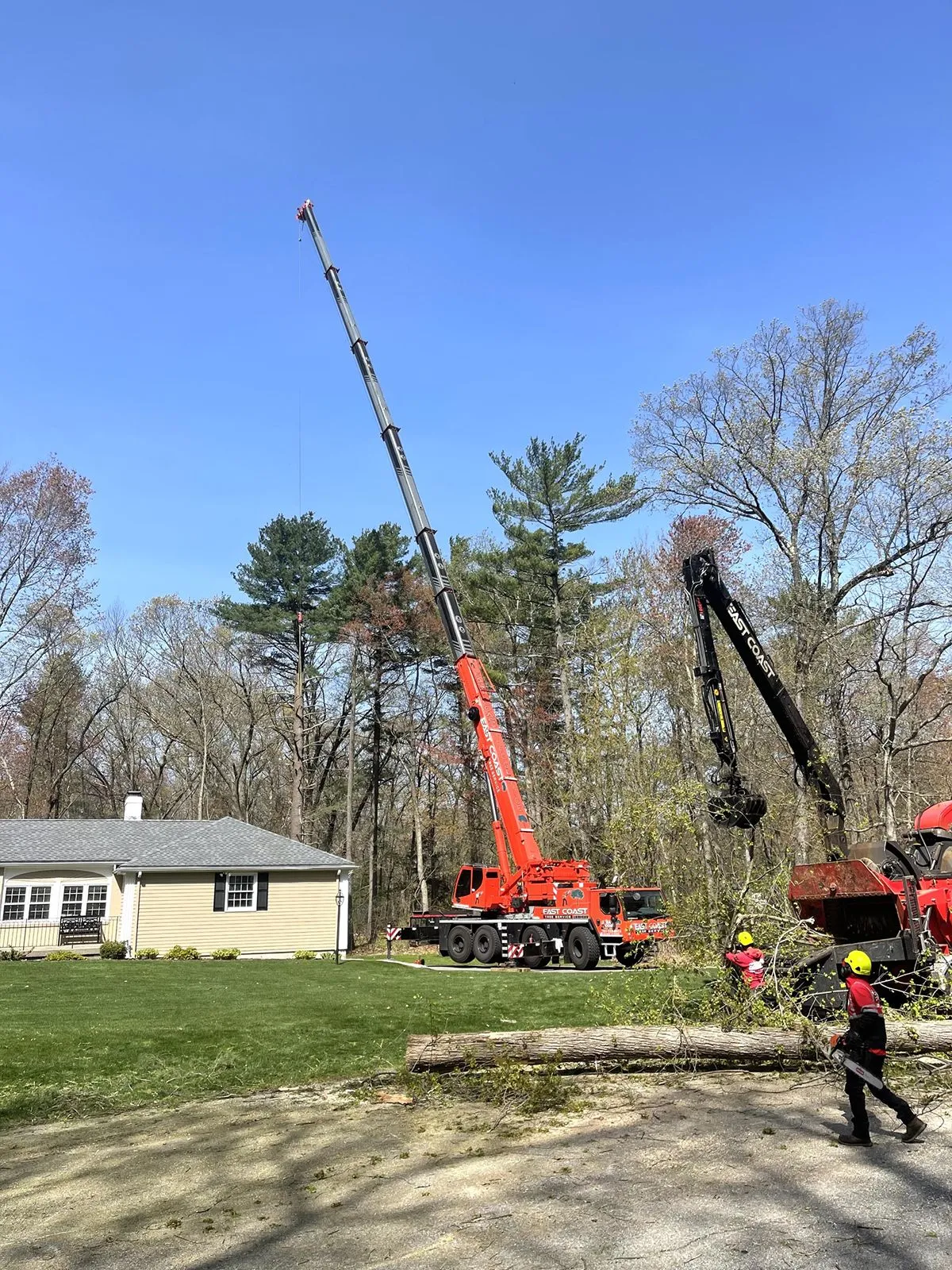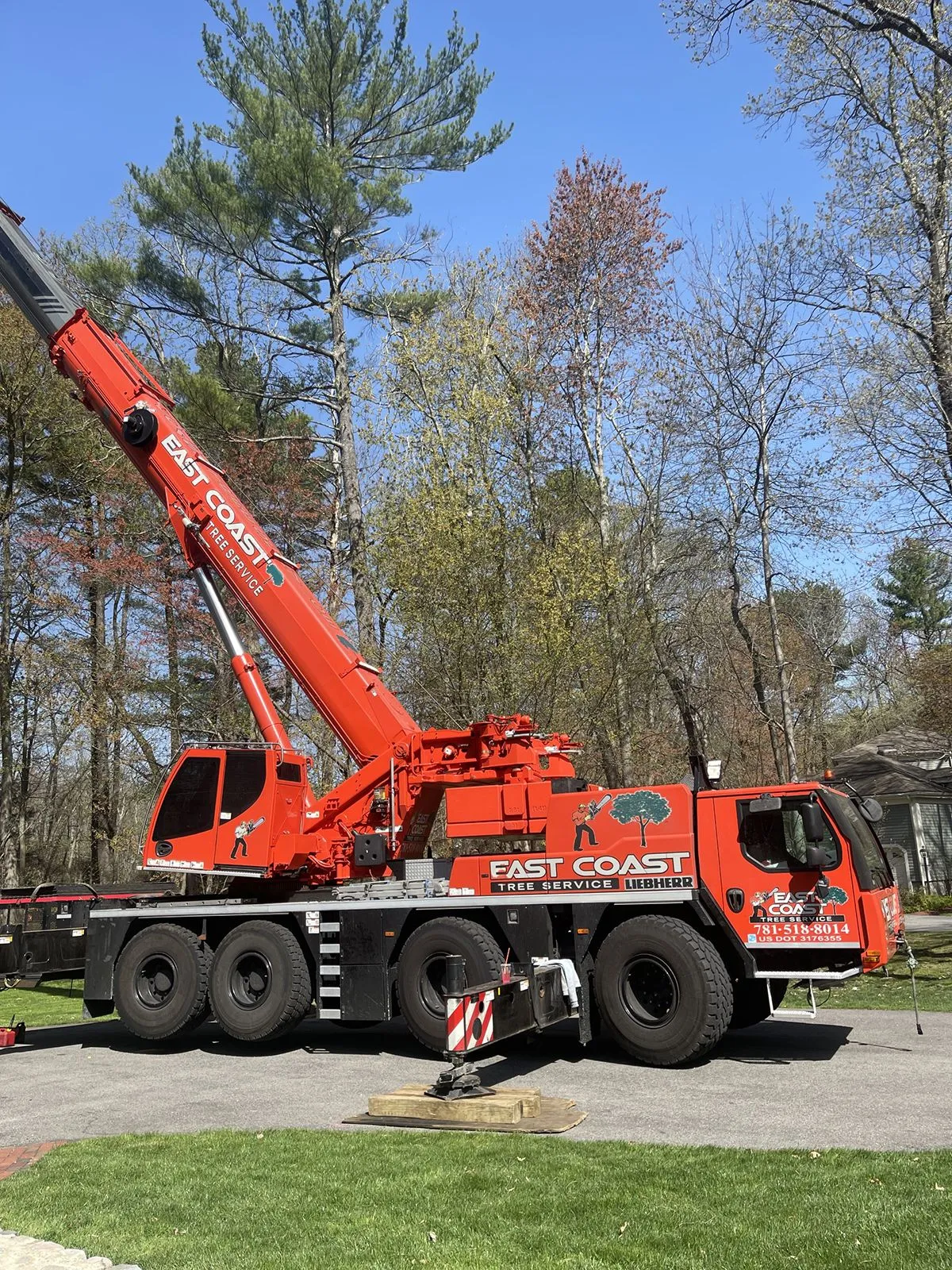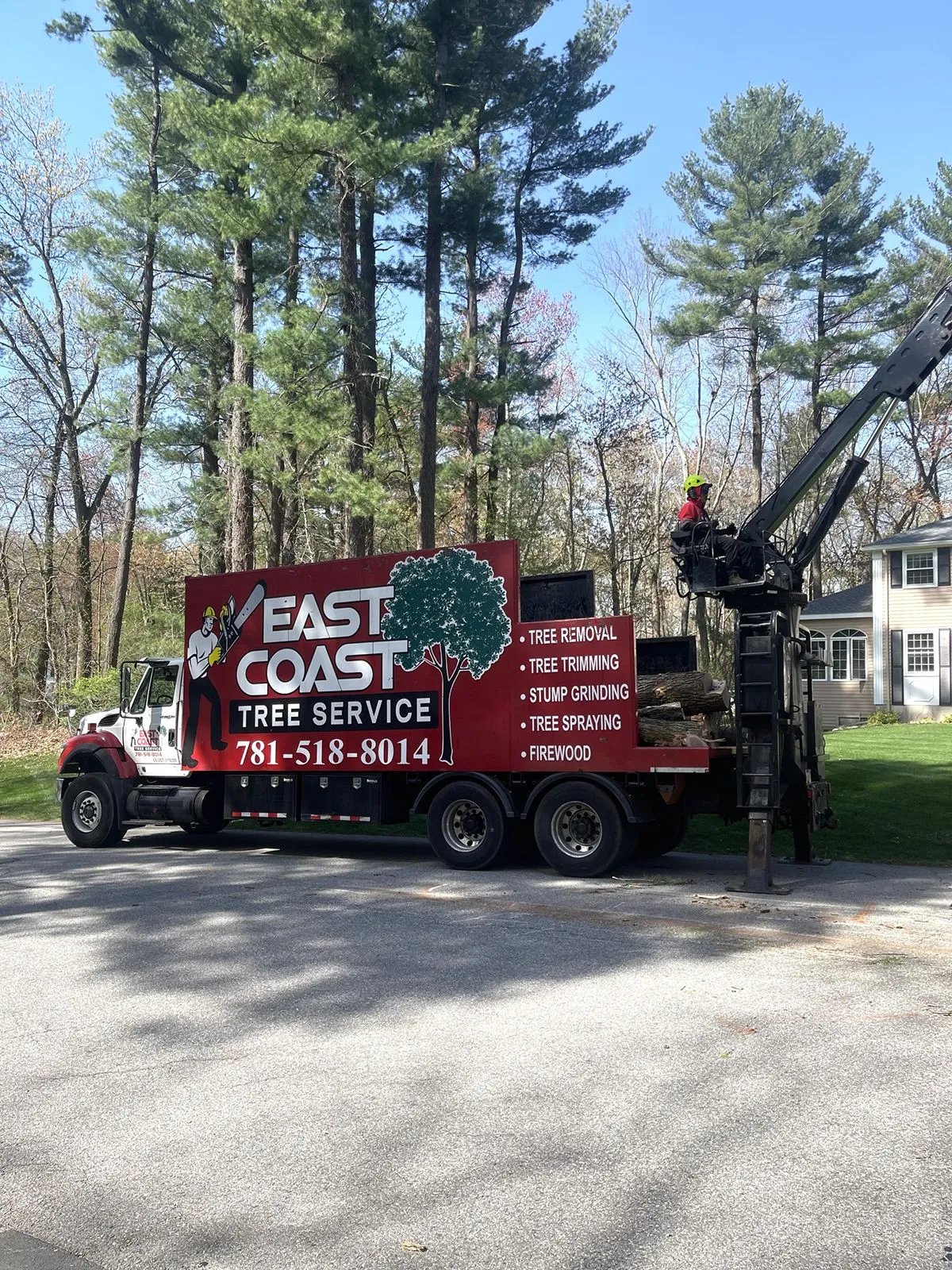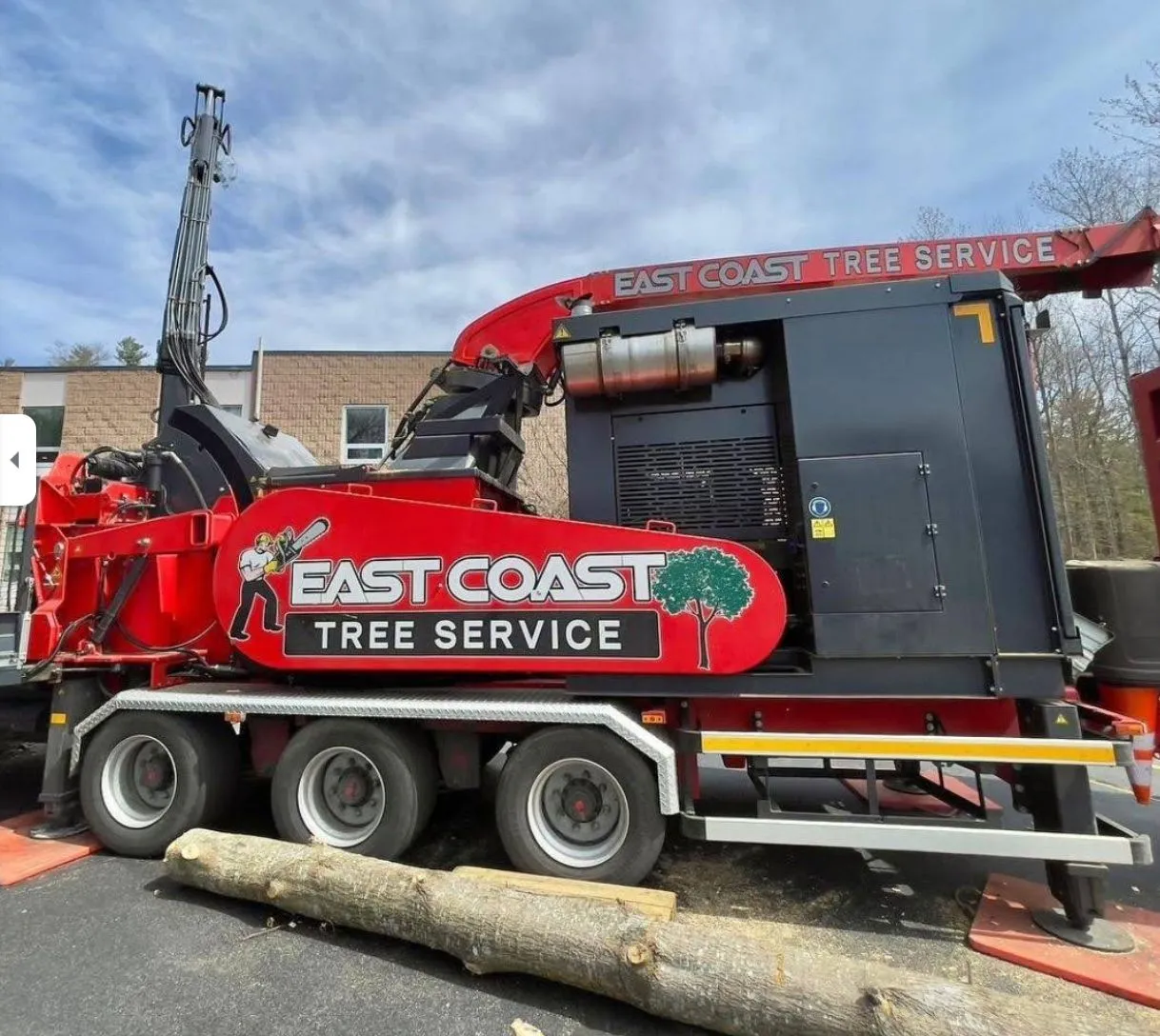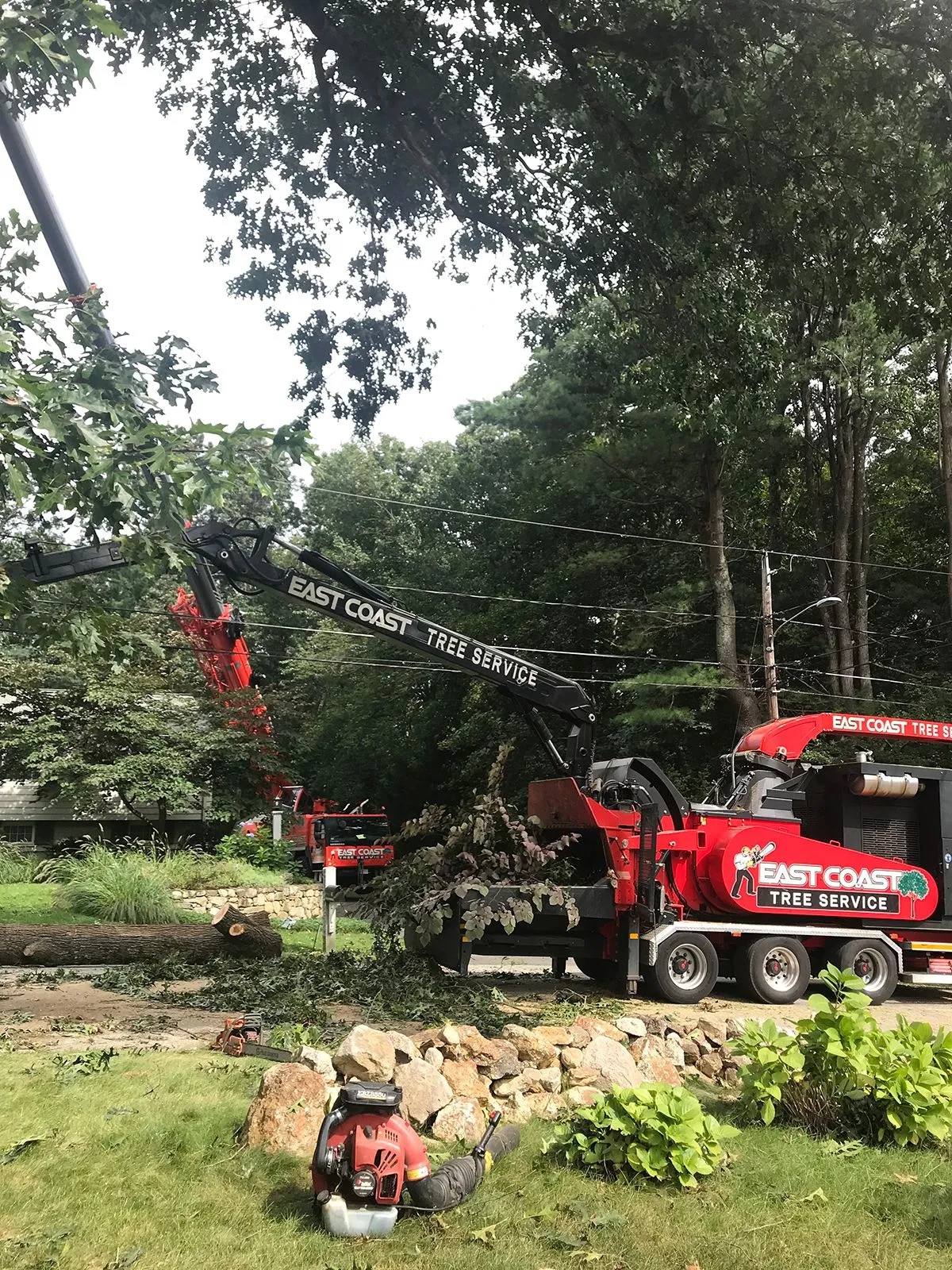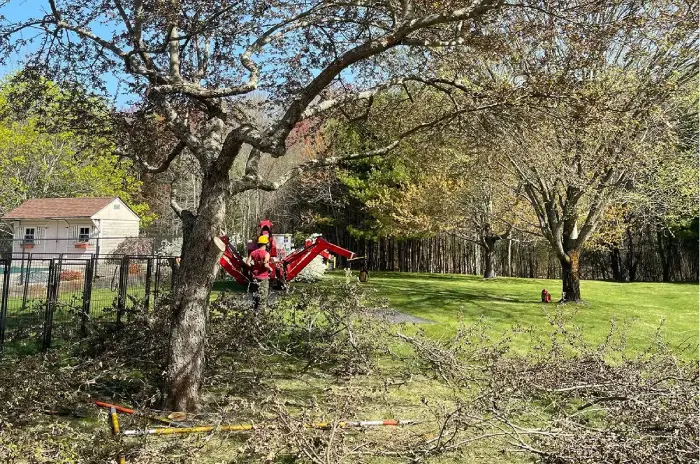
Our team includes multiple ISA Certified Arborists. East Coast Tree Service is a TCIA member and is fully insured and licensed for the work we perform, with general liability coverage and workers’ compensation insurance. Emergency tree service is available 24/7, emergency calls receive a response within up to 1 hour, and same-day emergency response is available.
Call (781) 518-8014 for a free on-site estimate in Stoneham.
ISA Certified Arborists, Experience, and Tree Removal in Stoneham
Tree removal decisions get harder when the tree is still standing but has decay, a new lean, root movement, storm damage, large dead sections, or major limbs over a house. Our team includes multiple ISA Certified Arborists, giving East Coast access to arboricultural knowledge when evaluating those conditions.
East Coast does not claim that an ISA Certified Arborist is physically present on every job or that every estimate is performed by one. Free estimates are handled by the company’s sales team, which evaluates the tree, access, nearby structures, utilities, crane or rigging requirements, cleanup scope, stump work, and site conditions before pricing the project.
East Coast Tree Service was founded by Tom FitzPatrick in 2016. Tom has more than 25 years of experience in the tree-care industry and holds an Associate of Science in Arboriculture and Community Forest Management from the Stockbridge School of Agriculture at UMass Amherst. You can learn more on our About East Coast Tree Service page.
The term Massachusetts Certified Arborist, or MCA, refers to a separate voluntary certification program sponsored by the Massachusetts Arborists Association. East Coast is not being represented here as an MAA member or as holding the MCA credential. The company credential confirmed for this page is that our team includes multiple ISA Certified Arborists.
Tree Removal Near Spot Pond and Middlesex Fells Reservation
Stoneham sits less than 10 miles northwest of Boston, but a large portion of the town feels far less urban because approximately one-third of Stoneham lies within the Middlesex Fells Reservation. Spot Pond sits near the center of the Fells and covers about 298 acres, with a forested shoreline protected from normal development.
That landscape helps explain why Stoneham contains such a strong mix of wooded land and tightly developed residential streets. The Fells is state-managed conservation land, so a homeowner cannot treat a tree inside the reservation like a private backyard tree. Properties beside the Fells also need a clear understanding of the property line before work begins.
Stoneham’s own open-space documentation describes the Spot Pond/Fells forest as primarily red and white oak, eastern white pine, and hickory. Maple, ash, beech, birch, hemlock, spruce, red pine, pitch pine, and other species form a smaller part of that woodland.
Spot Pond and the Fells are also useful geographic reference points. Route 28/Main Street runs along the eastern side of much of the reservation, while Woodland Road provides access to the main DCR facilities. Stone Zoo, the Sheepfold area, trails around Spot Pond, and the broader Middlesex Fells trail network make this one of Stoneham’s best-known parts of town.
Another local conservation area is Whip Hill Park, a 30-acre property under the care of the Stoneham Conservation Commission. The Town’s directions show a practical route from I-95/Route 128 onto Route 28 South/Main Street, through Stoneham Center, then onto Franklin Street and Perkins Street toward Whip Hill. That same route illustrates how quickly Stoneham changes from its busy Main Street corridor to wooded residential areas.
A private tree near a wetland, pond, stream, flood zone, or other regulated resource area can also create a Conservation Commission issue even when the trunk is clearly on private property. That needs to be checked before vegetation is removed.
Stoneham’s 2008 Ice Storm: Lessons in Emergency Preparedness
The December 2008 New England ice storm is a useful regional example of what prolonged freezing rain can do to trees and electrical infrastructure. NOAA records show major tree and power-line damage across parts of New England, with some of the hardest-hit areas in interior Massachusetts and southern New Hampshire. We do not present it as a Stoneham-specific East Coast Tree Service case study.
What is directly documented for Stoneham is the continuing risk. The Town’s Hazard Mitigation and Municipal Vulnerability Plan classifies ice storms as a high-frequency hazard and specifically notes that ice buildup places excessive weight on trees and power lines. Blizzards are also classified as high-frequency events.
For a homeowner, the warning signs after an ice storm, nor’easter, thunderstorm, or heavy wet snow are practical: a new trunk lean, soil lifting around the root plate, split leaders, newly exposed cracks, hanging limbs, broken tops, or a tree that has shifted toward a house or utility line.
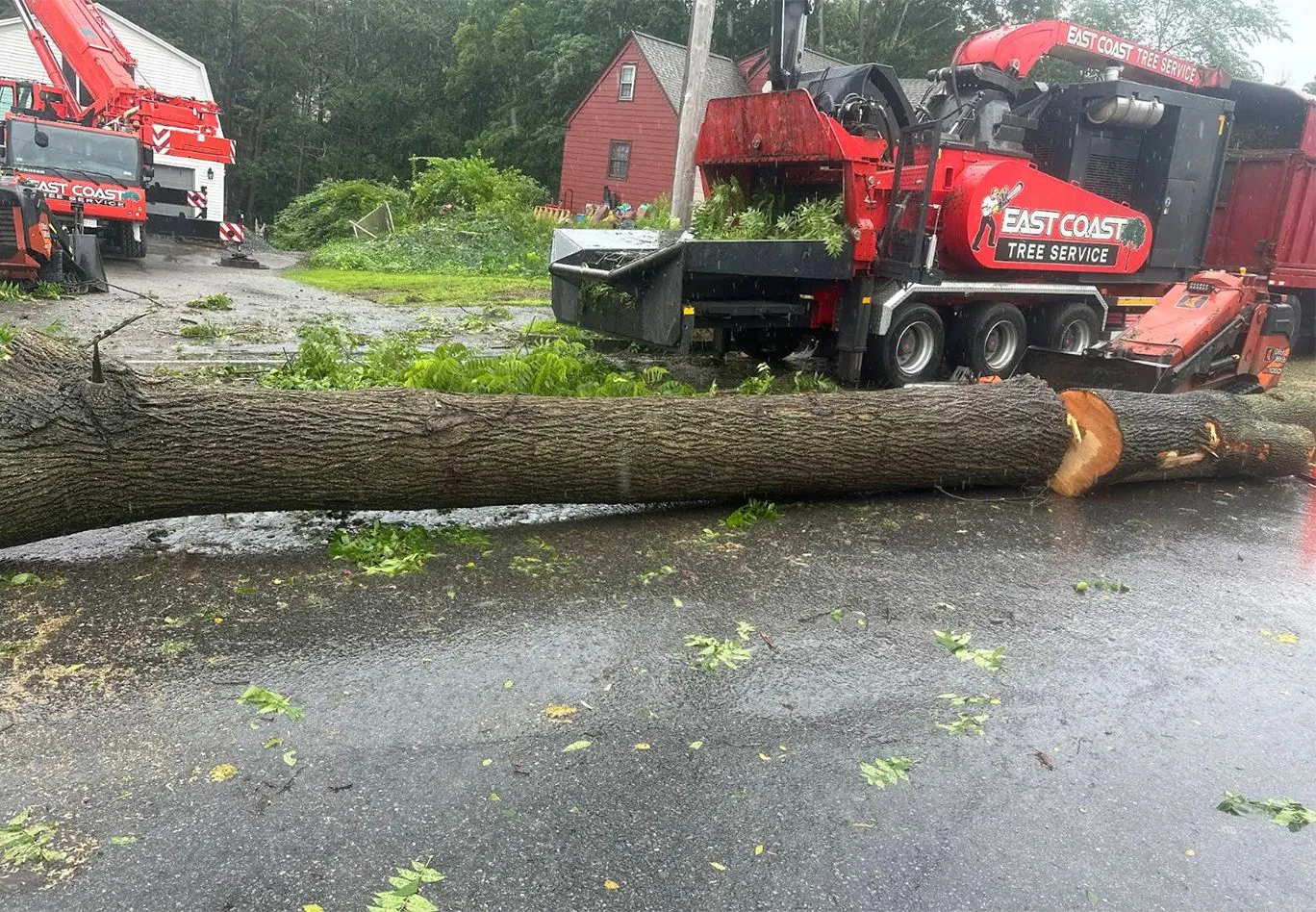
East Coast provides 24/7 emergency tree removal. Emergency calls receive a response within up to 1 hour, and same-day emergency response is available. Live electrical lines, active severe weather, blocked roads, and utility clearance can still affect when physical removal can safely begin.
Removing Mature Oaks and Maples on Narrow Stoneham Streets
Stoneham’s documented vegetation gives us something more useful than a generic list of New England trees. Around Spot Pond and the Fells, red and white oaks are among the dominant hardwoods, with eastern white pine and hickory also prominent. Maples, ash, beech, birch, spruce, and hemlock are present as well.
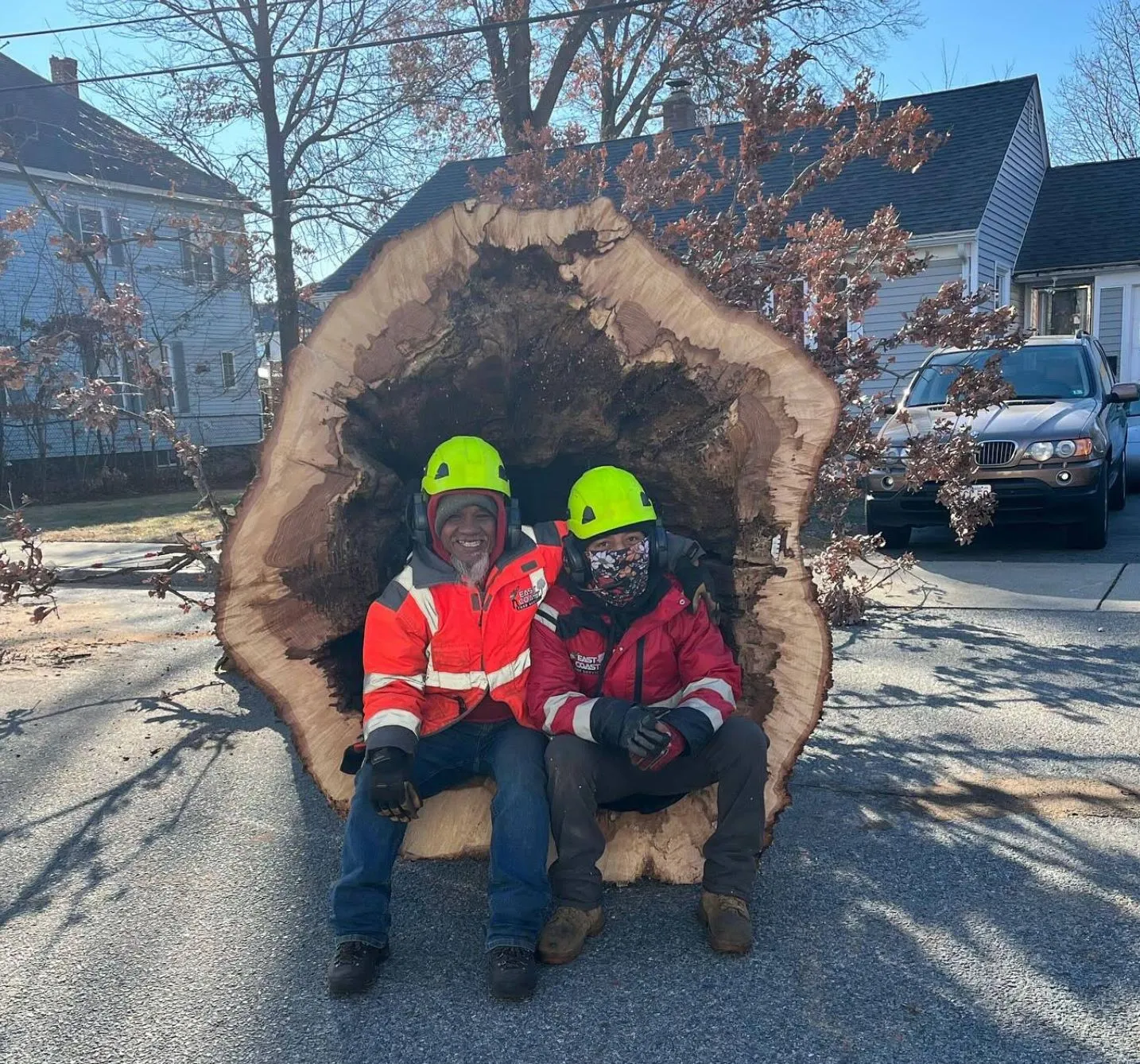
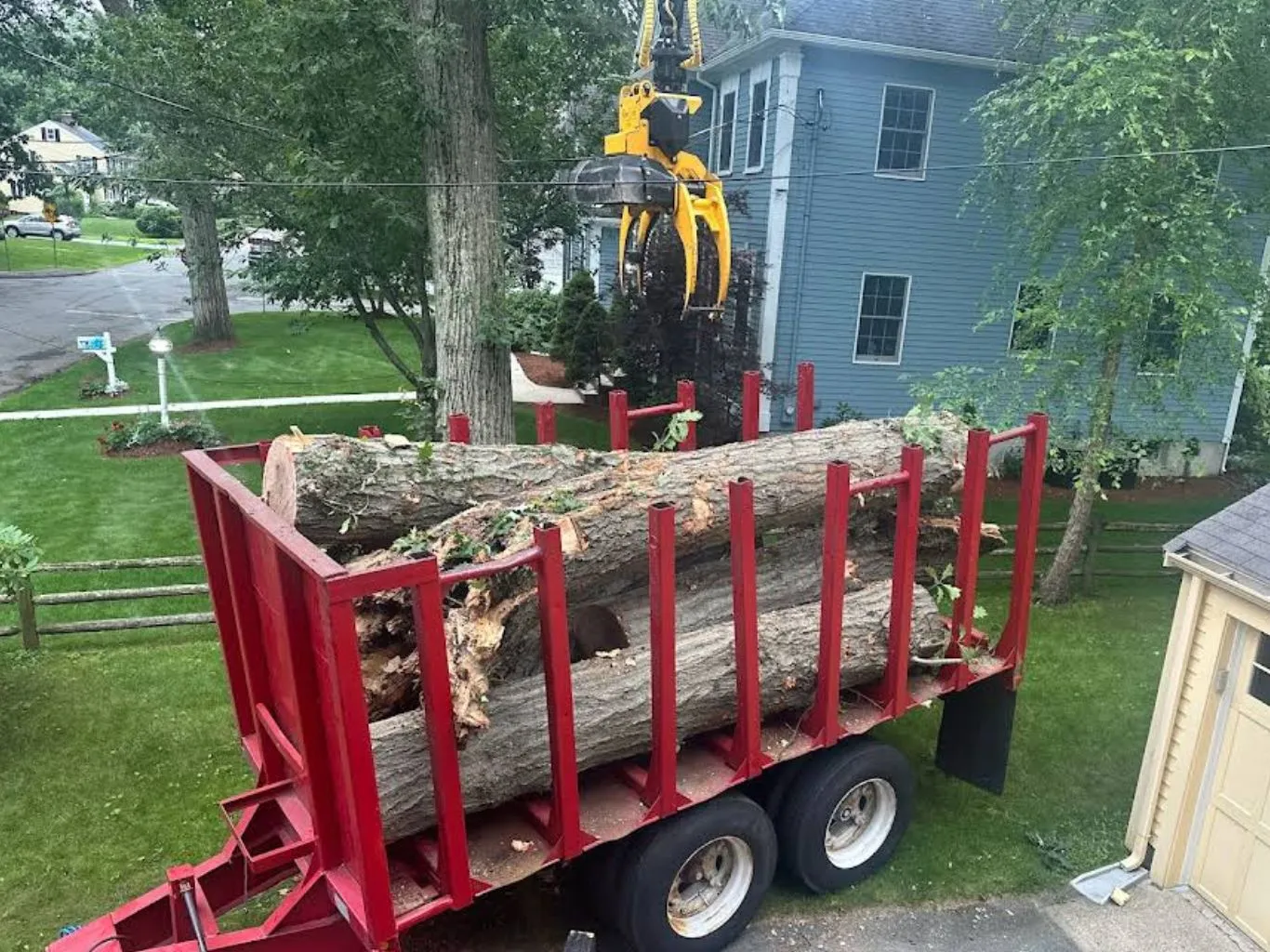
Red oak (Quercus rubra) can become a heavy removal tree. Mature trunks and large lateral limbs carry substantial weight, so a broad oak over a roof, driveway, or neighboring lot may need to be dismantled in smaller controlled sections or lifted by crane.
White pine (Pinus strobus) creates a different problem. Height and crown exposure can matter more than trunk density. A tall pine on a small residential lot can place the upper canopy well over a house or adjacent yard, and snow, ice, and wind damage can affect leaders and upper stems.
Sugar maple (Acer saccharum) is also relevant in Stoneham and appears in current municipal planting documentation. Mature maples can develop wide crowns with substantial lateral limbs. Crown shape, trunk condition, included unions, available lowering space, and proximity to structures change how the tree is taken apart.
Ash trees deserve extra attention because of Emerald Ash Borer. Massachusetts DCR reports that EAB is now well established throughout the Commonwealth. That does not mean every ash in Stoneham is infested, but an ash with severe decline or dead upper canopy should be evaluated with EAB-related deterioration in mind.
Stoneham’s streets add another layer. Main Street is Route 28 and functions as a regional north-south corridor. Stoneham Square sits where Main, Franklin, and Central Streets converge. Nearby residential streets often have less staging room than an open suburban lot. The weight of the wood has to be considered together with driveway width, parked vehicles, neighboring houses, utility lines, and where trucks or a crane can actually set up.
Crane Removal Near Franklin Street and Power Lines
Franklin Street runs out from Stoneham Center toward residential areas and Whip Hill. A large tree along this type of developed corridor can have a house on one side, pavement or a driveway on another, neighboring property close by, and overhead utilities occupying the remaining airspace.
This section is intentionally not presented as a Stoneham case study. East Coast has not provided a verified Franklin Street project that would support claiming an actual crane removal there.
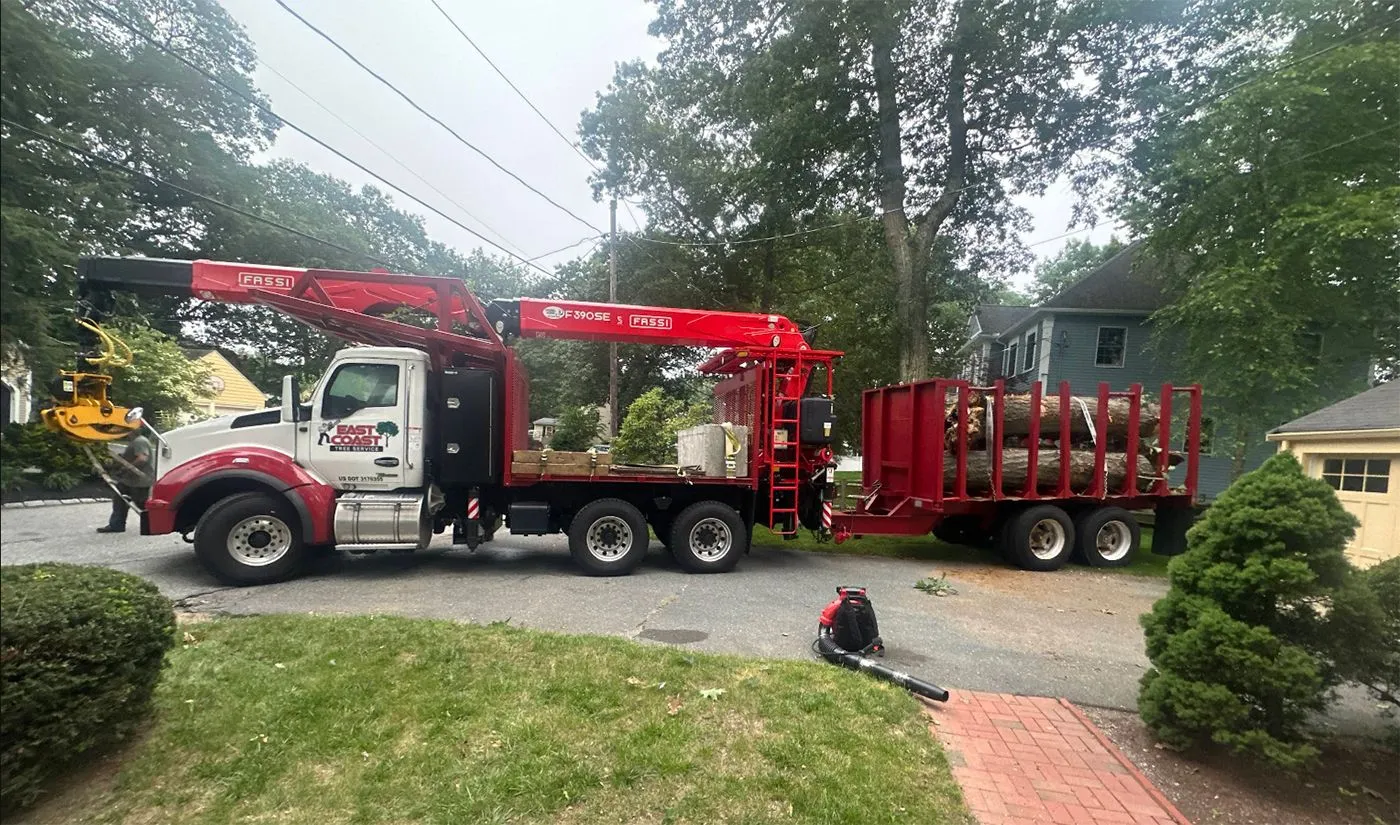
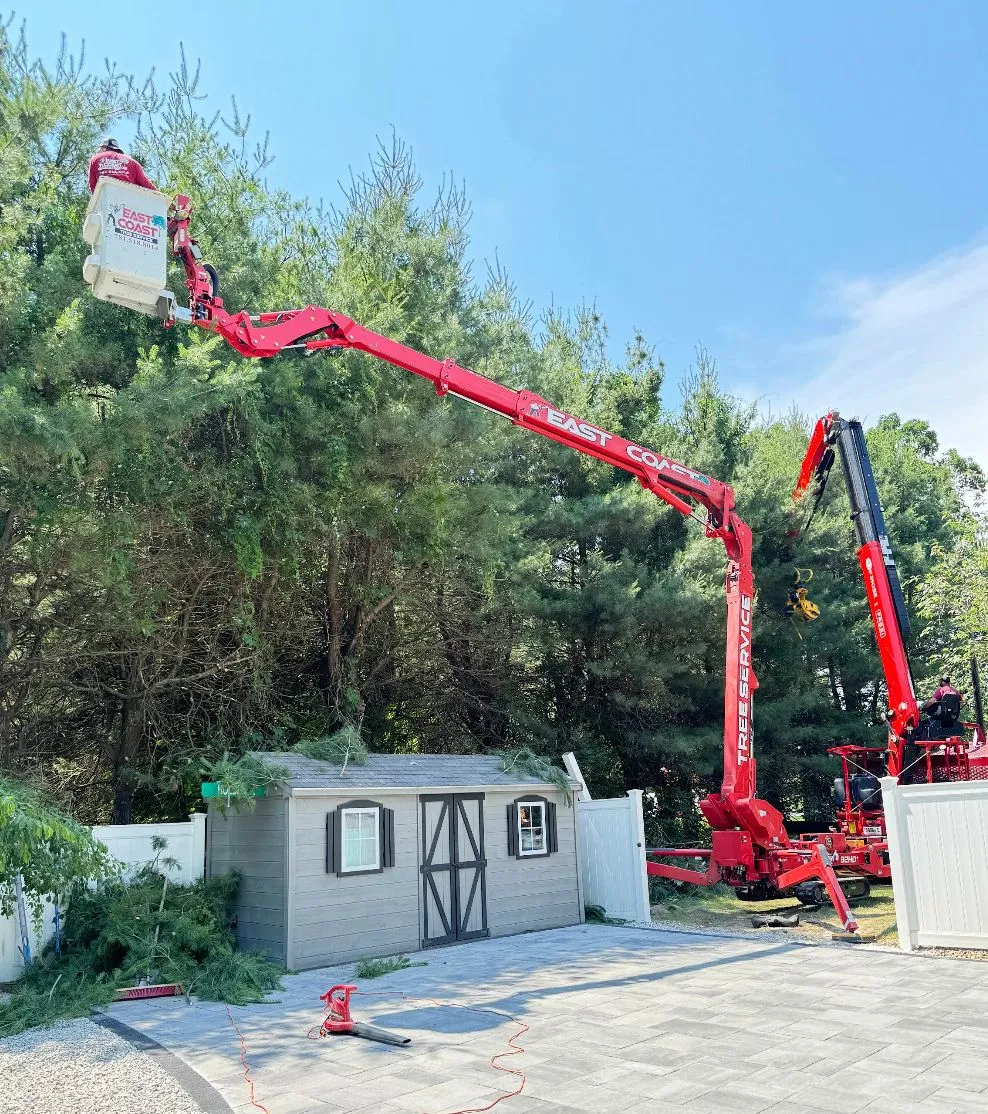
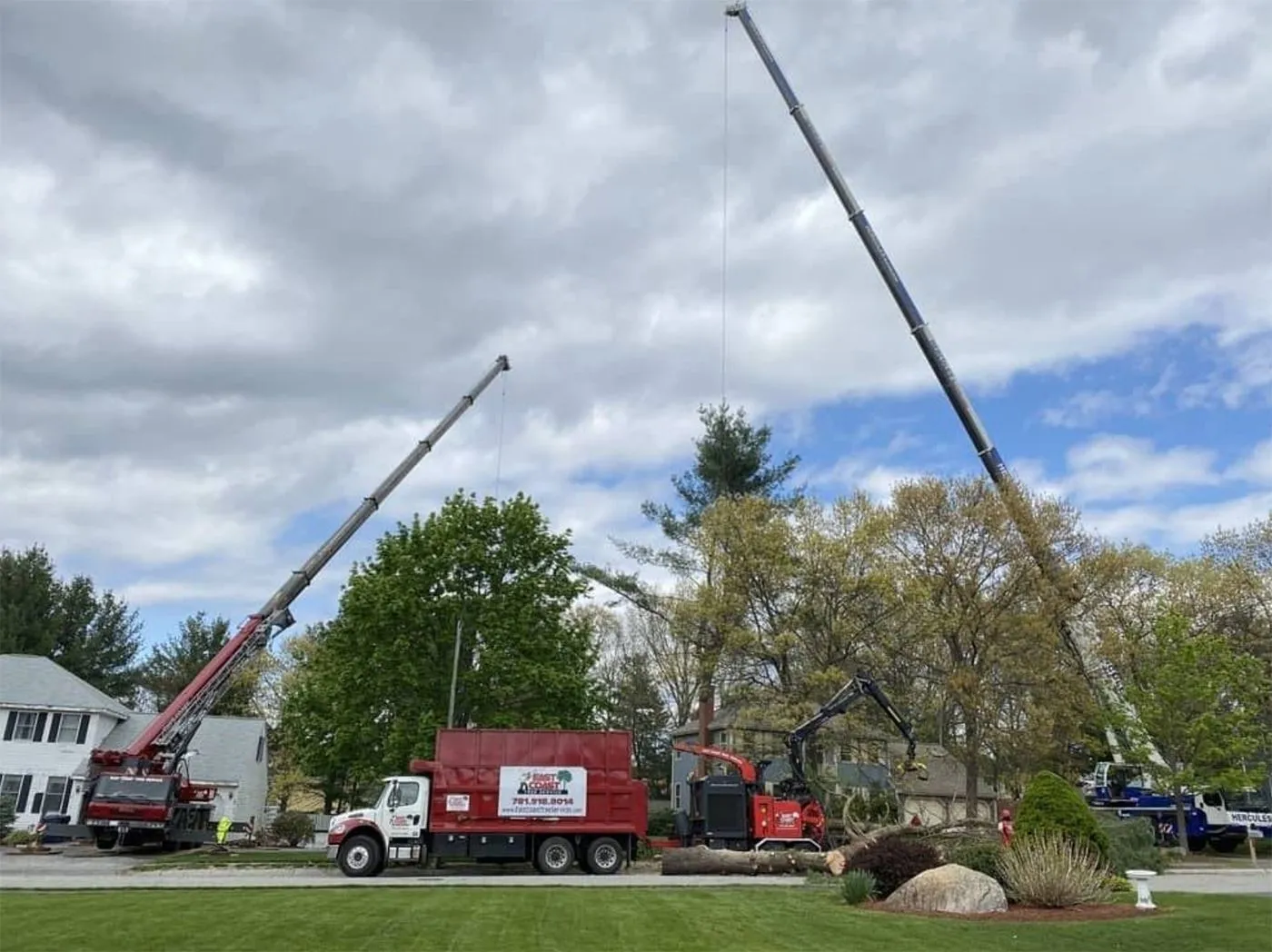
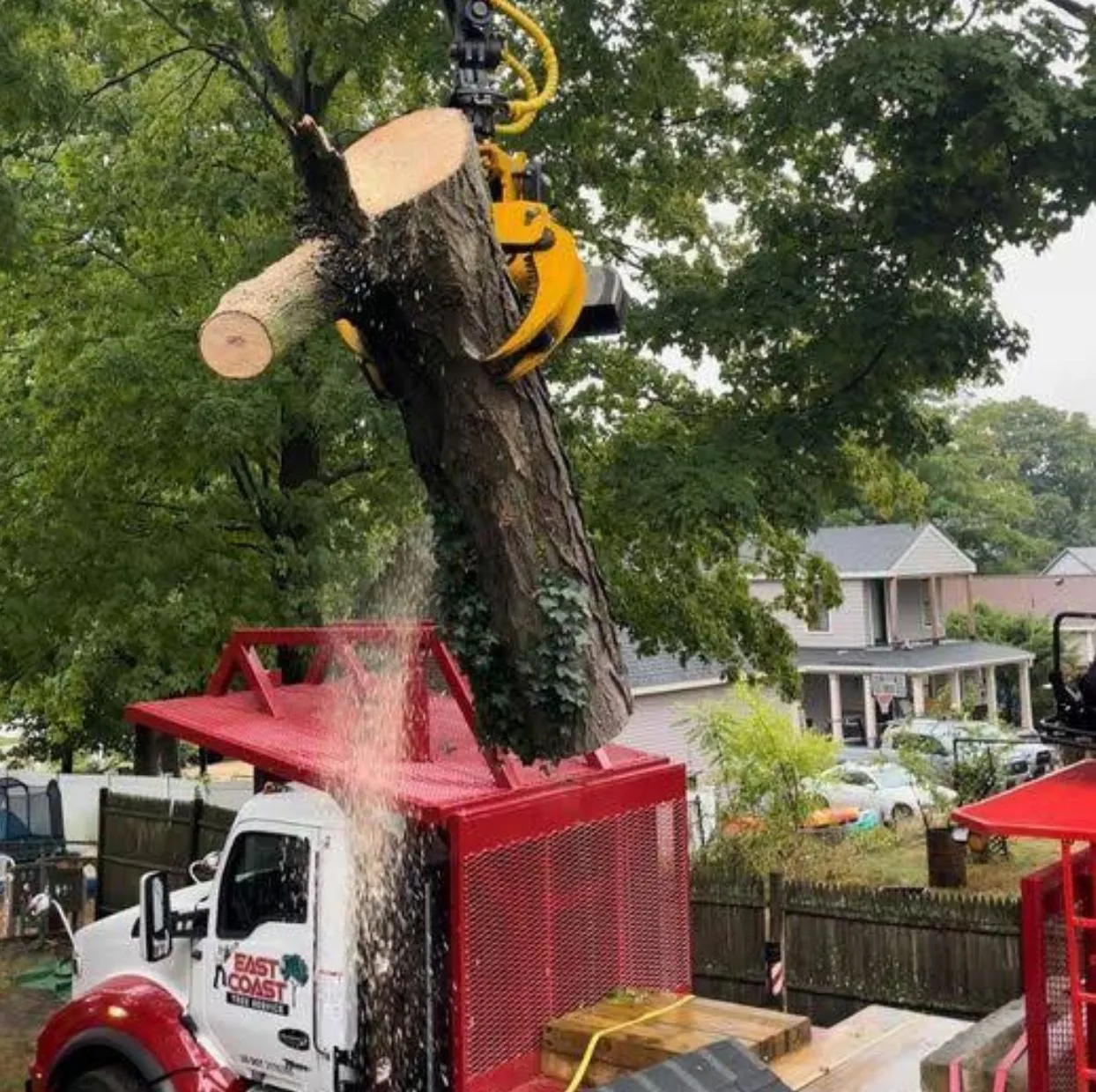
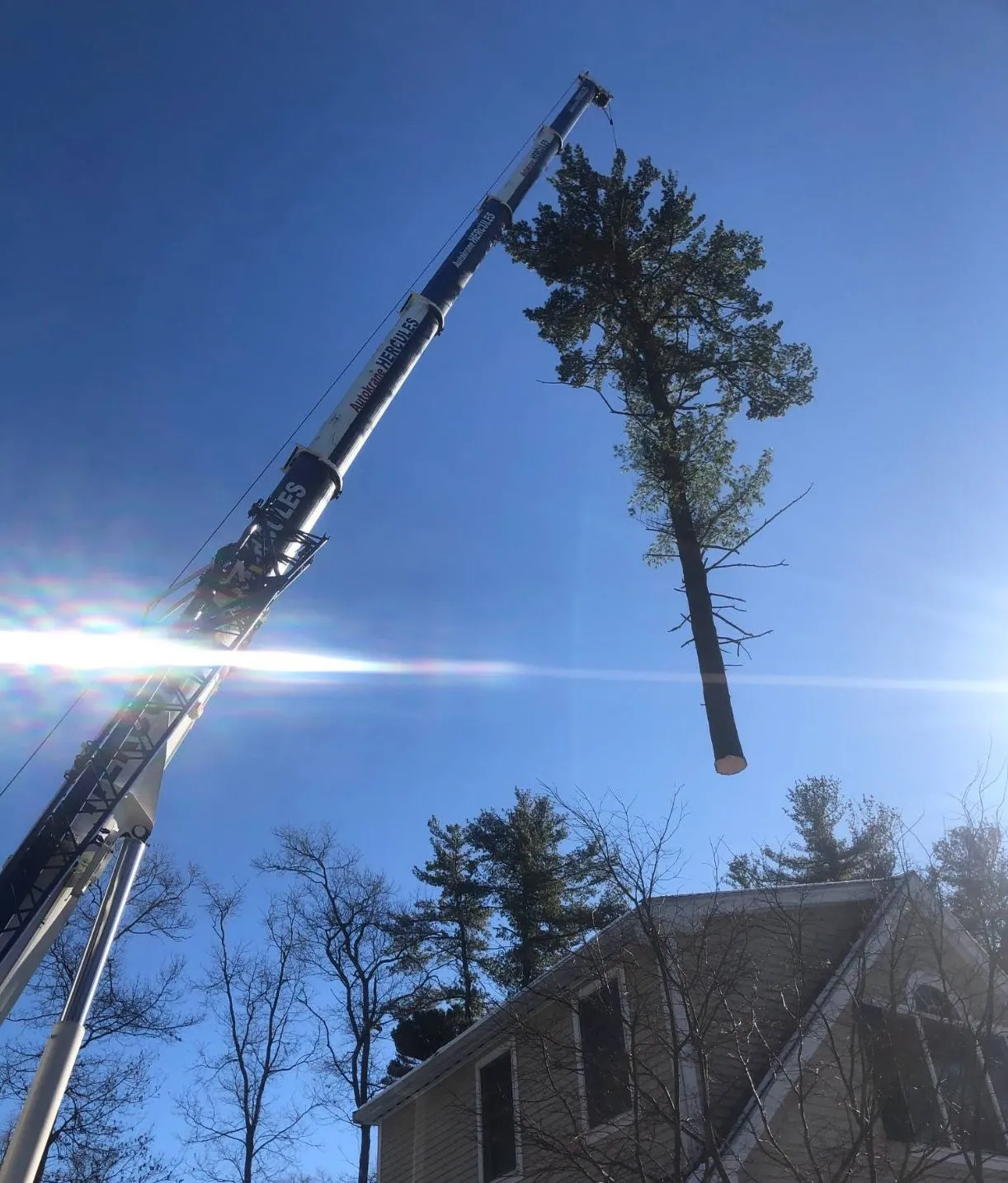
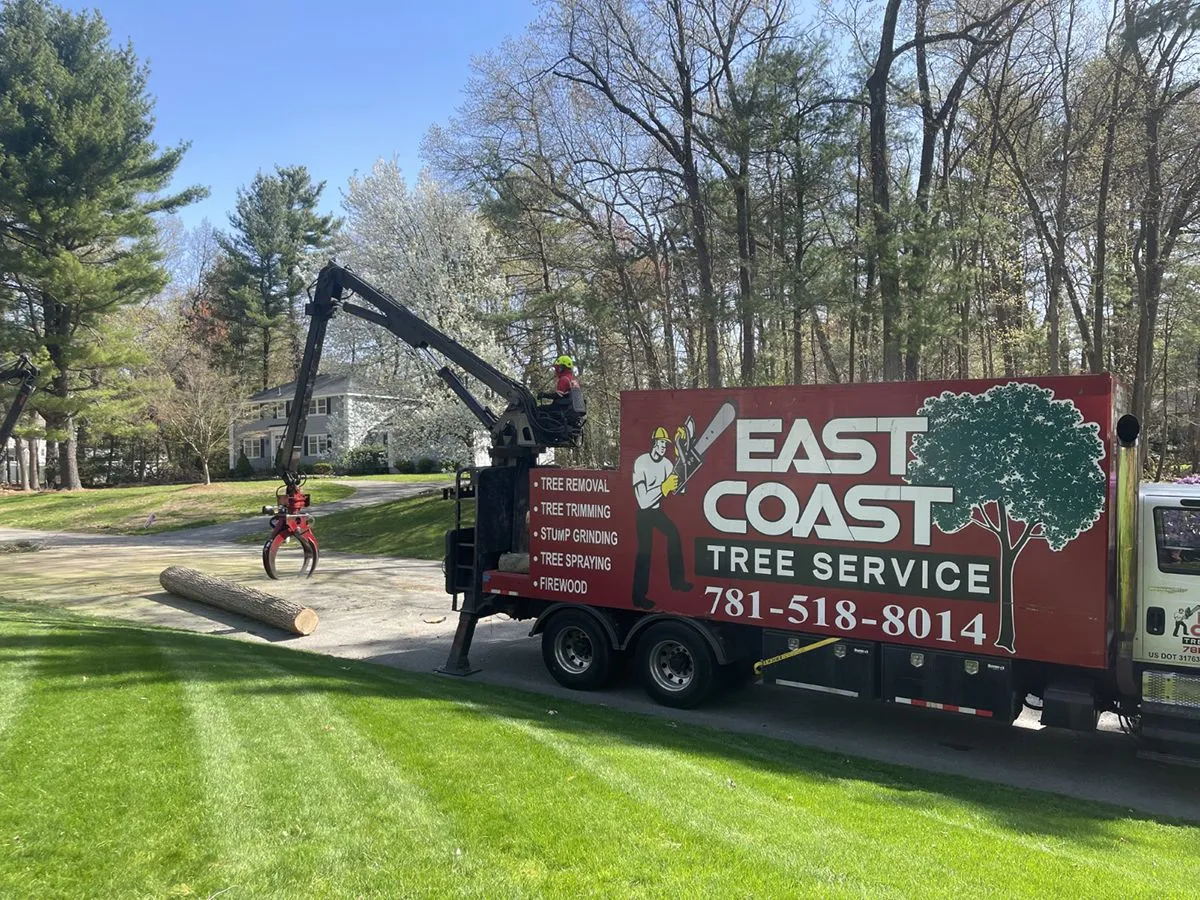
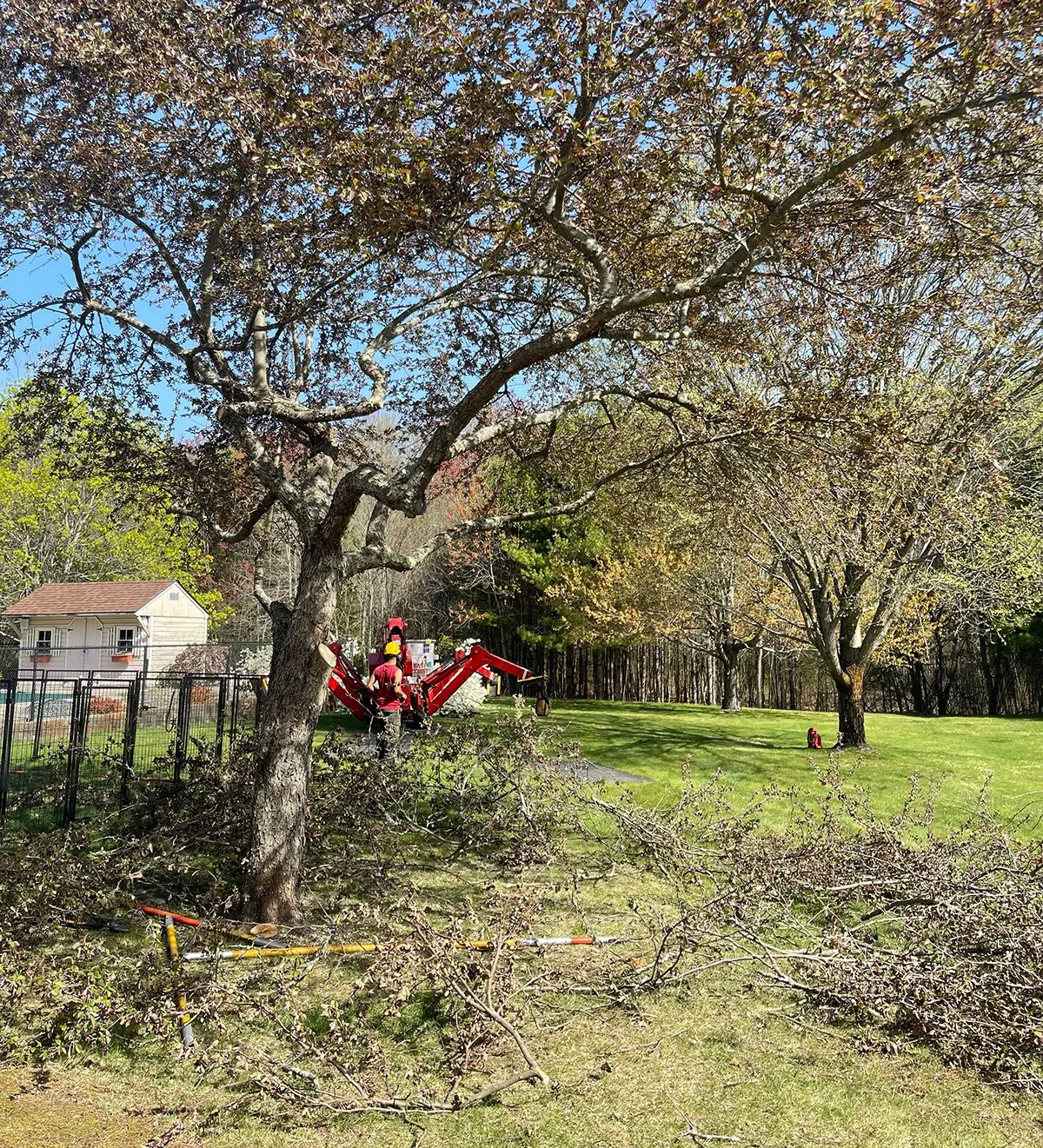
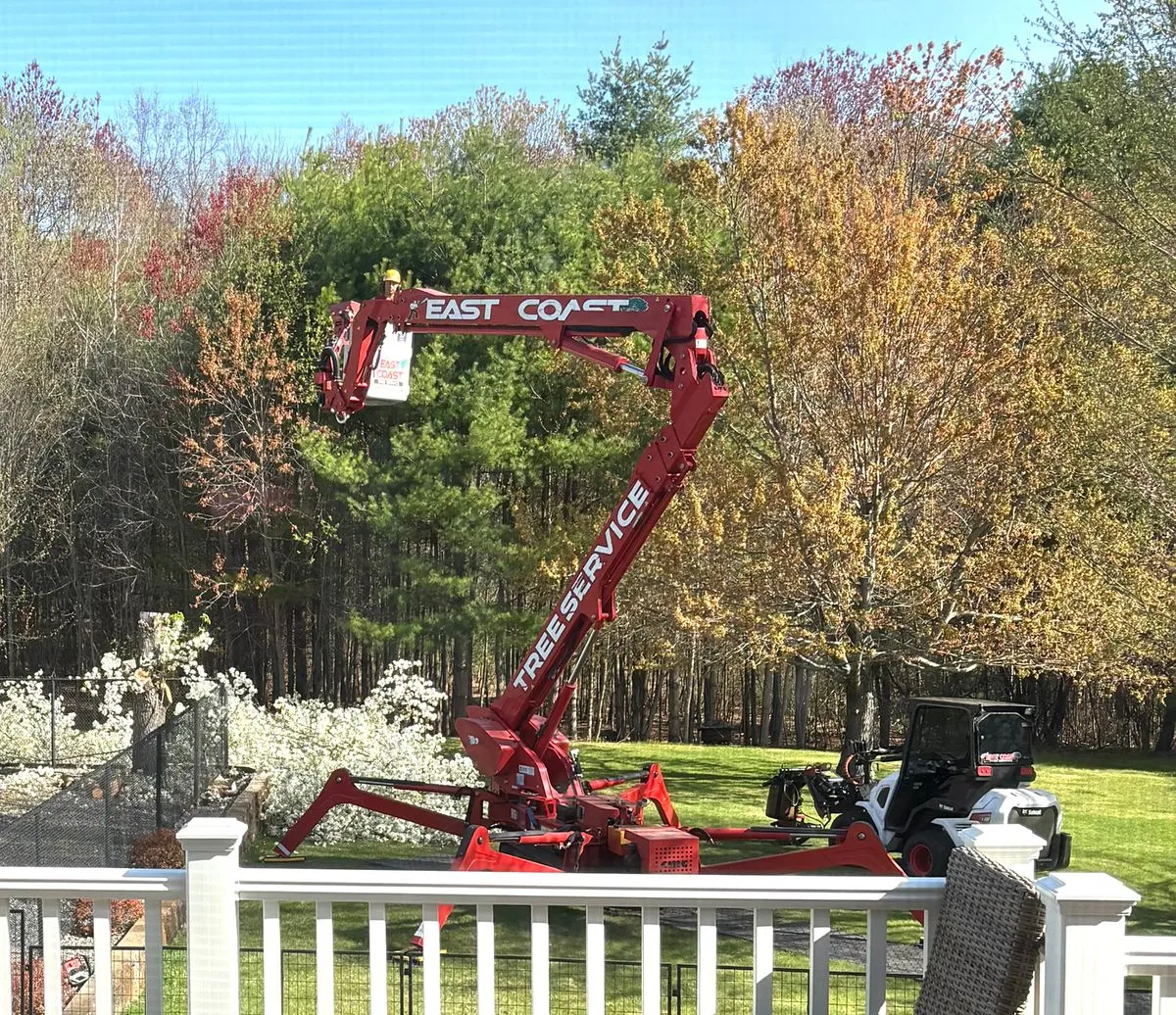
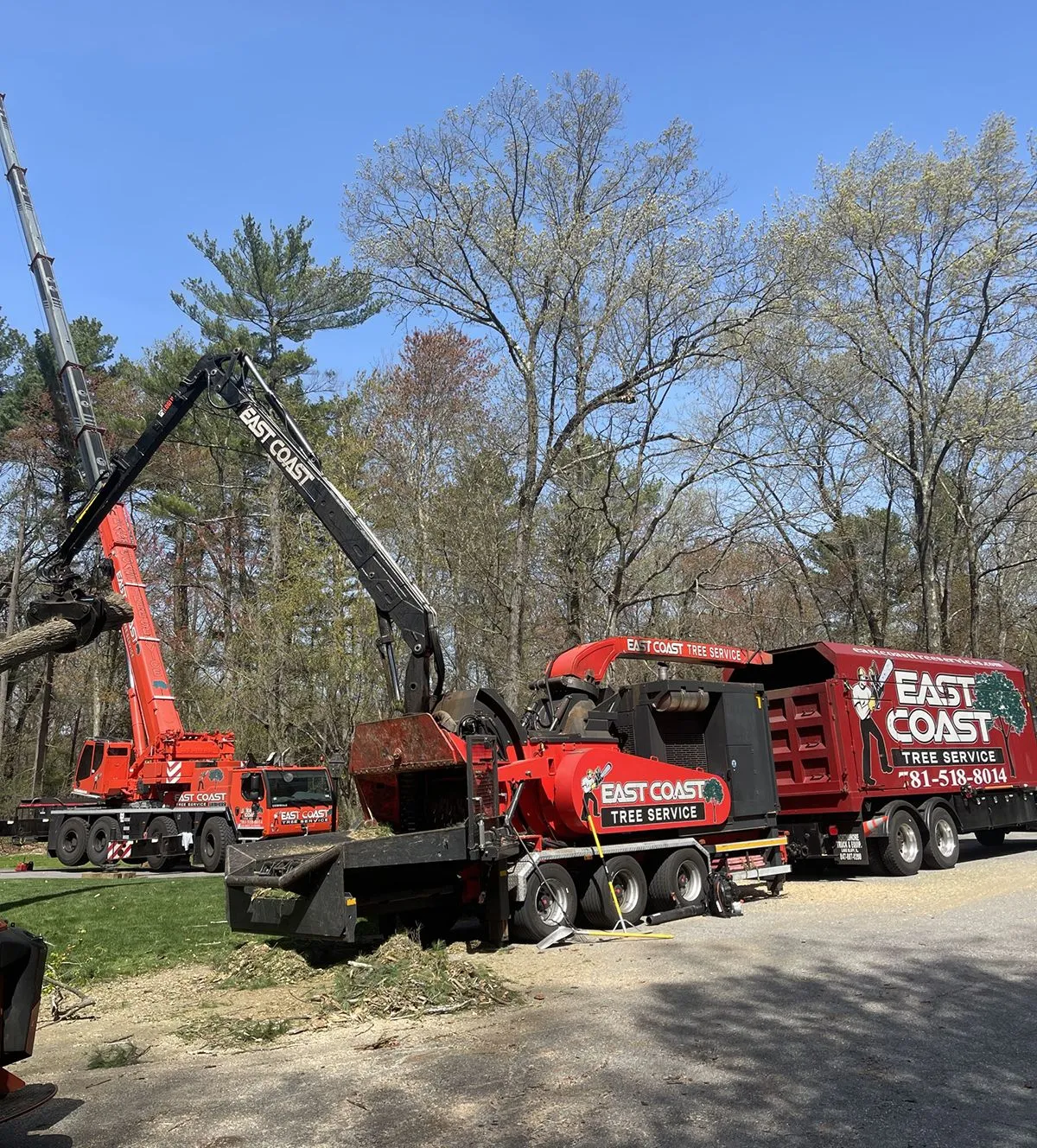
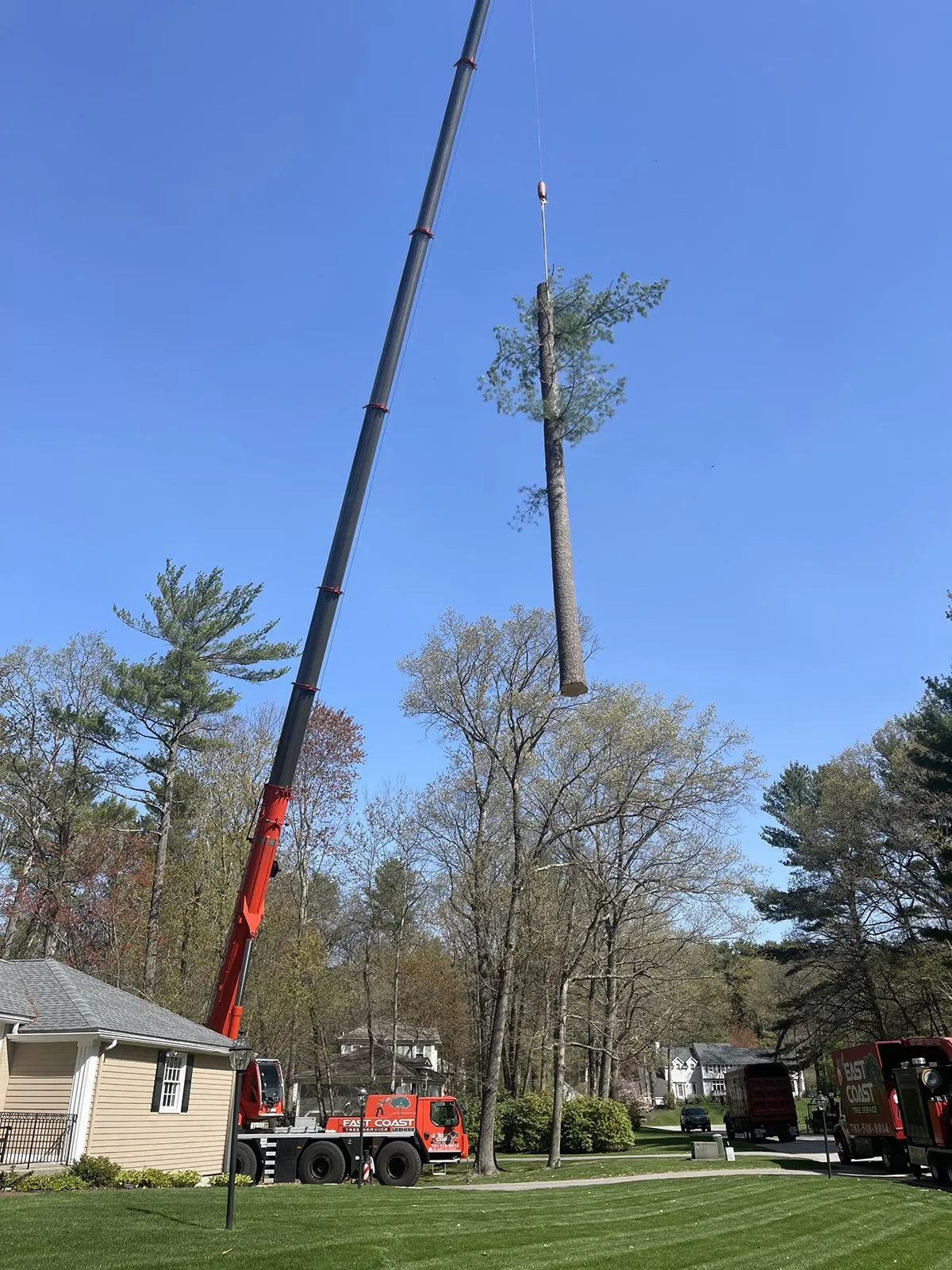
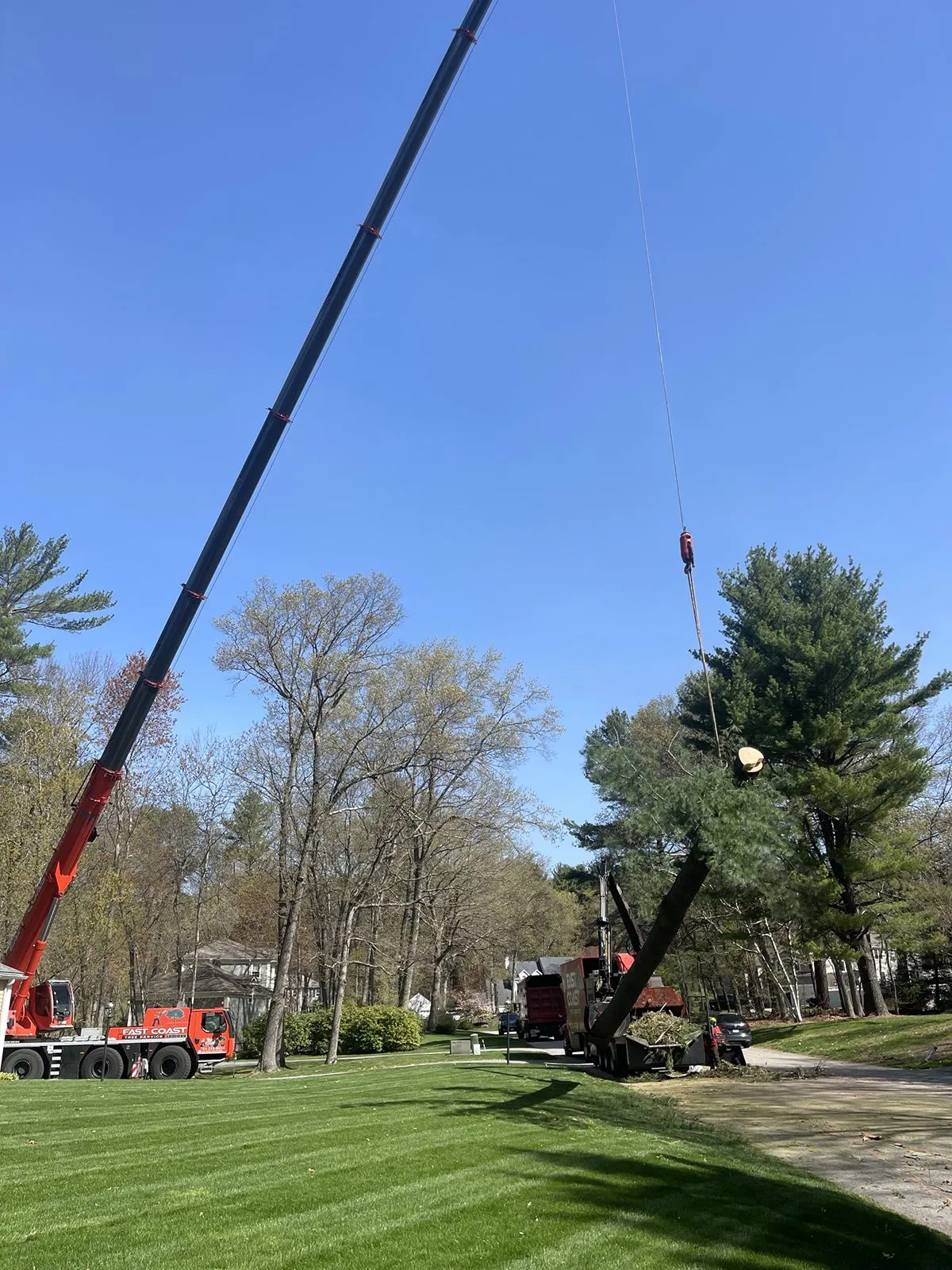
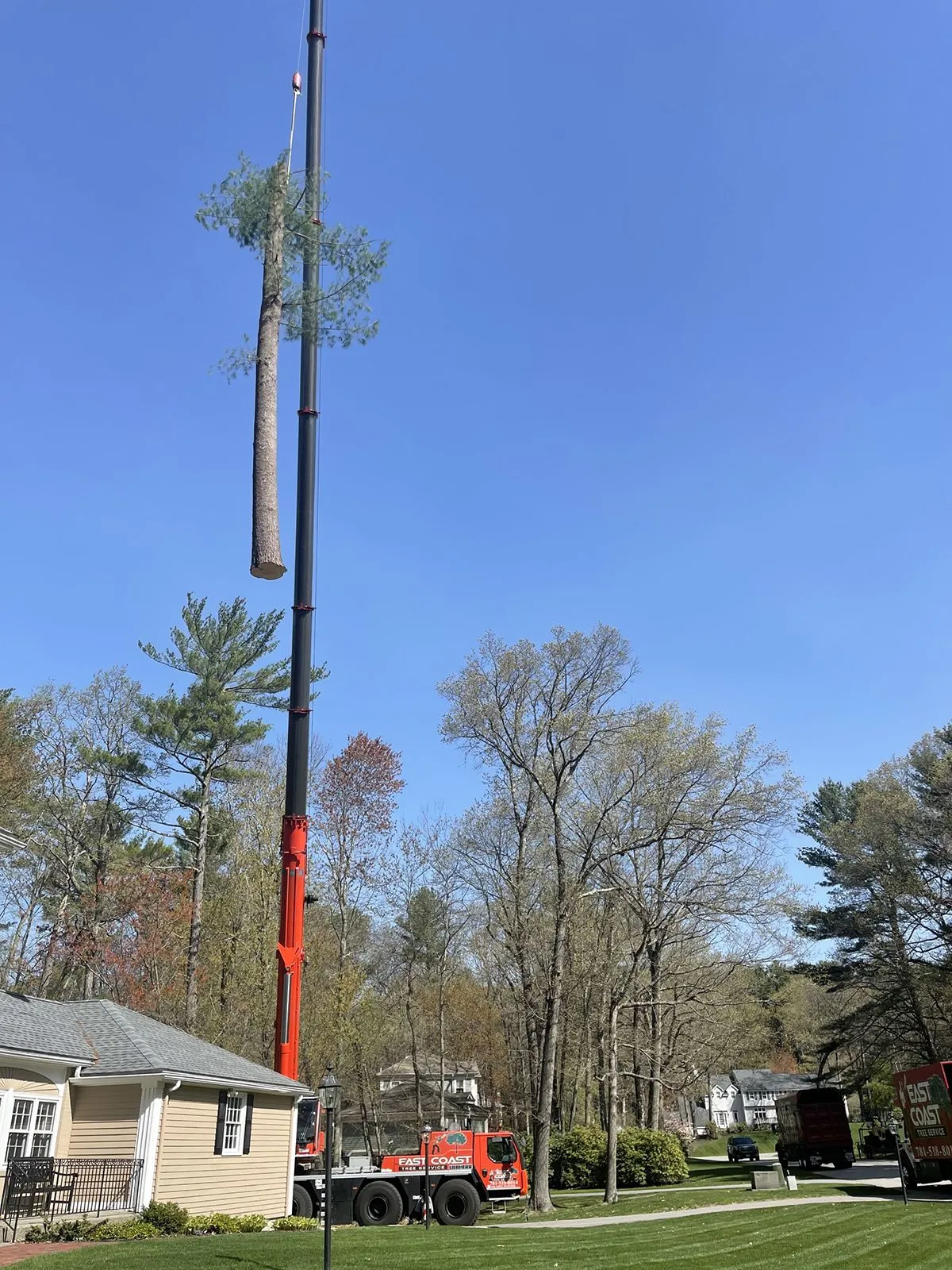
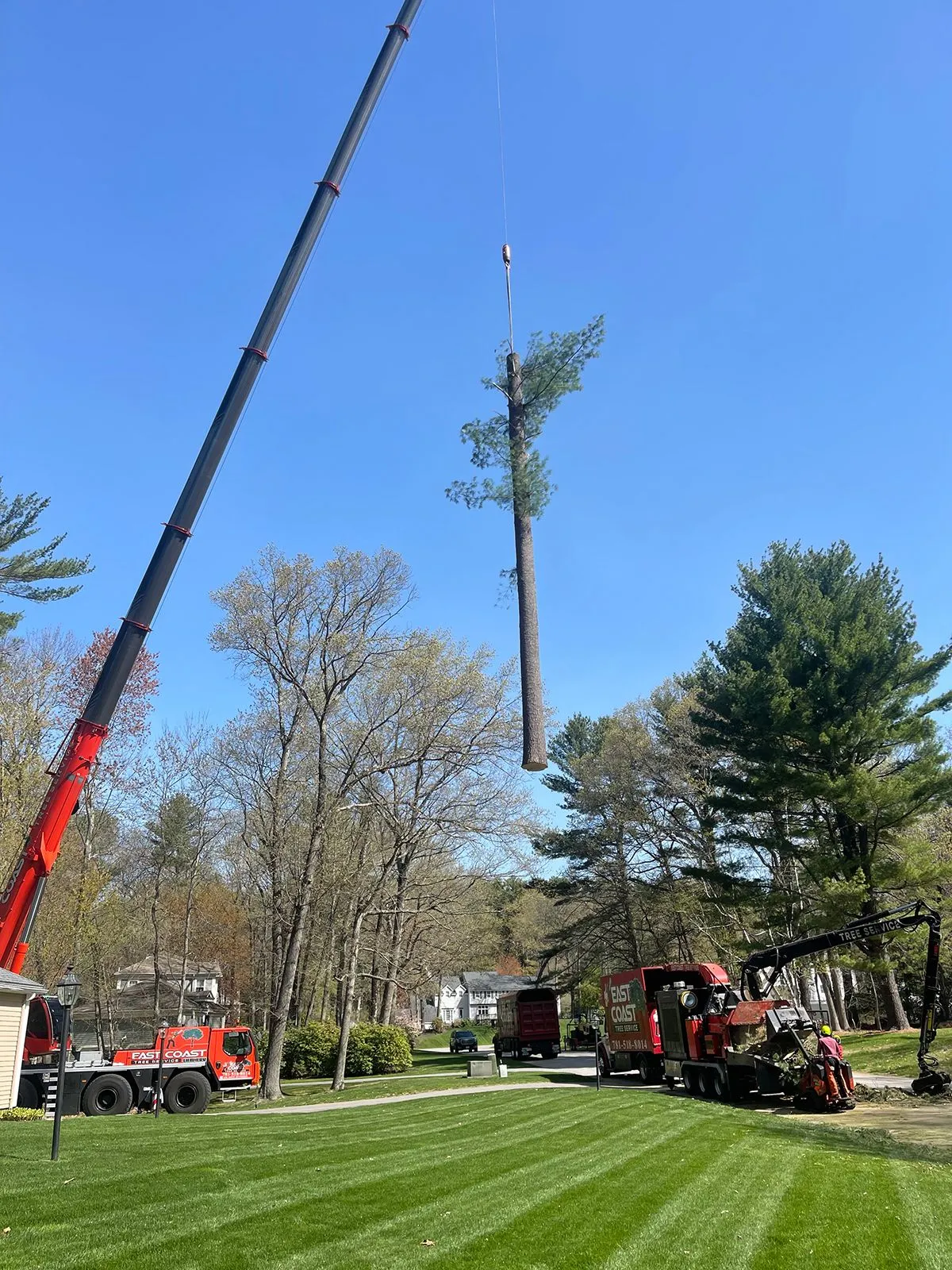
The operating problem is still real. When a tree has little usable drop zone, crane-assisted removal can allow cut sections to be lifted away from roofs, garages, pools, fences, lawns, or narrow landing areas. Conventional rigging may be the better method where crane access or setup does not make sense.
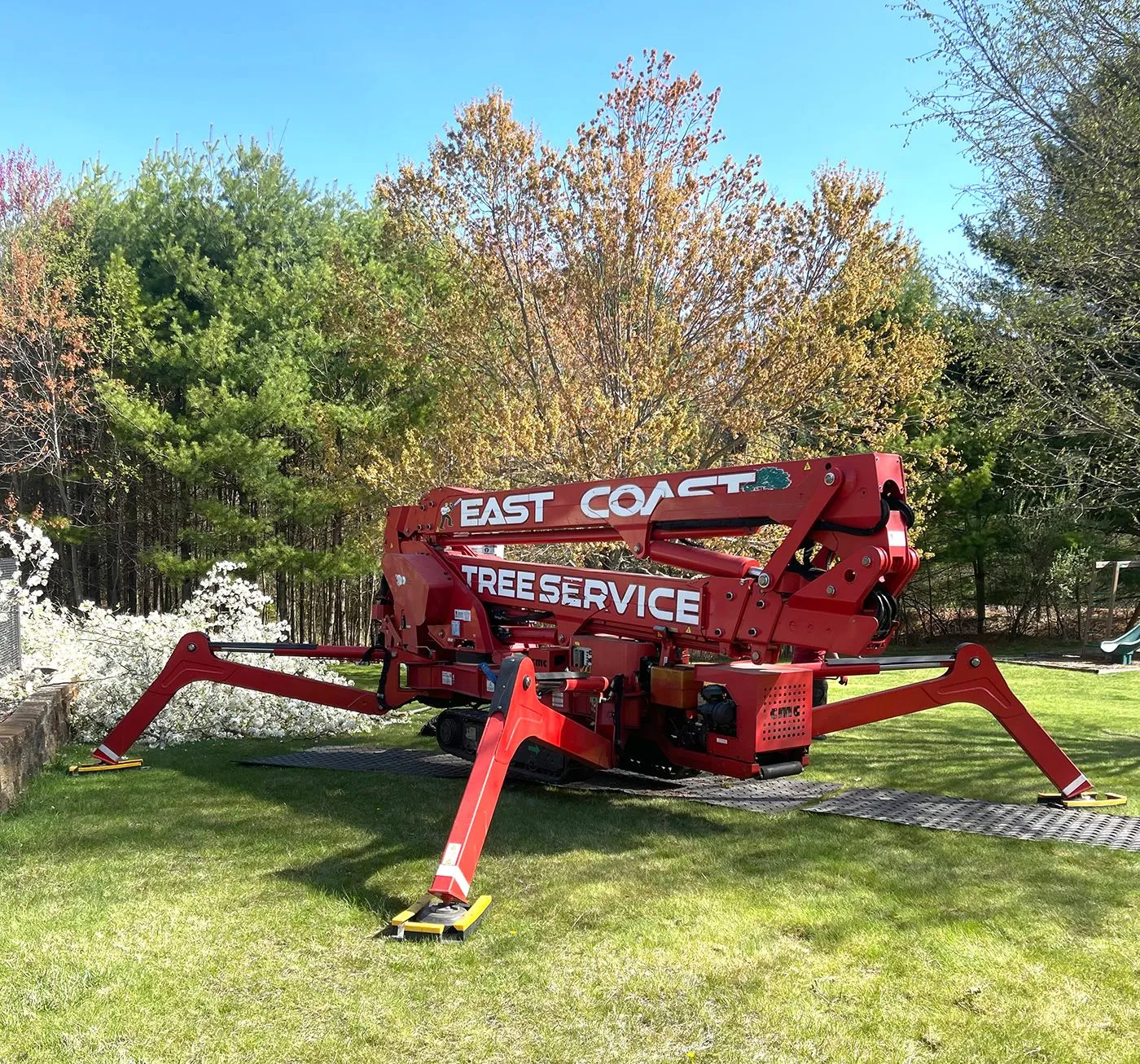
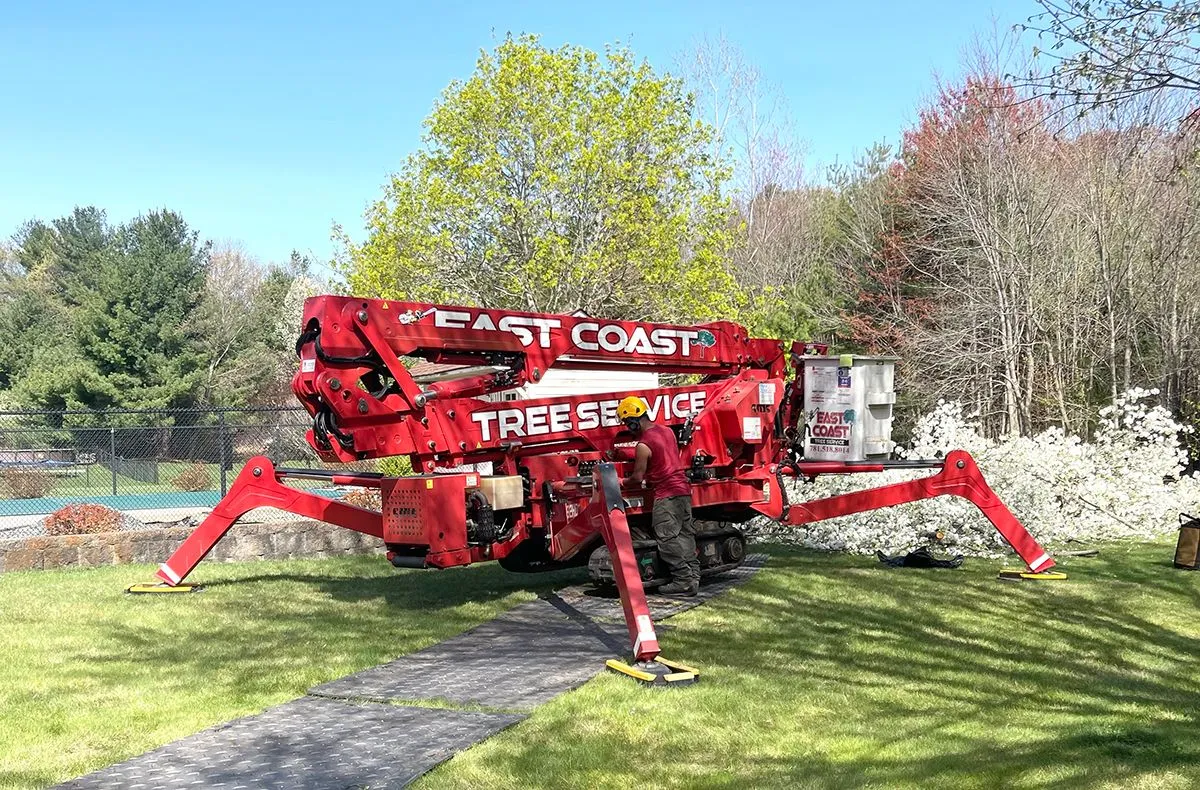
A crane setup has to account for reach, piece weight, road and driveway access, overhead conductors, ground bearing conditions, and outrigger placement. Outriggers may require suitable load-distribution support depending on the equipment and surface. East Coast has not provided a company-wide specification stating that one particular type of pad, mat, or cribbing is used on every property, so we do not make that claim.
The crew does take the steps required to work around the property and full cleanup is included when the job is complete. During the estimate, the salesperson can review the lawn, driveway, landscaping, pool, hardscape, and other areas that may affect setup.
Can East Coast remove a tree near power lines without Eversource involvement?
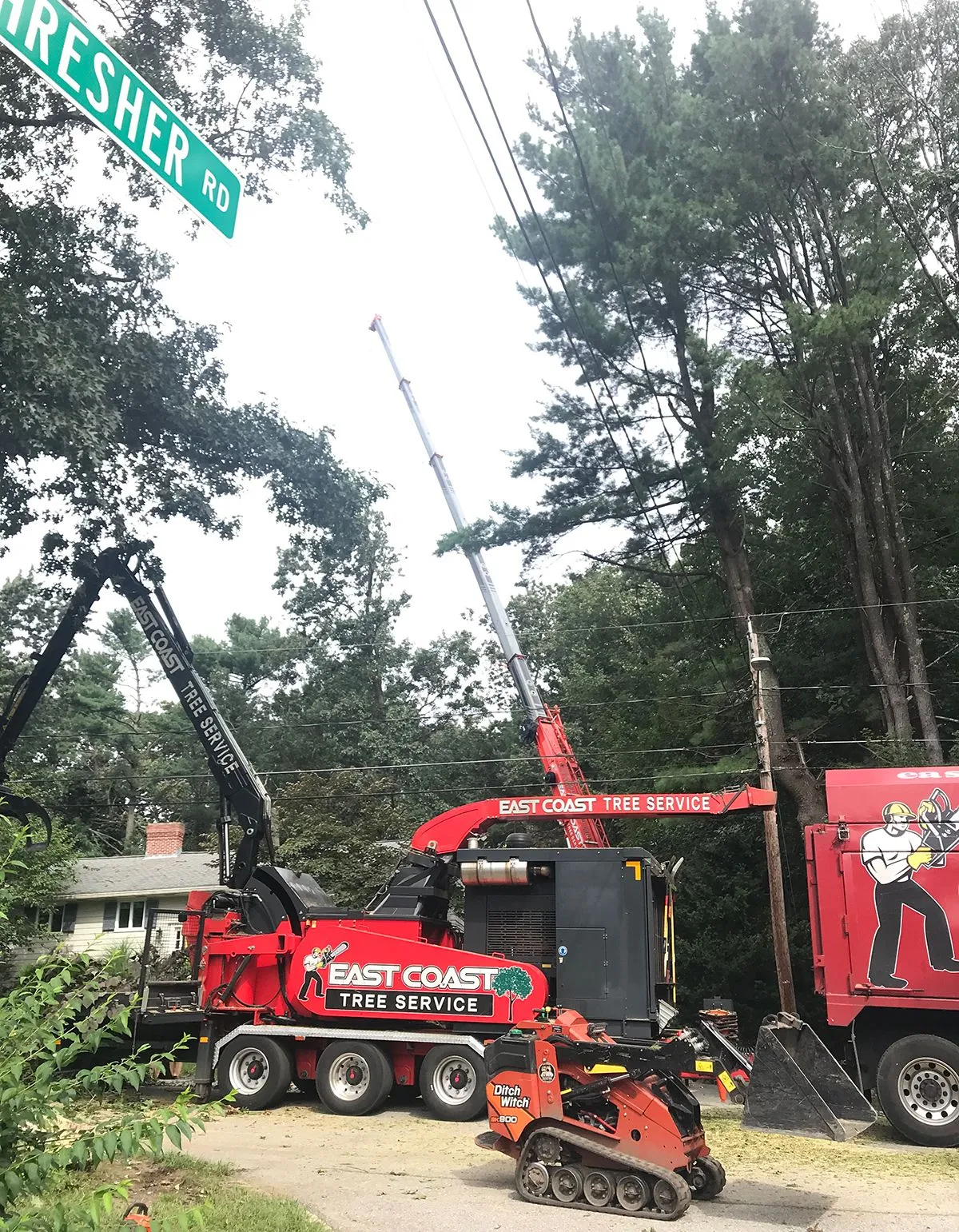
Sometimes a tree can be removed near a service line without utility intervention, but that cannot be assumed before seeing the site. The Town of Stoneham identifies Eversource Energy as its electric utility. Eversource states that homeowners are generally responsible for maintaining trees around the service line between the utility pole and their home, while Eversource manages vegetation associated with its distribution system.
If a tree or limb is touching an energized conductor, treat it as an electrical hazard rather than an ordinary removal. Stay away and contact Eversource. The utility also provides options for dropping, reattaching, or otherwise addressing service wires when tree work requires it.
Permit Requirements for Tree Removal in Stoneham, MA
For an ordinary private tree entirely on private property and outside wetlands, floodplain, riverfront, public-way, or conservation restrictions, Stoneham’s current published materials do not show a blanket permit required for every private tree removal. The Town explicitly distinguishes private trees from Town trees and states that private trees are generally the responsibility of the private property owner.
The location of the tree can change the answer quickly.
- A tree between the sidewalk and curb may be a Town tree.
- A tree within a public way or its boundary may qualify as a public shade tree under Massachusetts General Laws Chapter 87.
- A tree near a wetland, stream, pond, vernal pool, or flood zone can require Stoneham Conservation Commission permission.
- A tree on state conservation land such as Middlesex Fells is not an ordinary private-property removal.
The comparison report referenced Stoneham Town Bylaws Chapter 14 for tree permits. Current Town records show that Chapter 14 concerns water. Stoneham’s current Tree Bylaw is Chapter 24, covering the Tree Warden, public shade trees, the Tree Committee, and private tree planting. We use the current Town code rather than repeating the outdated chapter reference.
Chapter 24 places the care and management of public trees under the Stoneham Tree Warden and ties public shade tree management to Massachusetts General Laws Chapter 87.
Working with Stoneham DPW and Conservation Commission
Two municipal offices matter most when a tree sits in a questionable location: the Stoneham Department of Public Works and the Stoneham Conservation Commission.
DPW administers Stoneham’s Tree Care Program and manages Town trees on public grounds and within street rights-of-way. The Town specifically tells residents to contact DPW when there is doubt about whether a roadside tree is private or municipal.
The Conservation Commission deals with a different question: wetlands and protected resource areas. Stoneham’s homeowner guidance tells property owners to contact the Commission before hiring a tree company, landscaper, or contractor when work may occur near protected wetlands.
Stoneham’s published guidance identifies regulated areas that can include work within 100 feet of swamps, marshes, forested wetlands, or intermittent streams; within 200 feet of vernal pools, ponds, or perennial streams; and within the 100-year flood zone. A 25-foot natural no-disturb zone is also part of current local guidance for new construction.
This is relevant beyond Spot Pond. Stoneham documents wetland and flood-hazard areas associated with Sweetwater Brook, the northwest portion of town near I-93, and other brooks and wet areas. Some wetlands can appear dry during part of the year, so a homeowner should not decide jurisdiction based only on whether standing water is visible in August.
East Coast does not claim that it automatically obtains Conservation Commission or Town permits for customers. The salesperson can flag site conditions during the free estimate, but the applicable municipal requirements should be verified before regulated work starts.
Protecting Historic Homes During Tree Removal in Stoneham Center
Stoneham Center is more than a commercial intersection. Town preservation documents identify a concentration of historic civic, commercial, and residential buildings around Stoneham Square, including Town Hall, the Fire Station, the Stoneham Public Library, and older commercial buildings dating to the town’s shoe-industry period.
The surrounding residential streets include documented historic properties such as the Fuller House on Franklin Street, the Silas Dean House on Pine Street, and the Old Town House on Central Street. The Old Burying Ground on Pleasant Street is the surviving remnant of Stoneham’s original town center and is listed on the National Register of Historic Places.
Those locations matter to tree removal because established neighborhoods can leave very little margin for uncontrolled material. A mature limb cannot simply be dropped if the landing area contains a slate roof, porch, narrow driveway, stonework, neighboring structure, overhead wire, or established landscaping.
Main Street/Route 28 is Stoneham’s primary north-south corridor, while Montvale Avenue connects the town center toward I-93. Franklin and Central Streets converge with Main in Stoneham Square. Traffic, parked vehicles, access from a narrow driveway, and the position of the house can all determine whether a tree should be climbed, rigged in smaller pieces, accessed by another method, or removed with crane assistance.
Stoneham also has the Tri-Community Greenway, which connects the town with Woburn and Winchester, while Whip Hill, Middlesex Fells, Spot Pond, Stone Zoo, Stoneham Town Common, and the historic center provide very different examples of the landscapes found within a relatively compact town.
Stoneham Tree Warden Coordination and Compliance
The current Stoneham Tree Warden is listed by the Town’s Tree Committee as Tom Brady. The Tree Warden works with DPW and has responsibility for public trees under Stoneham’s Chapter 24 Tree Bylaw and Massachusetts law.
Massachusetts General Laws Chapter 87 treats trees within a public way or on its boundary as public shade trees. State law says that a public shade tree generally cannot be cut, trimmed, or removed by a private party without written permission from the Tree Warden. Removal can also require a public hearing unless a statutory exception applies.
Stoneham goes a step further in its homeowner guidance: only the Town is permitted to prune, cut, or remove Town trees, and fines can apply to unauthorized work. A tree between the sidewalk and curb is a common example of a Town tree. Where there is no obvious sidewalk or curb, the Town tells residents to contact DPW to determine ownership.
Does East Coast Tree Service “work with” the Stoneham Tree Warden? We will account for the distinction between private and public trees and can identify when municipal coordination needs to happen, but we do not claim an established partnership with the Tree Warden or that East Coast automatically handles every approval on the homeowner’s behalf.
What Does Tree Removal Cost in Stoneham, MA?
For planning, current 2026 Boston-area market data puts many residential tree removals between roughly $432 and $2,166, with an average around $812. Small accessible trees can fall below that range. Large, highly restricted, emergency, or crane-assisted removals can go well above it.
These are third-party market ranges, not East Coast Tree Service pricing.
| Tree height | 2026 Boston-area planning range |
|---|---|
| Up to 30 ft. | $230–$700 |
| 30–60 ft. | $700–$1,900 |
| 60–80 ft. | $1,200–$2,300 |
| Over 80 ft. | $1,500–$3,100 |
Source: Angi’s 2026 Boston tree removal cost data. HomeGuide’s 2026 national data reports a $400–$1,200 average range, with large and complex projects reaching $3,000 or more.
Height is only the starting point. Trunk diameter, species, wood weight, decay, access, house or garage proximity, pools, utility lines, rigging, crane requirements, emergency timing, stump grinding, and regulated site conditions can all change the scope.
How much does crane-assisted tree removal cost in Stoneham? There is no dependable flat “crane fee” that can be applied to every removal. Angi’s current Boston data says trees requiring crane access can add $500 or more to the total. On some properties, however, a crane can reduce climbing, rigging, and repeated material handling enough that looking at the crane as a simple surcharge gives a misleading picture. The complete job needs to be priced from the site.
How much does it cost to remove a large oak tree in Stoneham? A useful third-party planning range for a large 60- to 80-foot oak is about $1,200 to $2,500. Angi’s Boston data puts 60- to 80-foot removals at $1,200–$2,300, while HomeGuide’s 2026 data lists oak removals up to $2,500. A mature red oak over a house, on a narrow lot, near wires, or requiring crane assistance can exceed that range.
Full cleanup is included with East Coast’s service. If the stump also needs to go, stump grinding can be discussed as part of the requested scope.
What the Free On-Site Estimate Covers
East Coast provides free on-site estimates in Stoneham. The visit is handled by the sales team rather than being advertised as an ISA Certified Arborist estimate on every project.
The salesperson can review the tree’s size and visible condition, trunk diameter, lean, access, nearby homes and garages, driveway and lawn conditions, pools and fences, overhead utilities, available landing space, crane setup, rigging requirements, cleanup, stump grinding, and obvious permit or wetland questions that deserve further checking.
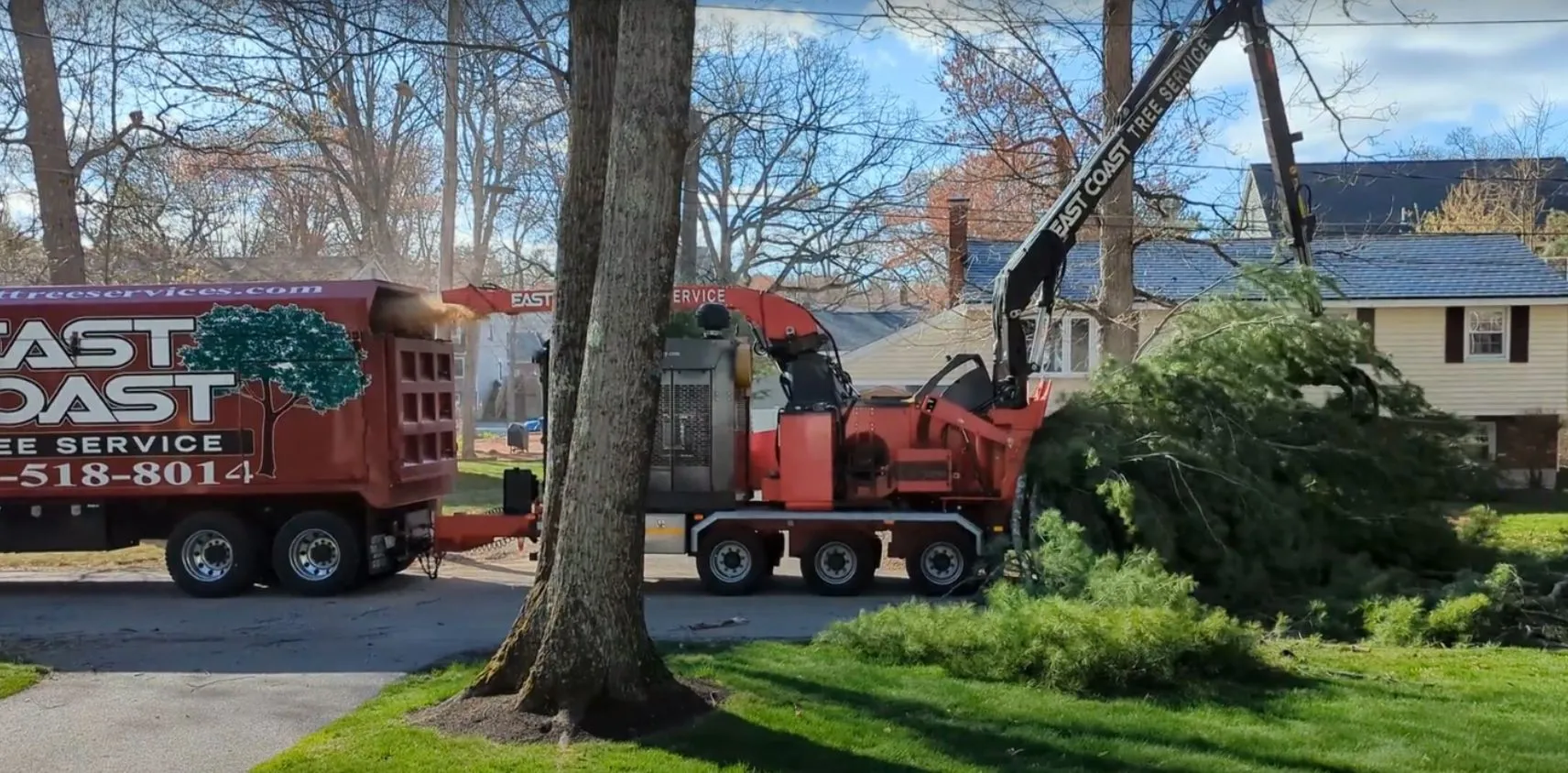
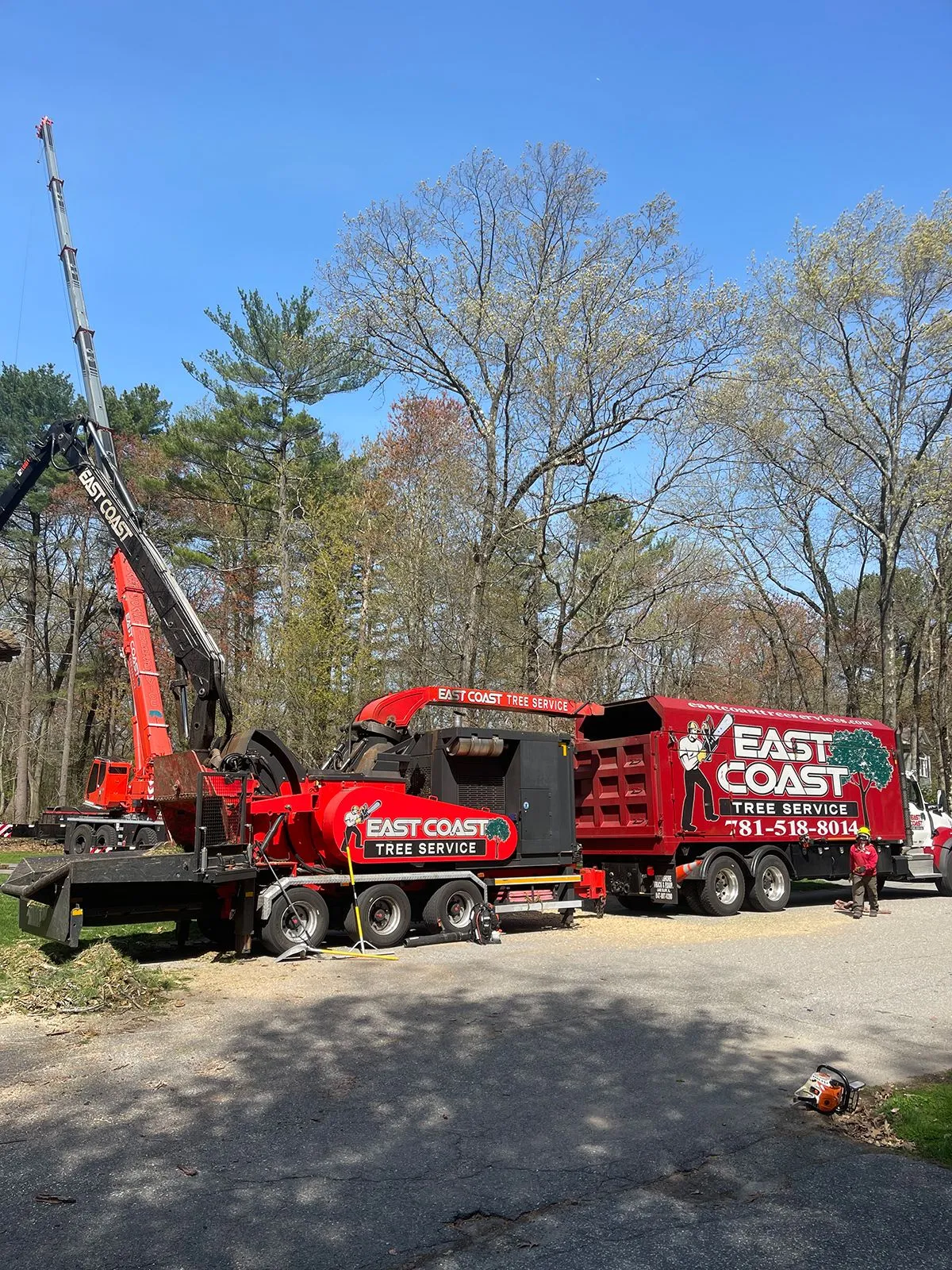
That is also when property protection gets planned. Tight Stoneham lots can require careful decisions about truck positioning, crane or outrigger setup, material movement, the path between the backyard and street, landscaping, driveway surfaces, and where cut wood can be staged before it leaves the property.
East Coast includes full cleanup after the work. The exact protection method varies with the property and equipment rather than following one universal setup for every lawn or driveway.
For homeowners elsewhere in this part of Middlesex County, East Coast also serves nearby Reading, Wakefield, Woburn, Winchester, and Wilmington. The main Stoneham tree service page covers the company’s broader services in town.
Contractor Insurance, Homeowners Insurance, and Financing
East Coast Tree Service is fully insured and licensed for the work it performs. The company carries general liability coverage and workers’ compensation insurance. Those protections concern the contractor. They are separate from the homeowner’s property insurance policy.
Does homeowners insurance cover tree removal? Coverage commonly applies when a covered event causes a tree to fall on and damage an insured structure such as the house or detached garage. Some policies can also cover removal when a fallen tree blocks a driveway or required access.
Preventive removal of a standing dead, declining, or hazardous tree is generally treated as property maintenance rather than a covered loss. Policy wording, cause of loss, deductibles, and debris-removal limits vary. Contact your insurance carrier or adjuster for a coverage decision.
Do you offer financing if I need help paying for tree removal? Yes. Financing is available for qualifying projects. Approval and terms depend on the financing program available at the time. Mention financing when scheduling your estimate so the current options can be discussed.
If a tree in Stoneham is dead, storm-damaged, leaning toward a structure, interfering with safe access, or too compromised to remain in place, call (781) 518-8014. East Coast Tree Service offers free on-site estimates, crane-assisted removal where appropriate, full cleanup, financing for qualifying projects, and 24/7 emergency service.