

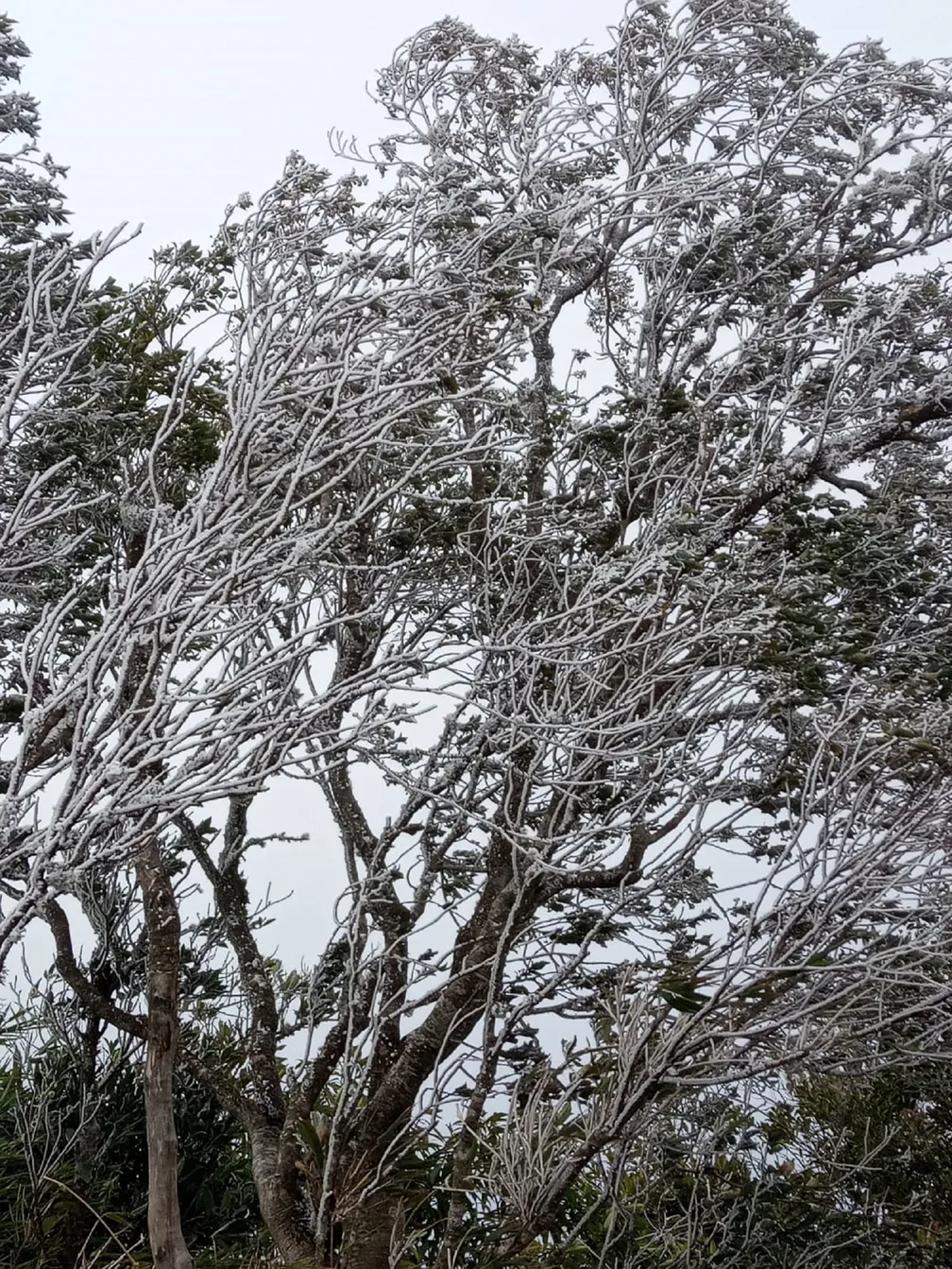
If a nor’easter is in the forecast and you already have a tree that has started leaning, lifting soil around its roots, dropping large dead wood, opening a trunk split, or showing decay at the base, we would rather look at it before the wind and wet snow arrive.
Those are signs a tree may need removal, but none of them should be turned into a removal decision from one symptom alone. What matters is what has changed, how much of the tree is affected, whether the defect can be managed, and what sits within reach if the tree or a large section fails.
Here in eastern Massachusetts, that last part matters. A questionable tree over open woods is one problem. The same tree over a Tewksbury driveway, Billerica roofline, parked car, or frequently used walkway deserves a different level of attention.
Here are the seven signs we would want checked before the next nor’easter puts more load on the tree.
1. The tree has a new lean, or the lean is getting worse
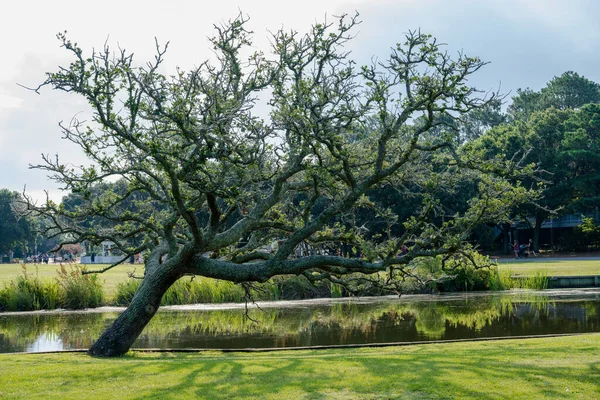
We do not recommend removing a tree simply because it leans. Plenty of trees grow at an angle for years. They respond to sunlight, slopes, competing trees, previous damage, and the space available around them.
We pay much more attention when the position has changed. Maybe you have looked at the same oak outside the kitchen window for 15 years and suddenly it seems closer to the roof. Maybe a pine that used to stand upright shifted after several days of rain. Maybe the trunk is now leaning and the ground around the base looks different at the same time.
That combination deserves an inspection before another storm adds wind load to the crown.
Look at the ground, not only the trunk
From a safe location, look around the base. Fresh cracks in the soil, mounding on one side, roots lifting, or a gap opening near the trunk can tell us more than the angle itself.
A recently leaning tree with visible root-plate movement has lost some of the support that was keeping it upright. At that point, waiting for strong wind to “see what happens” is a poor test.
When does leaning lead to removal?
If the lean is old and the tree has adapted to it, removal may not be needed. If the tree shifted recently and the supporting roots are moving, the situation is much harder to mitigate with ordinary pruning.
We also look at direction. A tree losing anchorage toward unused woods creates a different risk from one moving toward a bedroom, street, driveway, neighboring property, or utility corridor.
If you notice a recent change, tell us that when you call. “It has always leaned” and “it started leaning after last week’s rain” describe two very different trees.
2. The soil is heaving, or major roots have been damaged
A healthy-looking crown does not tell us everything about the root system. Roots anchor the tree as well as supply water and nutrients. Damage below ground can become a structural problem before the canopy shows an obvious decline.
Before a nor’easter, we want to know about two types of root warning signs: movement and damage.
Movement may appear as fresh soil lifting or cracking around the base. Damage may come from trenching, utility work, driveway installation, excavation, grading, or heavy equipment operating close to the tree.
Think back to what changed around the property
If a tree suddenly concerns you, ask what happened around it during the last year or two. Was a trench cut nearby? Was a driveway widened? Did excavation remove roots on one side? Was soil added around the trunk? Did machinery repeatedly travel over the root area?
You may not see a dramatic wound above ground even when the tree’s support system has changed.
Root damage does not always mean immediate removal
We need to know which roots were affected, where the damage occurred, how the tree responded, and what stands within its possible failure zone.
Recent root-plate movement is different. If the soil is actively lifting as the trunk leans, keep people and vehicles away from the area and call sooner rather than later.
That tree has already started moving as a unit. A nor’easter does not need to uproot it from a perfectly stable position. It may only need to continue a failure that has already started.
3. Large dead branches or broken limbs are hanging over something you use
A few dead twigs in a mature tree do not automatically put the whole tree on a removal list. A large dead limb over the driveway is another matter.
Dead wood no longer has the same ability to respond to loading as living wood. Broken sections can also remain lodged in neighboring limbs after an earlier wind event.
From the ground, those branches sometimes look secure because they have been hanging there for weeks. We do not assume that means they will stay there through the next high-wind event.
Pay attention to what is beneath the dead wood
A large dead branch over any of these areas deserves attention before storm conditions arrive:
- a roof;
- a driveway;
- a front entrance;
- a play area;
- a deck;
- parked vehicles;
- another frequently occupied part of the property.
If the rest of the tree is structurally sound, pruning may solve the problem without removing the tree. That distinction is worth making.
When dead branches point toward whole-tree removal
We start having a different conversation when dead wood is widespread, major portions of the crown have died, the trunk or roots show additional defects, or the tree itself is dead.
A completely dead tree close enough to reach a house or driveway gives us less reason to leave it standing and let another winter load test it.
One dead branch can be a pruning job. A dead tree with large brittle sections over the property may be a removal job. We want to see which situation you actually have.
4. The trunk or a major union has a fresh crack or split
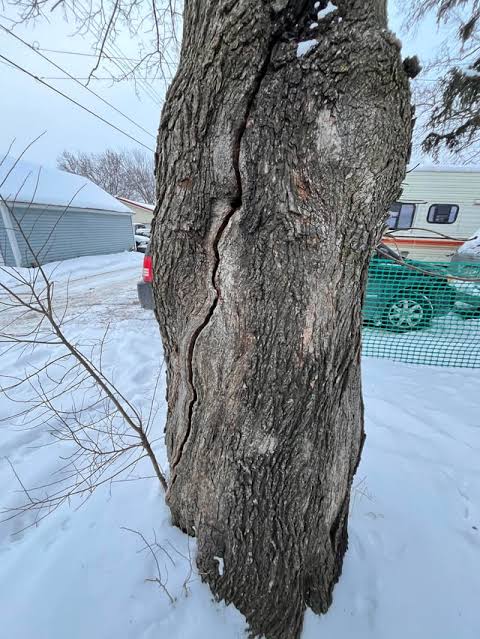
Trees develop scars, seams, old wounds, and irregular bark as they grow. We do not call every line on a trunk a structural crack.
A fresh separation in the wood gets our attention, especially when it appears where two large stems join or where a major limb connects to the trunk.
The timing matters again. A split that appeared after wind, ice, or heavy loading tells us something different from an old wound the tree has been growing around for years.
Watch for movement around the crack
From the ground, you may be able to see:
- a crack that appears wider than before;
- two stems beginning to separate;
- fresh exposed wood inside a union;
- bark opening along a new split;
- one side of the crown sitting differently after a storm.
Do not try to pull the stems apart to see how deep the crack goes. Do not climb into the tree for a closer look.
If a major union is actively separating, additional wind or snow load may enlarge the failure.
Can a cracked tree be saved?
Sometimes a structural problem can be managed through pruning or support measures.
East Coast Tree Service’s Tewksbury service includes cabling and bracing among the options used for certain weak unions. That does not make every cracked tree a cabling candidate.
Location of the defect, amount of remaining attachment, decay, crown weight, tree condition, and the target below all matter.
If the defect has progressed beyond what can reasonably be mitigated, removal becomes a more practical option before the storm makes the separation larger.
5. Conks or mushrooms are growing from the trunk, root flare, or major roots
Fungal growth is one of the most misunderstood tree decay signs.
A mushroom on the lawn five feet away from the tree does not prove the trunk is hollow. A conk growing directly from structural wood deserves more attention.
Certain fungi break down wood. Fruiting bodies on the trunk, root flare, or major roots can be evidence that decay is present somewhere in that tissue.
The part we cannot determine from a casual look is how much wood has been affected and how much usable structure remains.
A green canopy does not rule out decay at the base
Trees can continue producing leaves while decay develops in another part of the structure. That is why we do not use “it still looks green” as the only test.
Before a nor’easter, we become more concerned when fungal fruiting bodies appear along with another change:
- a new lean;
- soft or crumbling wood;
- a cavity near the base;
- root movement;
- dead sections of crown;
- a major crack.
The combination gives us more to investigate than the fungus by itself.
Fungus does not automatically mean the tree comes down
We need the location and extent of the defect.
Some trees can remain serviceable with localized decay. Others have decay in a part of the trunk or root system that is carrying a large portion of the load.
The goal of an inspection is to tell those situations apart.
If the structural loss is too extensive for the tree’s location and expected storm loading, removal may be the safer choice.
6. There are large cavities, soft wood, or extensive decay at the base or trunk
A cavity looks dramatic because you can see that wood is missing. That still does not let us decide risk by measuring the opening with our eyes.
Trees can continue adding wood around damaged areas. What matters is how much structurally useful wood remains, where that wood is located, whether the decay is progressing, and how the rest of the tree is loaded.
A small cavity and a large cavity also mean different things depending on where they occur.
Base decay deserves special attention before high wind
When decay affects the lower trunk or root flare, it is occurring near the part of the tree that transfers the load into the ground. That is one reason we take soft, crumbling wood around the base seriously.
Look for changes you can see without poking or digging into the tree:
- bark falling away from an old wound;
- wood that already appears broken down;
- an expanding cavity;
- fungal growth in the same area;
- movement in the trunk or roots.
Leave probing and structural evaluation to the inspection.
What about carpenter ants?
Ant activity can show up around moist or damaged wood, and homeowners often notice the insects before they notice the cavity.
We would not remove a tree because someone saw carpenter ants. Treat them as one more reason to look closely at the condition of the wood.
The structural question is still the tree, not the insect.
A hollow tree is not automatically a dead tree
Some hollow trees continue living for years.
The decision changes when the remaining structure can no longer provide a reasonable level of support for that tree in that location.
A cavity beside open woods gives us one risk picture. A similar defect in a large trunk leaning over a home gives us another.
That is why we inspect both the defect and the property around it.
7. The tree or major limbs are in conflict with power lines
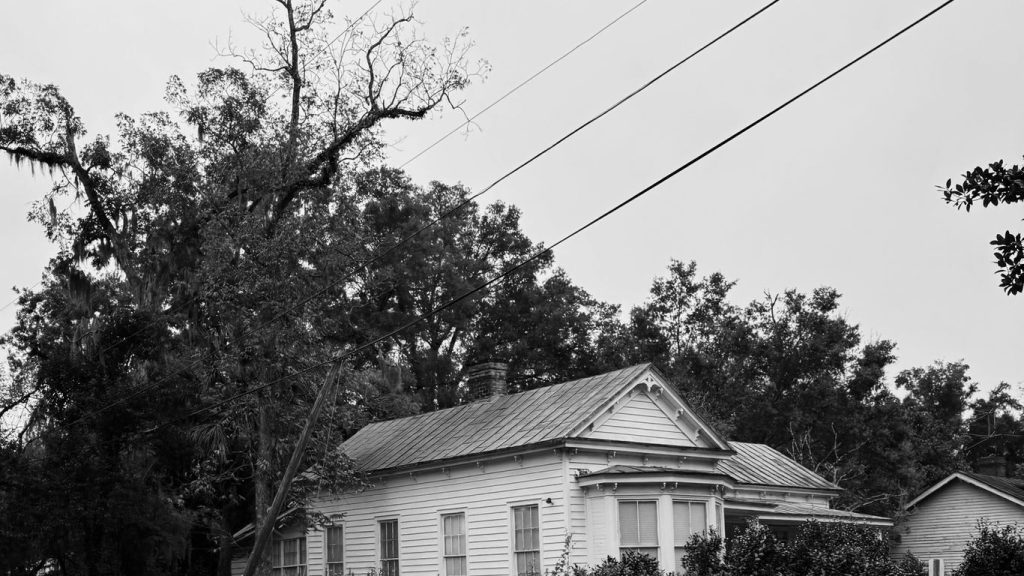
This one needs a different rule from the other six.
If a tree or broken branch is currently touching an electrical line, do not approach it to inspect the tree.
Stay away from the line, the tree, and anything in contact with them. Contact the utility responsible for the electrical equipment and follow its instructions.
We do not want a homeowner standing under the canopy trying to decide whether the trunk looks rotten while electrical conductors are involved.
A power-line conflict does not automatically mean whole-tree removal
Sometimes utility clearance or professional pruning addresses the conflict. Other times the tree also has structural problems that make removal the better long-term option.
The distinction belongs in the assessment.
If a tree is already leaning toward the lines, has large dead limbs over them, or has major root or trunk defects on the utility side, it is worth dealing with the situation before a nor’easter adds movement.
Do not prune around energized lines yourself
A branch does not need to knock a line onto the ground to create an electrical hazard.
Do not use a pole saw, ladder, rope, or chainsaw around conductors.
Utility involvement and appropriate tree-work procedures come first.
On planned removals where utility coordination is needed, our local tree-removal process accounts for that coordination rather than treating the lines as another object to work around.
One warning sign does not always mean removal
The title of this article promises seven signs a tree may need to come down.
The word may matters.
We do not think homeowners benefit from being told that every cavity, dead branch, lean, mushroom, or root wound means the tree is finished.
A professional assessment asks a broader set of questions. How likely is the tree or part to fail? What could it hit? How serious would that impact be? Is the condition changing? Can pruning reduce the load? Can a weak union reasonably be supported? Has root anchorage already started to fail? Would removal eliminate a risk that cannot be reduced enough through another option?
That is how we get from “there is something wrong with this tree” to an actual recommendation.
What makes a warning sign more concerning before a nor’easter?
The forecast changes how soon we want a questionable tree looked at.
Strong wind loads the crown. Wet snow can add weight to branches and weak unions. Rain can further saturate soil around a root system that is already moving. Freezing conditions can add another form of loading.
A tree does not have to be perfectly healthy to survive a storm, and a defect does not guarantee failure.
The concern is giving a known weakness another load before anyone has evaluated it.
If you already have a new lean, lifted root plate, major split, hanging branch, or tree in contact with wires, we would not use the storm as the test.
What can you check safely from the ground?
You do not need to become your own arborist before calling us.
Walk to a position where you can see the tree without standing beneath suspicious branches. Look at the whole crown, then look at the trunk and base from a distance.
Compare what you see with older photos if you have them. A phone photo from last summer can sometimes answer an important question: was that lean, crack, or canopy gap already there?
You can also tell us about changes around the tree. Construction and trenching matter. So does a recent wind event.
If the tree started dropping larger wood this season, mention it. If mushrooms appeared at the base, mention where they are growing. If the soil lifted after the last rainstorm, that moves higher on our list.
What should you leave alone?
- Do not climb the tree.
- Do not dig around roots to see how many are damaged.
- Do not stick tools deep into cavities.
- Do not cut a branch that is hung up in another part of the canopy.
- Do not try to reduce a newly leaning tree by taking limbs off yourself.
- Do not approach utility lines for a closer photo.
A pre-storm inspection is supposed to reduce risk. It should not create another one while you are gathering information.
A tree near the house does not automatically need removal either
Distance from the house changes consequences, but proximity alone is not a structural defect.
We work around mature trees close to homes throughout eastern Massachusetts. The question is whether that particular tree has a condition that makes keeping it in that position an unreasonable risk.
We look at what can reach the roof, branch attachments, roots, existing defects, and access if removal becomes necessary.
If the tree is healthy enough to retain and the concern can be managed through pruning, we would rather identify that before treating removal as the default.
Pruning before the storm and removing before the storm are different decisions
Some pre-storm tree work is about reducing a specific hazard. That may mean removing deadwood or a damaged branch.
Some situations involve a weak union that can be evaluated for structural support.
Other trees have progressed beyond a branch-level problem.
If the root plate is moving, the trunk has a major active split, or decay has left too little reliable structure in a high-consequence location, pruning may not solve the main concern.
The right service follows the defect.
Why we would rather inspect before the forecast gets bad
Planned tree work gives us better conditions for evaluating the property.
We can look at equipment access, see where sections can be lowered, and evaluate nearby structures and landscaping.
If the tree is in a tight yard, we can decide whether climbing, a bucket truck, rigging, or crane-assisted removal fits the site.
That is a much better planning environment than making the same decisions after a tree is already resting on the roof during a storm.
Our Tewksbury tree service page covers both planned tree removal and 24/7 storm response for local properties.
For Billerica homeowners, our Billerica tree service page covers tree removal, trimming, storm work, and local inspections.
If the nor’easter has already started, your priorities change
Once strong wind, heavy rain, or snow is actively moving damaged trees, this is no longer the time to stand underneath the canopy checking cracks.
Stay away from damaged trees and hanging limbs. Keep cars and people outside the likely fall area when possible.
If electrical lines are involved, contact the utility and stay clear.
If a tree has already landed on a house, blocked the only access, split apart, or is actively shifting toward an occupied area, that moves into emergency-service territory.
East Coast Tree Service provides 24/7 emergency response across our published eastern Massachusetts service area.
A tree can look bad and still be worth keeping
This is one reason we do not like diagnosis by photo alone.
Trees respond to old injuries. They add wood around wounds. Some old scars remain stable.
A healthy tree may carry one defect that can be managed. Another tree may still have a green canopy while its roots are losing support.
Appearance matters, but the structural context matters more.
If there is time before the next storm, an inspection gives you the chance to separate those two situations.
Removal becomes more likely when several problems line up
We do not use a simple point system where three defects automatically mean “remove.”
We pay attention when the problems reinforce each other.
A new lean plus lifted soil tells a stronger story than an old lean alone.
A cavity at the base plus fungal growth plus a changing lean deserves more attention than a cavity by itself.
A large dead branch over a roof has a different consequence than the same branch over an unused corner of the property.
A fresh trunk split carrying a heavy crown toward the driveway makes the target part of the decision.
The recommendation comes from the whole picture.
Tree removal in Billerica before storm season
Billerica properties can present everything from open yards to tight residential sites where mature trees stand close to roofs, roads, fences, and neighboring lots.
When removal is the right choice, access affects how we approach the job.
A tree with open space around it may allow one method. A large tree between structures may require controlled rigging or crane assistance.
Our current tree removal service in Billerica starts with an on-site inspection of the tree, targets, and access before the removal plan is set.
The same decision applies in Tewksbury, Reading, and surrounding towns
Nor’easter preparation is not about removing every large tree near a house.
It is about finding the tree that has already given you a reason to question its structure.
That may be the pine whose root plate shifted, the maple with one stem pulling away at a major split, the dead tree beside the driveway, the oak with a large suspended branch over the roof, or the tree with decay at the base and a new change in position.
Those are the calls we want before the forecast gets worse.
What to tell us when you request an inspection
You do not need technical terminology.
Tell us what changed and when you first noticed it. Tell us what the tree can reach. Mention any recent construction around the roots and whether large branches have already fallen.
If there is a crack, tell us whether it seems new. If the tree leans, tell us whether the angle recently changed.
Photos from a safe location can help give context before the visit.
The more clearly we understand the change, the easier it is to separate routine tree care from a tree that needs attention before the next storm.
Get the questionable tree looked at before the weather makes the decision
If you see one of these seven signs a tree needs removal, the next step is not to grab a chainsaw or assume the entire tree has to go.
Get the condition assessed while there is still time to choose the right response.
We provide tree removal, trimming, storm cleanup, and 24/7 emergency tree service for homeowners and businesses in Reading, Tewksbury, Billerica, and communities throughout eastern Massachusetts.
Call East Coast Tree Service at (781) 518-8014 if you have a tree you are worried about before the next nor’easter.
If pruning can address the problem, that should be part of the conversation. If the tree has lost enough structural support that removal is the safer option, we would rather plan that work in normal conditions than meet the same tree after the storm has already put it on your house.