

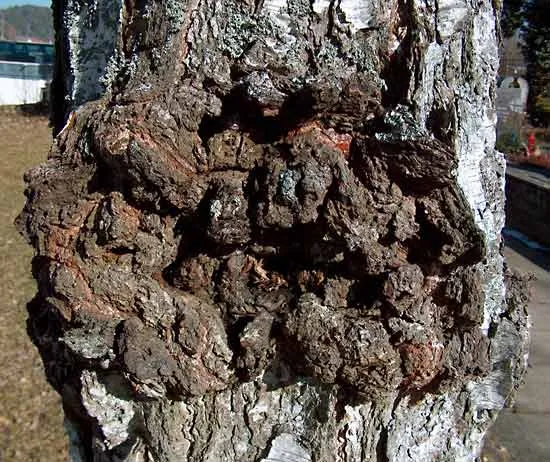
A canker on a tree trunk does not automatically mean the tree is dying. Some cankers stay localized for years. Some kill individual branches that can be pruned out. Others reach the main stem, combine with decay or disrupt enough living tissue that keeping the tree becomes difficult to justify.
The first thing we want to know is not simply, “Does this tree have a canker?”
We want to know what tree we are looking at, where the lesion is, how far it extends around the stem, whether the crown is declining and whether the wood around the canker is still structurally sound.
That distinction matters with diseases such as Nectria canker, perennial target cankers and Thousand Cankers Disease. They all involve dead areas of bark, but they do not behave the same way.
What Is a Tree Canker?
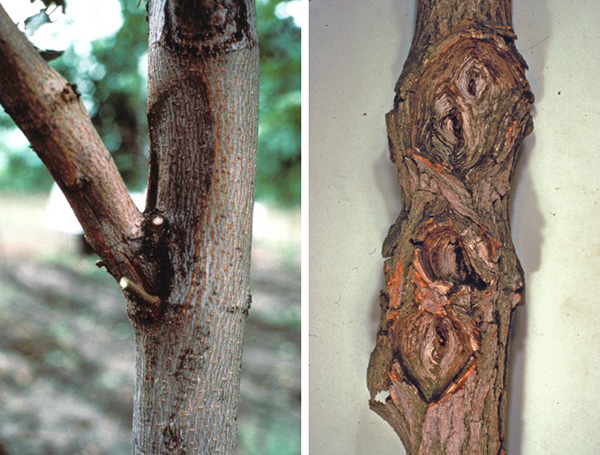
A tree canker is an area where bark and the living tissue beneath it have been killed.
The lesion may look sunken, discolored, cracked or swollen around the edges. On an older perennial canker, the tree may repeatedly build woundwood around the damaged area, leaving rings that resemble a target.
Some fungal cankers on trees also produce visible fruiting structures. Depending on the pathogen, these can look like tiny red, orange, pink, brown or black dots or cushions on the bark.
The appearance gives us clues.
It rarely tells the whole story by itself.
Mechanical injuries, frost cracks, sunscald and other damage can resemble disease. Several different pathogens can also produce a canker on a tree trunk.
A Canker Is a Symptom Pattern, Not One Disease
Homeowners sometimes use “cankers disease” as though every trunk lesion comes from the same fungus.
It does not.
Nectria, Neonectria, Cytospora, Diplodia, Eutypella and other fungi can produce cankers on woody plants. Bacterial diseases can create canker-like damage as well.
Thousand Cankers Disease is different again because the name describes an insect-fungus complex involving walnuts.
We start with the host tree and the pattern of damage before naming the disease.
Location Changes the Outlook
A two-inch canker on a small branch may be easy to deal with if we can remove that branch while preserving a useful crown.
Put a similar lesion on the main trunk and the options change.
You cannot prune the trunk off a mature shade tree and still have the same tree.
A trunk canker may instead need monitoring, laboratory diagnosis, structural evaluation or removal depending on its size and what is happening inside the wood.
That is why we pay so much attention to location.
How Girdling Changes a Canker
The living tissues just beneath the bark help move sugars and support the tree’s growth.
As a canker expands around a twig or branch, it can eventually girdle that stem.
Once the living tissue is interrupted all the way around, the portion beyond the canker dies.
You may see leaves wilt in summer, one branch fail to leaf out in spring or an isolated section of crown suddenly turn brown.
On a removable branch, we may be able to cut below the affected area.
On the main trunk, complete or near-complete girdling is a much more serious situation.
Nectria Canker Often Starts With a Wound or Stressed Tree
One disease homeowners may encounter in Massachusetts is Nectria canker caused by Nectria cinnabarina.
It is sometimes called coral-spot canker because the fungus can produce orange to pink spore-bearing pads through infected bark.
The pathogen commonly acts as an opportunist.
Pruning wounds, damaged bark and other injuries can provide entry points, especially when the tree is already stressed.
We may see a sunken or water-soaked lesion first. As the infection develops, bark can crack, split or slough away. Branches beyond a girdling canker may decline or die.
Orange or Pink Spots Are Worth a Closer Look
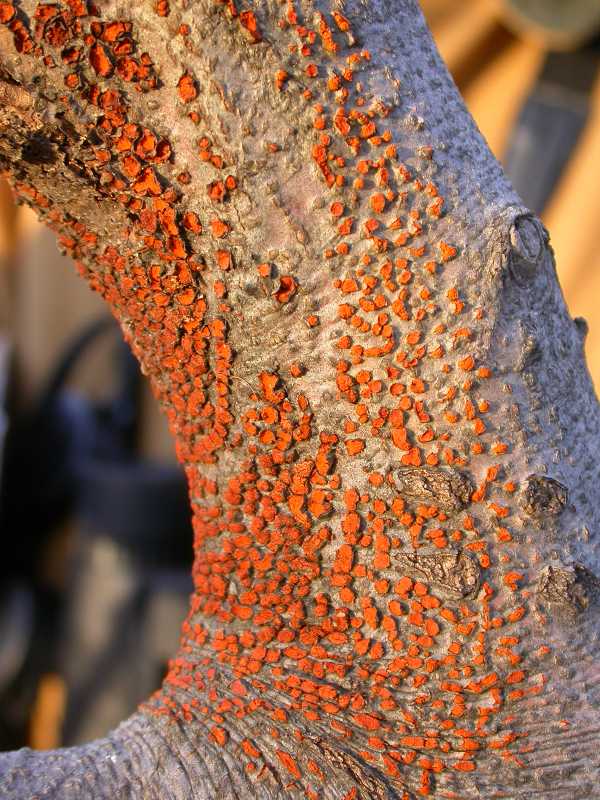
Those small coral-colored structures can be a useful identification clue.
They are not the same as ordinary lichen.
With active Nectria, the pads are fungal structures associated with infected or dead bark and wood.
We still do not identify the disease from color alone.
Species, lesion pattern and the condition of nearby tissue matter, and laboratory confirmation may make sense when management depends on knowing the pathogen.
Nectria Does Not Mean Automatic Tree Removal
A tree can have a Nectria-infected branch and remain a reasonable tree to keep.
When the infection is confined to branches that can be removed without sacrificing the tree’s structure, pruning is often part of management.
We want the pruning cut well beyond the visibly cankered tissue.
That distance matters because the fungus may extend farther into the wood than the obvious lesion suggests.
Cuts are best made under appropriate dry conditions, and tools should be cleaned when working through known infected material.
After that, we continue watching the crown.
One round of pruning does not guarantee that every infection point has been removed.
Do Not Cut Flush Against the Trunk to Chase a Canker
More cutting is not automatically better.
When an infected branch needs to come off, the final pruning cut should respect the branch attachment rather than slicing into sound trunk tissue to make the surface look clean.
A flush cut creates an unnecessarily large wound.
It also removes tissues involved in the tree’s response to injury.
Our tree trimming work in North Reading and surrounding communities is based on what actually needs to be removed, not on making the biggest possible cut around damaged bark.
Target Canker Is Related, but It Is Not the Same Nectria Problem
Another disease homeowners may see described as Nectria canker is target canker caused by Neonectria ditissima.
This distinction is worth making because target canker behaves differently.
It is particularly associated with hardwoods and is well documented on birch in southern New England.
The fungus expands when the tree is dormant.
During the growing season, the tree produces woundwood around the damaged area.
The cycle repeats.
Over the years, those alternating zones create the target-like rings that give the disease its name.
A Target-Shaped Trunk Canker Can Persist for Years
Some target cankers look terrible long before the entire tree declines.
The tree may continue producing foliage and woundwood around the lesion for years.
That does not mean the trunk is normal.
The repeated injury can create a large structural defect. Decay fungi may also establish through the damaged area even though Neonectria itself is not primarily a wood-decay fungus.
A green crown and a sound trunk are two different questions.
This is where the word “terminal” can be misleading.
The tree may still be biologically alive while the trunk has become a poor structural risk beside a house.
When a Trunk Canker Becomes a Structural Problem
We look at how much of the circumference is affected, but circumference alone does not settle the decision.
We also look for exposed or decayed wood, cavities, cracks, weak woundwood, changes in trunk shape and the location of the defect.
A large old canker low on the trunk deserves more attention than a superficial lesion on a small side branch.
Targets matter too.
A compromised tree deep inside an unused wooded area presents a different situation from the same defect beside a bedroom, driveway or play area.
Crown Dieback Helps, but There Is No Universal Removal Percentage
You may see advice that a tree becomes terminal once 30%, 40% or 50% of the crown dies.
We do not use a single percentage for every canker disease.
Crown loss is useful evidence.
The cause and distribution matter more.
A tree that lost several small peripheral branches may still have a usable structural framework.
Another tree with less total dieback may have a severe trunk canker underneath the remaining live crown.
The percentage is one piece of the inspection.
Thousand Cankers Disease Is Primarily a Walnut Problem
Thousand Cankers Disease, or TCD, belongs in a different category.
The main host of concern is black walnut, Juglans nigra.
The disease involves two organisms working together: the walnut twig beetle, Pityophthorus juglandis, and the fungus Geosmithia morbida.
The beetle tunnels through the bark and introduces the fungus into the living tissues underneath.
A small canker can form around an individual beetle attack.
Then another forms.
And another.
With heavy attack, those lesions can begin merging until enough phloem is damaged to kill branches and contribute to widespread crown decline.
You Usually Cannot See “A Thousand Cankers” From the Outside
The name creates the impression that the trunk should be covered with obvious wounds.
That is not necessarily what a homeowner sees.
Individual TCD cankers develop beneath the outer bark.
The bark surface may look relatively normal, show a small crack or develop dark amber staining.
Tiny beetle holes can also be present.
The more obvious symptom may be above your head: yellowing foliage, flagging branches and progressive dieback in the crown.
That is another reason not to diagnose the disease from a photograph of one spot on the trunk.
Tiny Beetle Holes Matter on a Declining Black Walnut
Walnut twig beetles are very small.
Their entrance and exit holes can be about pin-sized.
In an area where TCD occurs, many tiny holes associated with declining walnut branches and cankers beneath the bark are important diagnostic evidence.
We would not tell a Massachusetts homeowner to start peeling bark off a valuable walnut looking for galleries.
If the symptoms genuinely resemble an invasive pest complex, documentation and professional or regulatory diagnosis make more sense than destructive home investigation.
Thousand Cankers Disease Is Serious, but Massachusetts Needs Context
TCD has killed black walnuts in western parts of the United States.
That history is why the disease receives so much attention.
The eastern picture has been less straightforward.
Conditions such as drought stress appear to influence how severely trees decline, and some eastern state programs have reported much lower impacts than originally feared.
As of the current 2026 resources we reviewed, we do not treat Thousand Cankers Disease as a routine confirmed diagnosis in Massachusetts.
The state’s current forest-health threat information does not identify it as an established statewide problem.
That does not mean a suspect should be ignored.
It means a black walnut with branch dieback in Chelmsford is not automatically a TCD tree.
What Should You Do if a Massachusetts Black Walnut Looks Like TCD?
Start without moving wood.
Take clear photographs of the crown, trunk and any visible small holes or staining from a safe position.
Note whether the tree is a black walnut and when the dieback started.
Massachusetts maintains a reporting system for unusual invasive pests and pathogens, and USDA also asks that suspected TCD be reported to plant-health officials.
Until the cause is clear, moving potentially infested walnut firewood long distances is a poor idea.
Wood movement is one of the pathways agencies monitor for insects that live beneath bark.
Do Not Use the California 50% Rule on Every Massachusetts Tree
You may encounter TCD guidance recommending removal when less than half of the walnut crown remains alive.
That type of threshold comes from specific pest-management settings.
It should not be transferred to every oak, maple, birch or pine with a canker.
A residential tree decision has to account for the pathogen, trunk condition, root condition, structural defects, targets and realistic options for pruning.
We prefer to look at the actual tree before calling it terminal.
A Canker on a Branch Is Usually a Different Decision From a Canker on the Trunk
This distinction is simple and useful.
If an infected branch can be removed back to healthy structure without stripping too much of the tree, pruning may solve the immediate problem.
If the canker is on the main trunk, we cannot remove it that way.
Now we are deciding whether the tree can continue to live with the defect and whether the remaining trunk is strong enough for its location.
Those are different questions.
Look Above the Canker
A canker often tells you more when you look at the crown it supplies.
Is the branch beyond it alive?
Are the leaves undersized?
Did that portion fail to leaf out?
Is the same side of the crown thinning?
Has dieback increased over several seasons?
A localized bark defect with healthy growth above it deserves a different level of concern from an expanding lesion associated with progressive branch death.
Look Below the Canker Too
The condition of the root system changes how well a tree can respond to disease.
Construction damage, excavation, grade changes, drought, saturated soil and root injury can all add stress.
Some canker fungi become far more aggressive when trees are weakened.
If a homeowner tells us the canker appeared after driveway work severed roots or after several dry summers, that history matters.
The bark lesion may be only one part of the problem.
Tree Stress Can Be Part of the Disease Story
A pathogen can be present without causing the same level of damage in every tree.
Healthy trees may produce woundwood and contain slower-growing infections.
Stressed trees often have less capacity to do that.
We therefore pay attention to drainage, root disturbance, recent transplanting, drought exposure and previous injuries.
Trying to treat only the visible canker while ignoring an ongoing root problem rarely gives us the full picture.
Pine Canker Does Not Mean Thousand Cankers Disease
The word “canker” appears in pine problems too.
That does not connect the tree to TCD.
Thousand Cankers Disease is associated with walnuts and the walnut twig beetle.
Pines in southern New England can develop different fungal cankers. UMass has documented Cenangium canker on hard pines and other canker pathogens on conifers, including Cytospora and Diplodia.
A pine with resin, branch dieback and sunken bark needs a pine diagnosis.
It does not need walnut-disease treatment.
Resin on a Pine Is a Clue, Not a Diagnosis
Conifers commonly produce resin around wounds and infections.
If one pine branch is dying and resin is building around a lesion, we look at the branch, needles, wound history, surrounding branches and overall tree stress.
Drought and winter injury can predispose certain pines to canker development.
Transplant stress can contribute too.
Several pathogens can produce similar external symptoms, so identifying a “pine canker” from resin alone is unreliable.
Blight in Trees Is Not the Same Thing as a Canker
The terms sometimes get mixed together.
Blight generally describes rapid browning or death of leaves, shoots or other plant tissue.
A canker is a localized lesion on bark and cambium.
One disease can cause both.
For example, a branch canker may girdle a twig and cause the foliage beyond it to blight.
That does not make every case of branch browning a canker disease.
We trace the dead foliage back toward the live portion of the branch and look for where the change begins.
Fungal Fruiting Bodies Help Narrow the Diagnosis
Small structures erupting through bark can be useful.
With Nectria, orange or pink pads can stand out clearly.
Other fungi produce black, brown or differently shaped structures.
We look at their position relative to dead tissue and the canker margin.
A phone photo may show enough to narrow possibilities.
Microscopy or laboratory testing may still be needed when species identification matters to the management plan.
A Lab Sample Can Be More Useful Than Another Internet Photo
Many fungal cankers on trees overlap visually.
UMass maintains a tree and shrub diagnostic service specifically for problems like branch dieback, cankers and insect damage.
The best diagnostic tissue is often taken from the transition between affected and healthy material rather than from wood that has been dead for a long time.
Old dead wood accumulates secondary organisms and can make it harder to determine what started the problem.
If diagnosis changes the decision between pruning, monitoring and removal, testing can be worth the extra step.
When Pruning Can Help
Pruning is most useful when the canker is confined to a branch we can remove without compromising the tree.
The cut needs to reach clean, appropriate tissue.
We also want to avoid pruning during conditions that favor spread of a known canker pathogen.
The remaining crown still has to make sense after the branch is removed.
Cutting out disease while leaving the tree badly unbalanced is not much of a win.
When Pruning Cannot Solve the Problem
A large perennial canker in the main trunk cannot be pruned away like a dead branch.
Neither can a major basal canker extending into the root flare.
At that point, management becomes an assessment of remaining structure and expected progression.
Sometimes the tree can continue to be monitored.
Sometimes reducing individual branches decreases load.
Sometimes the defect has advanced far enough that removal is the practical choice.
When a Canker Is More Likely to Be Terminal
We become more concerned when several factors appear together.
- A canker nearly or completely girdles the main stem.
- The crown above it is progressively dying.
- Major scaffold limbs are affected.
- Decay has colonized the wounded wood.
- The trunk has developed cracks or substantial loss of sound tissue.
- The tree is already severely stressed.
- The defect sits where failure could hit a home, driveway, parked vehicles or people.
One item does not automatically decide the case.
The combination often does.
A Tree Can Need Removal Before It Is Biologically Dead
This is one of the most useful distinctions in tree care.
Homeowners sometimes wait for a diseased tree to be “dead enough” before calling about removal.
Tree risk does not work that way.
A living tree can have a trunk defect that no longer provides a reasonable margin of safety.
A large canker combined with internal decay can make failure more concerning even while the upper crown is still green.
Our decision is based on both tree biology and structure.
A Dead Branch Can Become the Immediate Problem
Sometimes the disease diagnosis can wait while the branch hazard cannot.
If a canker has killed a heavy limb over a roof, driveway or walkway, that branch deserves attention regardless of the exact fungus.
We can address the hazardous deadwood and then determine whether the remaining tree needs further assessment.
For homeowners in the area, our tree service in Chelmsford, MA includes both pruning and removal, so the site can be evaluated before assuming which one is needed.
Chelmsford Trees Need a Site Decision, Not a Disease Label Alone
Wooded lots and mature residential trees are common around Chelmsford.
A canker on a tree deep in the back of a larger lot may be monitored differently from the same defect over a garage.
Access matters too.
Our Chelmsford work includes pruning, tree removal, storm cleanup and crane-assisted work when the condition or location of a tree calls for it.
The disease tells us what may be happening.
The site tells us what happens if the tree or branch fails.
North Reading Cankers Can Turn Into Removal Decisions Too
When a trunk has reached the point where pruning cannot address the defect, removal may become the better option.
Our tree removal service in North Reading is available for dead, declining and structurally compromised trees throughout North Reading, Billerica, Tewksbury and surrounding communities.
We still want to see the tree first whenever conditions allow.
A cankered trunk is a reason to inspect.
It is not a reason to write the removal prescription before we arrive.
Do Not Confuse Leaf Browning With a Trunk Disease
A tree can have brown leaves without a canker.
Heat, drought, root damage, vascular disease, insects and foliar pathogens can all produce canopy decline.
If browning is what first caught your attention, our guide to leaf scorch versus bacterial disease explains why canopy pattern and root history matter before assigning a disease name.
Then look back toward the trunk and branch bases for actual canker lesions.
Do Not Carve the Canker Out
Homeowners sometimes try to help by cutting dead bark away until they reach material that looks healthy.
On a mature trunk, that can enlarge the wound and remove living tissue without eliminating a pathogen already established farther inside.
Do not turn a diagnostic inspection into trunk surgery.
The same applies to drilling holes, pouring chemicals into the lesion or coating every canker with wound paint.
Management depends on the diagnosis.
Take Photos From More Than One Distance
If you are calling us about a canker, one close-up is useful.
Add a few more.
Take a photo of the entire tree.
Take one showing where the canker sits on the trunk or branch.
Photograph the crown from a distance.
If leaves are declining, include those too.
That helps us understand whether we are dealing with one local wound or a tree-wide pattern.
Do not climb or stand under dead limbs just to get the picture.
Tell Us What Changed
History helps.
Did the lesion appear after a branch broke?
Was the tree struck by equipment?
Were roots cut for a walkway or driveway?
Has one section of crown been dying for several seasons?
Did the tree decline quickly this summer?
Is it a black walnut?
Does the bark show tiny holes?
Those details can narrow the next step before anyone makes a cut.
When We Would Rather Monitor Than Remove
A localized canker on an otherwise vigorous tree may not justify removal.
If the main trunk remains structurally reasonable, the crown is stable and the lesion is not rapidly expanding, monitoring can make sense.
That might include repeat photographs, periodic inspection and watching the crown during the next growing season.
Trees change.
A good decision today can include checking again rather than pretending every diagnosis needs an immediate intervention.
When We Would Rather Remove Than Keep Watching
The balance changes when the defect is advancing and the consequences of failure are high.
A large main-stem canker with decay, increasing crown death and a target beneath the tree gives us less reason to stretch the monitoring period.
The same is true when a trunk is extensively girdled or when major branch attachments have been compromised.
If an on-site look shows that removal is appropriate, you can request an estimate from East Coast Tree Service before the work is scheduled.
Cankers Are Easier to Manage Before the Tree Is in Crisis
A small branch canker gives us options.
A large trunk lesion with years of decay gives us fewer.
That is why we would rather see a questionable area while the tree still has a healthy crown than after half the canopy has died.
If you notice sunken bark, target-shaped woundwood, orange or pink fungal structures, repeated branch dieback or a spreading canker on a main stem, take a closer look before the next storm exposes the weak point.
East Coast Tree Service works throughout Reading, Tewksbury, Billerica, Chelmsford, North Reading and surrounding eastern Massachusetts communities.
Call us at (781) 518-8014 if a cankered tree needs pruning, structural evaluation or removal planning.